Machine learning is one of the most fun tools in artificial intelligence. It is used to build and train systems to work beyond human capabilities. ML developers use their skills to harness the growing demands of the digital era.
The machine Learning market to grow CAGR of 34.8% from 2023 to 2030
The inspiration for the recent developments of AI use cases comes from consumer-centric technology. Hyping the use of ML, it has embarked on its excellence in industries like Real-Time Chatbots, Banking and finance, Self-driving automotive, Social networking, Agriculture, and many more. Embedded and cloud-based AI/ML services and solutions are scaling up businesses’ profits. Let’s get a sneak peek into the reasons for learning machine learning.
What is Machine Learning?
Machine learning (ML) is a subset of artificial intelligence, which runs on data and algorithms as fuel. ML models imitate human functioning without actual human intervention and have improved accuracy.
ML learns from previous experiences to enable client communication, accelerate decision-making, and self-learn from past experiences. Curious ML developers experiment with the opportunities hidden in large datasets to gain better insights, cognition, and action from a computer system.
Infinite data availability, affordable data storage, and optimized computation propel the growth of the AI and ML industry. Industry giants are keenly interested in investing huge amounts of money to stay competitive.
This tech evolution will keep on adding new possibilities for its experts. The outperforming field will reciprocate numerous benefits to its researchers and practitioners. The next section answers why machine learning is exciting.
- Python Machine Learning Course
- Applied AI Course
- Certification Course in Data Science
- PG in Data Science
You can also explore our Deep Learning Module and other elaborate courses on big data, business analytics, and more. Choose a learning module that fits your needs—classroom, online, or blended eLearning.
Check out our upcoming batches or book a free demo with us. Also, check out our exclusive enrollment offers
Top 5 Reasons To Learn Machine Learning
Big Data, with its high volume, increased velocity, and greater variety, compels businesses to convert it into actionable insights. Cheaper computational processing, affordable storage, and automated analyses have resurged developers’ interest in machine learning.
Almost all businesses need ML as the models predict accurate results to identify lucrative opportunities and possible risks to return value to the businesses. Companies have incorporated machine learning into their operations.
Thus, they need skilled professionals to drill the data and find innovative solutions. Learning ML can be advantageous to businesses and ML professionals. The top five reasons to learn machine learning are listed below.
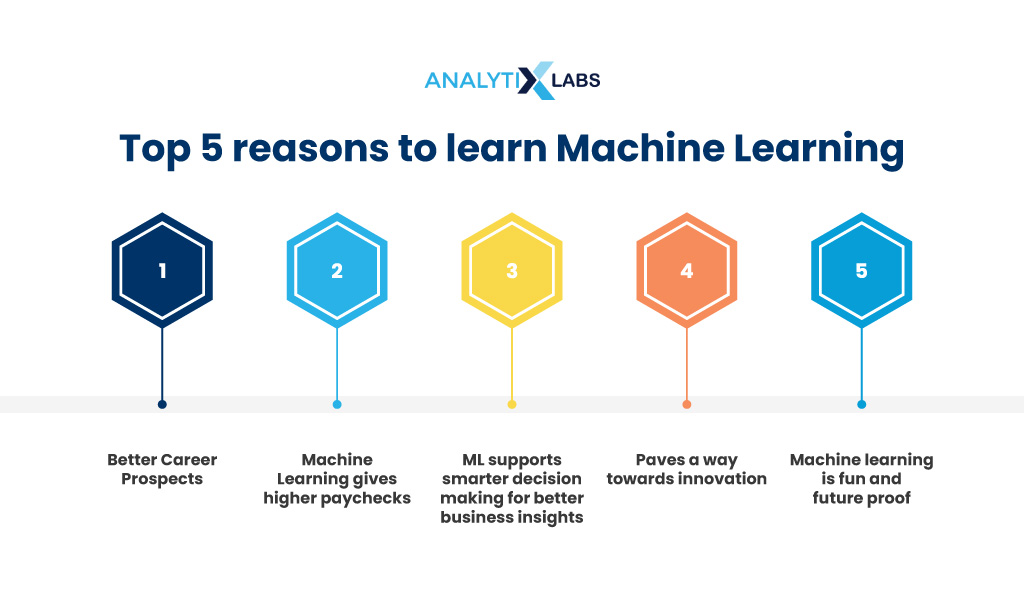
#1 Better Career Prospects
Machine learning (ML) is a large market covering major AI projects and software. AI and machine learning are integral to domains like e-commerce, healthcare, agriculture, online social media platforms, manufacturing industries, and more.
Companies look forward to professionals who can utilize skills to sustain technological advancements. Machine learning has proven important in different sectors of image classification, computer protection, pattern recognition, natural language processing, etc.
There are numerous opportunities for machine learning enthusiasts. Businesses have high requirements for job roles such as Machine learning engineers, automation engineers, and NLP engineers.
#2 Higher Paychecks
Machine learning is the fastest-growing sophisticated field. It hires skilled professionals with excellent critical and analytical skills, and organizations value experts with the required skill set.
That is why it comes under one of the highest-paid segments of the industries. The average salary of an ML engineer from the beginner to intermediate level in India is ₹6L – ₹11L/yr. While the salary of senior machine learning experts in the USA is $155,888.
#3 Better Business Insights
Machine learning algorithms are decked up to explore the information stored in multivariate big data sources. The historical data is analyzed for pattern recognition and identifying trends for the future. This hindsight and foresight help businesses to make smarter decisions to serve the business demands.
The predictive ability of ML helps the business evaluate the crests and troughs to ensure strategic implementation of plans. ML helps analyze the data critically to improve customer experience by making better predictions. Machine-generated informed decisions help improve business outcomes. Thus, using machine learning for business can help you achieve higher revenues and better customer satisfaction.
#4 A Way Towards Innovation
Machine learning is termed the skill of the century. It yields better results by using ever-growing data. The scope of machine learning will soon touch new horizons. The expansion of computational capabilities and technology has already enabled ML systems like chatbots, translation apps, and AI assistants. Intelligent systems and robotics are evolving rapidly with the use of ML.
#5 Machine Learning is Future-proof
The more data there is, the more possibilities there will be. The data in the large datasets keeps on being added regularly, creating newer opportunities for experts to work on. The field of machine learning allows you to work on AI systems, self-driving cars, deep learning models, hyperparameters, and tuning neural network architectures.
The novel areas develop your curiosity and broaden your thinking capabilities. Working in the evolving field consistently gives you experience, high paychecks, and stability, making your future secure.
Also read: Machine Learning Vs. Deep Learning
Know Different Types of Machine Learning
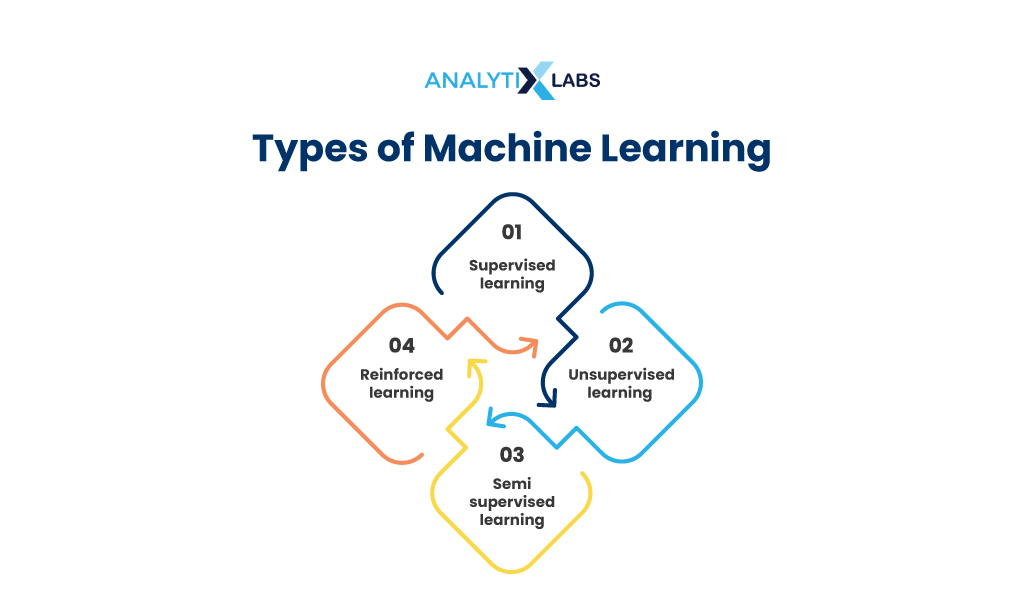
Machine learning receives and analyses the input data to generate output values with the help of programmed algorithms. ML is categorized based on the training algorithms and data ingestion. In Machine learning, data is of two types: labeled and unlabeled.
The one which has both input and output parameters is called labeled data. Labeled data is in machine-readable format but requires too much initial human effort for labeling. Unlabeled data has only one or no parameters in machine-readable format. Unlabeled data needs complex solutions as it minimizes human efforts.
-
Supervised Learning
Supervised machine learning uses examples to train the model. It is done by mapping between the input and output variables. The operator knows the input and output values; the algorithm’s task is to find a way to reach the target.
The trained algorithm searches for patterns learned from the observations and builds valuable insights. The learning and improving method is recurrently executed until the system achieves maximum accuracy. Target variables are compared with each round’s input and output variables to evaluate the model’s performance. Classification, regression, and forecasting fall under the supervised learning category.
- Classification: The ML programs in which the class labels are predicted by observing the values. The email filtering system checks whether the mail is spam or not spam. Other examples include face recognition.
- Forecasting: In machine learning, forecasting tasks use historical and present data to build future predictions and trends.
- Regression: The machine learning programs that predict the numerical value by understanding and estimating the relationship between the input and output variables. Regression analysis takes one dependent variable and other changing variables to make predictions. Stock analysis is an example of regression.
More blogs in the Regression Series :
- Learning Logistic Regression – Types, Algorithms, and more [Part 1 – Theory]
- Learning Logistic Regression – Applications using Python [Part 2- Practical]
- What is Linear Regression In ML?
- Logistic Regression in R
-
Unsupervised Learning
Contrary to the supervised learning technique, unsupervised learning has no labels; it is data-driven. It has too much data and certain tools to analyze the properties of the data. The model is trained to organize the data into groups and clusters based on features.
The algorithms interpret large datasets and address the data to find patterns without any human operator or answer key. The system self-learns from experiences and gradually improves. It is suitable for transactional data. Customer segmentation, buying behavior, and recommendation systems are tasks under unsupervised learning. Nearest neighbor, random forest, and self-organizing maps are unsupervised learning algorithms.
Techniques of unsupervised learning are:
- Clustering: Clustering involves grouping datasets based on certain criteria. Data segmentation and analysis tasks are performed by analyzing the clustered datasets. Clustering helps in data visualization and provides more insights about the data.
- Dimension Reduction: It is the process of consolidating the data estimation to find exact information. Projection is a dimension-reduction technique.
Also read:
-
Semi-supervised learning
Semi-supervised learning is a type of machine learning similar to supervised learning but works on labeled and unlabeled data. The training takes a small amount of labeled and many unlabeled data to make independent inferences. This combination allows algorithms to learn to label the unlabeled data. Face identification on a webcam is one example of this type of training.
-
Reinforced Learning
Reinforced learning is an ML technique that learns from the environment. It is a disciplined learning process using a set of inputs, actions, and end values. Defined rules are used to explore the options and possibilities in the dataset.
By monitoring and assessing the results, the system learns from its mistakes and improves to fit in the performance. The input datasets use feedback regarding rewards and punishments to learn from the behavioral environments.
Video games are examples of reinforced learning; the agent is the learning algorithm, and the game is the environment. The agent performs a set of actions and performs better at each stage.
Reinforced learning can be applied in various areas, such as artificial neural networks, industrial simulation, and resource management. Robotics applications, Google’s data centers, and AlphaZero are real-world use cases of reinforced learning.
Applications of Machine Learning in Various Fields
Machine learning is the most exciting branch of artificial intelligence. By mimicking human capabilities, systems have surpassed the computational skills needed to solve real-time problems better.
Machine learning algorithms, such as clustering, logistic regression, random forest, Naive Bayes Classifier, and support vector machines, are used by various fields to find optimal solutions and improve functioning.
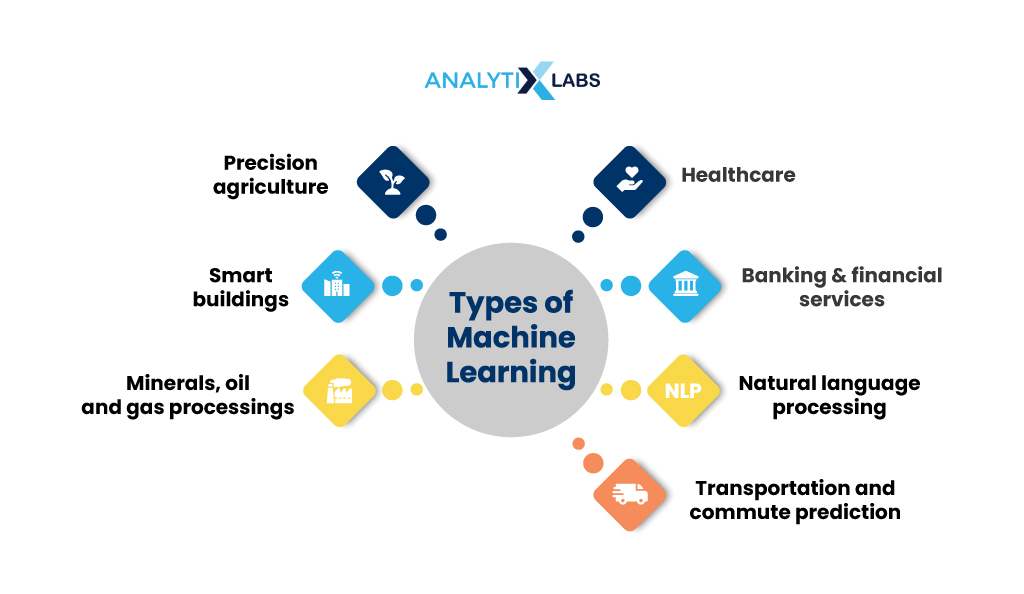
Social media, recommender systems, image recognition, virtual personal assistants, and face detection are some applications that have excelled in using ML. Other real-time applications are discussed below.
-
Healthcare
Machine learning algorithms have used healthcare data to find patterns in disease prognosis. ML algorithms are also used in genetic research and cancer prognosis. Approaches like decision trees, Bayesian networks, Artificial neural networks, and support vector machines are used to develop prediction models and generate precise patient treatments. With the help of IBM Watson in its immuno-oncology, Pfizer is developing cancer drug discovery.
-
Banking and Financial Services
The financial organization covers the sensitive credentials of numerous customers. This data needs to be shielded from fraud and spam. ML is crucial in handling churn prediction, fraud detection, loan eligibility prediction, money laundering, and stock market forecasting. Citibank has partnered with a Portugal-based company, Feedzai, to overcome the real-time frauds occurring in online banking by generating customer security alerts.
-
Natural Language Processing
NLP has developed from a nascent stage to a developed one using machine learning. It is used to understand and process human language through language translations and chatbots. Google Translate is one example using ML and recurrent neural network technology. Using GNMT (Google Neural Machine Translation System), it can seamlessly identify and switch between languages.
-
Transportation and Commute Prediction
GPS navigation on devices generates tremendous spatial data. This data, including locations, speeds, and routes, can be used for traffic management and routing algorithms. Commute applications like Uber and Ola use machine learning algorithms to find estimated wait time, arrival time, less-traffic routes, and pick-up and drop locations.
-
Precision agriculture
Machine learning algorithms help researchers to predict accurate and effective farming with reduced manpower. ML algorithms can be used to find patterns in the datasets to increase the productivity of crops. Smart agriculture uses systems for crop recognition, soil analysis, and crop health monitoring. Additionally, incorporating weather forecasts into the systems can help take necessary measures to prevent losses due to unprecedented weather changes.
-
Smart Buildings
AI and machine learning algorithms can be incorporated into the construction lifecycle, concrete mixture designing, and structural analysis. Construction projects use machine learning for effective project planning, risk mitigation, and construction safety. Companies like nPlan provide solutions to minimize uncertainty and risks in a construction project. The client base of nPlan includes Google (US), HS2 (UK), and Suffolk Construction (US).
- Minerals, Oil, and Gas Processing
Machine learning algorithms have been useful in finding mineral repositories and new energy resources. Predicting refinery sensor failures and streamlining oil distribution have made the process cost and time-effective.
Conclusion
Machine learning techniques allow us to collect information and react optimally to unique problems to find solutions for complicated cases. Data analytics and machine learning is applied in various fields to build models for predictive analysis. Machine learning algorithms have revolutionized e-commerce, retail, transportation, agriculture, healthcare, etc.
It will continue to evolve through research and recent developments in the field. The ML enthusiast can get technical exposure to a whole new world of possibilities that is beyond human expectations. Learning the ML tools and processes to fit the required tasks can assist in model building for complex tasks.
FAQs
- Why did you choose to learn machine learning?
Machine learning is the most exciting technology in artificial intelligence. It is worth learning as it effectively helps you strive for a competitive business edge.
- Why is machine learning important in a career?
Machine learning opens a new horizon of career opportunities in the AI field. ML experts can secure niche job roles with high salaries. Machine learning is readily evolving and offers future-proof opportunities.
- Is machine learning a valuable skill?
Machine learning is a valuable skill as it provides you benefits in both intellectual and monetary terms. The critical analytical skills help in business process automation and bring value to the businesses and industries.