

Generative AI Course
Prompt Engineering, LLMs and No-Code Automation. Build a Working AI Assistant You Can Demo.
72 Hours
1.5 Months

27 Sept
Noida
15 Mar
Interactive Live Online
18 Oct
Interactive Live Online
29 Mar
Gurgaon

Courses Included



Artificial Intelligence Engineering
₹ 20000/-
Artificial Intelligence Engineering
₹ 20000/-
Artificial Intelligence Engineering
₹ 20000/-
₹ 65000/-
₹ 48000*/-
Optional Course
Data Science using R
₹ 20,000
₹ 4000/-

Interactive Live Training
36 Hours

Self Study & Practice
Projects & Assignments

Placement Support
and Career Guidance
Generative AI Course Overview
The harder skill is not using ChatGPT or Gemini. It is writing prompts that hold up inside a workflow, then checking what comes back. This Generative AI course teaches that skill through builds instead of lectures.
You start with how large language models behave and why they fail the way they do. Later modules cover prompting frameworks, no-code automation and AI assistants. Every module ends with something you have built.
By the end of this course, you demo a working AI assistant that automates at least three real tasks. You explain every design choice you made. You also know where the model breaks and how to guard against it.
What is Generative AI?
Generative AI, or generative artificial intelligence, creates new content from patterns it learned during training. Ask it for a summary and it writes one that did not exist before. Traditional AI classifies or predicts from existing data. Generative AI produces something new. ChatGPT, Gemini, Claude and Midjourney are all generative AI applications. People also call it genAI or gen AI. The terms all mean the same thing.
Why Learn Generative AI?
Indian companies have moved past pilots. A survey of more than 2,500 businesses across five countries found 62% of Indian firms already using generative AI tools. That is the highest adoption rate among the five.
Talent supply has not kept up pace with the growth. The NASSCOM and Deloitte India Study on AI skills projects the talent pool to cross 1.25 million by 2027. This talent count sat near 600,000 in 2022, which works out to roughly 15% growth a year. While the Indian AI market is expected to grow at 25% to 35% a year over the same period, talent growth is at 15% only.
You can see that shortfall in current job descriptions. Roles now ask for prompt design, workflow automation and output evaluation alongside domain skills. Employers are hiring for system design, not tool use.
Prompting well saves you time on one task. Automating the workflow removes the task from your week. That second skill is what companies are short of, and learning it now puts you ahead of the supply.
What You Will Learn?
After completing this Generative AI course, you will be able to do six key things. You practice each one on live tasks.
- How large language models actually behave
- A large language model, or LLM, predicts the next piece of text from patterns in its training data.
- You learn what that design makes it good at, and where it reliably falls over.
- You compare GPT, Claude, Gemini and LLaMA on the same task and see the differences yourself.
- Prompt engineering that survives real use
- You practice zero-shot, few-shot, role-based and chain-of-thought prompting on live tasks.
- You build prompt structures you can reuse instead of rewriting from scratch each time.
- You learn to hold context across a multi-turn conversation without the model drifting.
- Output evaluation and quality control
- Generated text reads confidently even when it is wrong. That is the expensive part.
- You set up checks that catch hallucination before the output reaches a stakeholder.
- You learn where a human must stay in the loop and where automation is safe.
- No-code workflow automation
- You connect AI to the tools your work already runs on, without writing code.
- You build automations in Zapier, n8n and Make.com and test them against real inputs.
- You wire Notion, Google Docs and Slack into a single working flow.
- AI assistants without writing code
- An AI agent plans its own steps, calls other tools, and remembers context. A chatbot does none of that.
- You learn the four components that make an agent work: memory, planning, tool use and autonomy.
- You orchestrate agents with no-code tools and review how the leading agent frameworks approach the same problem.
- Responsible AI you can defend in a review
- You learn where bias, hallucination and data leakage enter a workflow.
- You apply guardrails and human-in-the-loop checks to your own capstone build.
- You reference the EU AI Act and NITI Aayog’s responsible AI approach when a compliance question lands.
Course Curriculum
Learn in short build cycles. Each module opens with a concept, moves into a guided lab, and closes with a concrete proof that you can ship. By the end of this course, you hold a working portfolio. Every module below lists what you will do while learning the theory of it.
The program also includes additional modules that extend your learning.
Download the brochure for the complete module-wise curriculum.
Request a Call back
Generative AI & Nocode Agentic AI
AI Foundations
- What is AI?
- AI vs. Automation vs. Analytics
- AI, Machine Learning (ML), Deep Learning (DL) – differences & connections
- Narrow AI vs. General AI vs. Super AI
- Key milestones in AI history
- History & Evolution of AI
- Core AI applications (NLP, CV, Robotics, Predictive Analytics)
- Future of AI: opportunities and risks
- GenAI in daily life & industries (like HR, Operations, Healthcare, Retail, Education, Finance, Manufacturing)
Generative AI Basics
- Introduction to Generative AI
- Traditional AI vs. Gen AI
- Everyday GenAI applications
- How GenAI works?
- Large Language Models (LLMs) explained simply
- Transformers in brief
- Training vs Fine-tuning vs Inference
- Key models (GPT, Claude, Gemini, LLaMA)
- Key important concepts – recent trends
- Text generation & completion techniques
- Prompt Engineering basics: role, task, context
- Core Prompting Tasks (Text generation & completion, Summarization (short & detailed), Rewriting in different tones/styles)
- Prompt Structures (instructional, role-based)
- Prompting Techniques (Zero-shot prompting, Few-shot prompting, Chain of Thought (CoT) prompting etc..)
- Role prompting
- Multi-turn interactions (context retention)
- Limitations of prompting
- Evaluating GenAI output quality
Large Language Models (LLMs)
- Large Language Models (LLMs): how they work
- Introduction to transformers
- LLMs vs. SLMs
- Popular LLMs (GPT, Claude, Gemini, LLaMA) – Overview – Strengths & Limitations
- Prompting techniques: Zero-shot, Few-shot, Role prompting, Chain of Thought (CoT)
- Advanced prompting (self-consistency, instruction tuning, multi-turn conversations)
- Multi-turn conversations & context management
- Introduction to embeddings & fine-tuning
Agentic AI - No-Code/Low-Code Tools for AI
- Introduction to Agentic AI
- No-code AI overview
- Use cases in productivity & automation
- Intro to workflow automation tools
- Introduction to Zapier basics (triggers & actions), n8n workflow design, Make.com integrations
- AI-powered productivity with Notion AI for task automation & summarization, Airtable for data storage & automation, Glide for mobile app prototyping etc,
- Design & Storytelling Tools (Canva AI (text-to-design, AI brand kit), Tome AI (AI-powered storytelling), Gamma.app (AI slide decks)
- Integrating AI into everyday workflows – Linking AI workflows with business processes
- Prototyping with no code/low code tools
AI Agent Creation
- What is an AI Agent? How it differs from chatbots
- Agentic AI vs. AI Agents
- Key components of Agentic AI: memory, planning, tool use, autonomy
- AI Orchestration with no-code tools
- Agent frameworks (LangChain, AutoGen, CrewAI – overview)
- Practical: Building an AI Research Assistant Agent
Ethics, Safety & Responsible AI
- AI challenges: Bias, hallucination, privacy & security issues
- Responsible AI principles: Fairness, Accountability, Transparency, Explainability
- Global AI Ethics Frameworks: – Responsible AI design principles (OECD, EU AI Act, NITI Aayog (India’s Responsible AI strategy), UNESCO, Microsoft Responsible AI)
- Safe & Responsible usage (Verifying AI outputs, Human-in-the-loop (HITL) systems, Trust & compliance in AI adoption etc)
- Responsible AI: Guardrails
- Case studies of AI Misuse
Capstone Project
Objective: Build an AI assistant that helps with productivity using GenAI + No-Code Automation using tools like zappier, make or n8n etc.
- Problem Identification: Choose a real productivity pain point (e.g., too many emails, meeting overload, research notes etc..)
- Workflow Design: Build automation using Zapier/n8n to connect AI with apps (Notion, Google Docs, Slack).
- Chatbot Assistant: Use ChatGPT/Notion AI for contextual Question & answers.
- Interface Prototype: Build front-end in Glide/Tome AI.
- Final Presentation & Demo: Live demo + explanation of workflow + reflection on ethics
- Should automate at least 3 tasks (e.g., meeting notes → task assignment → daily summary email)
Key Skills
- Understand the foundations of AI and Generative AI
- Master prompt engineering and prompting frameworks for real-world scenarios
- Automate workflows with no-code/low-code AI tools
- Design and deploy AI Agents for business and personal productivity
Learning Outcomes
Graduates of the program will be able to:
- Communicate AI concepts to both technical and business audiences.
- Design prompts and no-code workflows for productivity and automation.
- Build and deploy LLM-based apps with LangChain, RAG, and multi-agent systems.
- Implement computer vision models for tasks like image classification, surveillance, or defect detection.
- Apply reinforcement learning for decision-making, optimization, and autonomous systems.
- Develop advanced AI prototypes — from chatbots to CV-enabled drones.
- Integrate AI safely and ethically into real-world workflows.
- Showcase an AI portfolio with capstone projects across Generative, Agentic, and Advanced AI.
Projects
- Objective: Build an AI assistant that helps with productivity using GenAI + No-Code Automation using tools like zappier, make or n8n etc..
- Problem Identification: Choose a real productivity pain point (e.g., too many emails, meeting overload, research notes etc..)
- Workflow Design: Build automation using Zapier/n8n to connect AI with apps (Notion, Google Docs, Slack).
- Chatbot Assistant: Use ChatGPT/Notion AI for contextual Question & answers.
- Interface Prototype: Build front-end in Glide/Tome AI.
- Final Presentation & Demo: Live demo + explanation of workflow + reflection on ethics
- Should automate at least 3 tasks (e.g., meeting notes → task assignment → daily summary email)
- End-to-end AI Agentic Workflow integrating multiple modules.
Assignments
- Add extra features: e.g., voice input, task prioritization, or reminders.
- Explore alternative integrations (Slack, WhatsApp bots).
- Document your workflow and share video demo
Who Should Do?
This course is specifically designed for:
- Working professionals who already use AI tools daily: You work in marketing, HR, operations or finance. You already prompt daily. Here you automate the workflow around the prompt, not just the prompt itself.
- Analysts and business analysts: You add prompt design, automation and output evaluation to your reporting work. That cuts the manual steps between pulling data and delivering an answer.
- Freshers and career switchers with no coding background: This course needs no Python and no prior AI experience. You leave with a capstone assistant you can demo in an interview.
- Founders and small-team operators: You cut manual work without adding headcount and prototype internal tools yourself instead of queueing for developer time.
- Managers moving into AI-enabled roles: You learn enough hands-on detail to brief a team and test a vendor claim. If you want strategy without the build, our AI for Managers and Leaders course covers that instead.
Job Roles
- GenAI Associate / AI Analyst (Junior)
- Prompt Engineer (Entry-level)
- No-Code Automation Specialist
- AI Operations Executive
- Digital Transformation Associate
- AI Product Manager (GenAI focus)
- Business Analyst (AI-enabled)
- AI Consultant (No-Code focus)
- AI Automation Manager
- AI Workflow Consultant
- NoCode AI Builder
Key Skills
- AI and Machine Learning Fundamentals
- Deep Learning
- Natural Language Processing (NLP)
- Generative Models
- Large Language Models (LLMs)
- Prompt Engineering
- Python Programming
- Cloud Platforms
- Data Analysis and Visualization
- AI Fundamentals
- Data Science
- AI Tools
- AI Model Development
- AI Engineering
- Check your eligibility
Projects
- Goal: Build an AI assistant for productivity using GenAI + no-code automation (Zapier, Make, n8n).
- Marketing & Sales data manipulation and analysis
- Sports equipment retail data analysis and visualization
- Consumer electronics pricing data analysis & visualization
- Sports event analysis and reporting
In addition to multiple case studies used for class sessions, course includes following assignments and projects for self-study and hands-on skills.
Programming Tools and Languages









Generative AI Certification Details
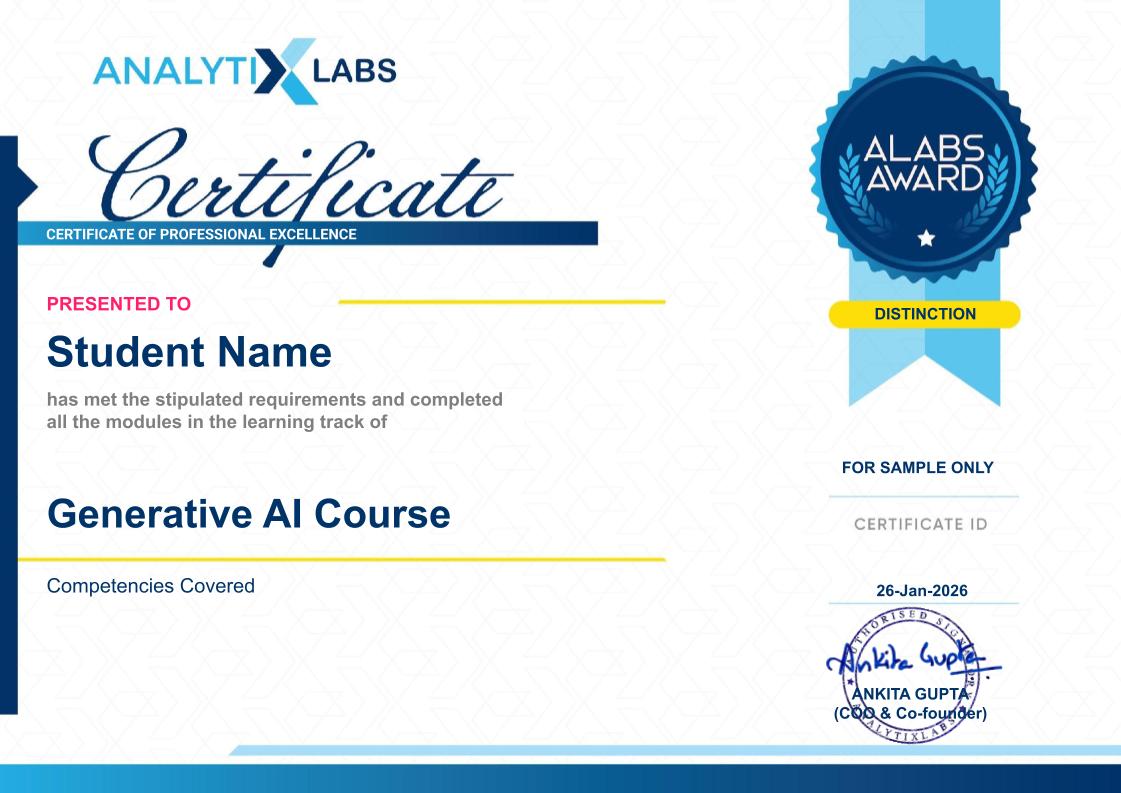
On successful completion of all stipulated requirements, including a final evaluation, you will be awarded AnalytixLabs Certification. AnalytixLabs certifications are highly regarded in the industry due to our extensive domain expertise. As India’s leading Data Science and AI institute, we maintain rigorous integrity in our certification process.
To secure certification, you must meet the specified requirements within your course timeline. This includes:
- Completing all required case studies
- Passing multiple-choice assessments (MCQs)
- Fulfilling additional course-specific criteria
You will have two attempts to pass each assessment.
Certification must be secured within one year of your course registration. We provide essential hands-on experience throughout your learning journey to prepare you for industry challenges.
Generative AI Course Fees & Learning Mode

Interactive Live Online
₹ 20,000 + taxes
Blend classroom dynamics with engaging, real-time interactive Online sessions tailored to busy schedules. This innovative approach combines traditional and digital learning, ensuring effective knowledge retention. Experience deeper understanding through flexible, responsive instruction designed for modern learners.
- Fees payable in installments
- 0% Interest EMI – Pay in Easy Installments (though education financing partners)
- Cost-effective courses with high ROI, making it worth every penny you invest.

Blended eLearning
₹ 15,000 + taxes
Fuse the rich atmosphere of classroom instruction with the flexibility and accessibility of eLearning modules, meticulously integrated to accommodate learning preferences. This unique blend ensures an optimal learning experience, empowering participants to delve into subjects deeply.
- Fees payable in installments
- 0% Interest EMI – Pay in Easy Installments (though education financing partners)
- Cost-effective courses with high ROI, making it worth every penny you invest.
Career Support

Profile Building
Tailored guidance to update your professional profile, aligning it with industry expectations and showcasing your strengths.

Interview Preparation
This will be followed by one to one interview preparation along with mock interviews (if required).

Continuous Support
There will be continuous support from our side for as long as you need it. Most of our students do get multiple interview calls and good career options based on the skills they learn during the course.
How To Apply
select your course, complete the registration form, and make payment.

Submit your application
Submit your application by filling out the form, providing necessary details, and clicking submit to complete the process.

Give a selection test
Take the selection test to demonstrate your skills and knowledge. This will help us assess your readiness for the course.

Reserve your seat
Reserve your seat today to secure your spot in the course. Act fast, as spaces are limited and fill quickly!

Payment
Complete your payment to finalize your enrollment in the course. Choose your preferred payment method and follow the prompts to proceed.
What Students Say About Us?
True Stories, Transformative Career Experience
Piyush Ganar, Class of 2012 IIM Ahmedabad
(Director of Operations, Kenty.AI)
The course material is very easy to understand and the case studies were based on real time business problems. What I love the most about Sumeet and his team is that they never operated the institute like a typical commercial enterprise but more like a temple for learning. The gates of Alabs are always open for students for any kind of help and guidance. I would recommend ALabs to all.
Raajeev Kumar Sahu
(Senior Manager – Data Science, FinTech Startup)
I am from Advance Big Data Science course of Nov 2016 batch. The course was very structured and got real world problems to practice during the final case studies. It has also boosted my skills to start participating in the hackathons. Chandra sir was really helped me in preparing my resume right from very beginning of the course. Also, the placement team was very well organized and connected to industry leaders so that people get the right opportunity right after completing the course. I really recommend this institute, who are interested to transition into analytics field.
Sumit Asthana
(Assistant Manager, Senior Data Scientist)
The rapid pace at which the institutes are mushrooming all over India and Facebook newsfeed being inundated with thousands of options for analytics training, there are only handful of training institutes or rather say only couple of places where they prepare you to foray into rapidly growing analytics vertical. I have been working into legacy systems for past 5 years and was quite apprehensive if I will ever break into data science successfully.
Surbhi Sultania
(Analytics Manager, Mastercard Data & Services)
I took three months Big Data training from Analytix labs. Before joining this course, I had so many questions and doubts that will this course be worthy enough but later I found myself lucky to join this program. All trainers are amazing and always ready to help. Live examples and Case Studies are given which helps in understanding the concept and hands on practice.Not only they help in quality in depth knowledge transfer but also tend to give right direction to your career.
Vibhu Gautam
(Professor of Practice – Computer Science, UPES)
I had been associated with AnalytixLabs since 2012. This has been possible because of the mentor ship and support you get from faculty there specially from Sumeet and Chandra.I did a Business Analytic course with a focus on Marketing Analytic. The course deliver had been great and most importantly you never feel like you are part of formal classroom teaching. You are mentored there at every step, from Code Errors to Understanding Statistics behind it.
Sign up for a Free Demo Class
Benefits of Demo Account
- Get access to trial sessions to choose the most suitable course.
- SAVE UP TO 40% on specialization learning tracks.
- JOB ORIENTED COURSES crafter and delivered by industry experts.
- INDUSTRY RELEVANT programs with latest curriculum.
Want to see how it works?
Frequently Asked Questions
What is a Generative AI course?
A Generative AI course teaches you to build with models that generate text, images and code. This one runs about 1.5 months and covers prompt engineering, large language models, no-code automation and AI assistants. You finish with a capstone assistant that automates at least three tasks. You need no programming background.
What is Generative AI in simple terms?
Ask ChatGPT to summarize a long report and it writes a summary that did not exist before. Ask Midjourney for an image and it produces one from your description. That is generative AI. It creates new content instead of sorting content that already exists. A spam filter labels your email. A generative model drafts the reply. People shorten the term to genAI or gen AI.
Do you need coding skills to learn Gen AI?
No. You learn GenAI here through no-code and low-code tools, so you never write Python. You build automations in Zapier, n8n and Make.com, and orchestrate agents without code. If you want Python-based AI development instead, our Full Stack Applied AI course covers model building and deployment.
What are the Generative AI course fees and duration?
The fee is 20,000 rupees plus taxes for the fully interactive live online mode, payable in installments. The program runs about 1.5 months. Download the brochure for more details.
What does the Generative AI course syllabus cover?
The syllabus covers six modules. Module 1 is AI and generative AI foundations. Modules 2 and 3 cover prompt engineering and large language models. Modules 4 and 5 cover no-code workflow automation and building AI assistants without code. Module 6 covers responsible AI. A capstone ties them into one working assistant.
How do you choose the best GenAI course?
Check three things when browsing through generative AI courses. Does the curriculum name specific tools and models, or only broad topics? Do you build and demo something, or only watch? Does the certificate require an assessment you can actually fail? Compare fees last. A cheap course that teaches nothing costs the most.
Is the course available online across India?
Yes. The interactive live online mode runs the same wherever you are. Learners join from Delhi, Noida, Gurgaon, Bangalore, Hyderabad, Pune and across India. Sessions happen live with an instructor. Recordings stay in your LMS afterwards.
How is Generative AI different from Agentic AI?
Generative AI produces content when you ask for it. Agentic AI decides the steps itself and executes them using other tools, with far less prompting from you. An agent plans, remembers and calls software. This course introduces no-code agents while our Agentic AI course goes deeper into frameworks and multi-agent systems.
Excited?
Talk to Expert
Counselor
to gain insights into your profile and
strategize your next career move!
