

Agentic AI Course
Design, build, and ship autonomous AI agents across no-code platforms, Python, and multi-agent systems
200 Hours
4 Months
27 Sept
Noida
15 Mar
Interactive Live Online
18 Oct
Interactive Live Online
29 Mar
Gurgaon

Learning Modes

Interactive Live Online sessions
Live, Interactive classes—Right on your screen, with instant doubt support.

Blended eLearning
Your Learning, Your Pace—backed by real-time interaction and doubts support.
Courses Included



Artificial Intelligence Engineering
₹ 20000/-
Artificial Intelligence Engineering
₹ 20000/-
Artificial Intelligence Engineering
₹ 20000/-
₹ 65000/-
₹ 48000*/-
Optional Course
Data Science using R
₹ 20,000
₹ 4000/-
04 Jan
Interactive Live Online
Interactive Live Online
INR 48,000 + Taxes
(0% Interest EMI – Pay in Easy Installments)
Overview

96 Hours Live Training
+ Self Study & Practice

Capstone Projects
& Assignments

Placement Support
and Career Guidance
Course Overview
Agentic AI now sits at the core of most business functions. An agent decides the next step, calls the right tool, and adjusts when something fails. It knows when to act, and how.
This Agentic AI course addresses the widening gap between available jobs and skilled professionals. The global job market is seeing steady growth in new agentic AI roles, but the number of skilled talent available has yet to match the pace. Learn Agentic AI skills that matter, because opportunities will only grow manifold.
Most organizations have people who can write prompts but very few have people who can put an agent into production and keep it stable when it fails. This gap shows up in hiring too. In our latest talent report, we noted that more agentic AI roles are open than qualified candidates.
Two things follow from that shortage.
- Experienced practitioners command a higher salary band because supply is thin.
- Professionals with 2 to 3 years in adjacent roles can enter on demonstrated skill, not years served. That rarely happens in an established field.
Close that gap by building an agent, deploying it, and keeping it stable in production. This Agentic AI online course is the right starting point.
This is why most hiring managers frame interview questions around handling an autonomous agent in production. They ask what you did when a tool call returned nothing and the agent kept looping or how you capped the token spend on a workflow that ran unsupervised overnight.
This Agentic AI certification course will teach you where, why, and how to place a human checkpoint with your autonomous agents. You see what happens when you leave that checkpoint out. You then debug the same class of failure yourself, across both modules.
Why Learn Agentic AI?
Agentic, by definition, means the capacity to act independently and make one’s own choices. Transcending this meaning to agentic AI, these are autonomous AI systems that can act autonomously and make decisions independently without human intervention.
These systems can learn, implement, execute, and iterate tasks to achieve set outcomes independently. While traditional AI is rule-based and requires human monitoring, agentic AI is statistical, where it learn and adapts from its surroundings and historical data.
Agentic AI is leading the way in every industry and domain. Learning the concepts and workings of these autonomous agents will give you a competitive edge in a time when skilled AI professionals are in short supply compared to the total number of opportunities.
The demand-versus-skilled professional gap is one reason why companies are willing to pay skilled agentic AI professionals more than the average payout. There’s no better time to upskill or reskill than now.
What You Will Learn?
In this course, you learn how AI agents work across industries and domains. You build and deploy them yourself. You then create multi-agent systems, streamline the workflows around them, and tie agent development to business goals.
This course builds six core skills. You apply each one in a working build before the programme ends.
- Agent architecture: Understand memory, planning, tool use, and autonomy as separate components you can debug individually.
- Framework fluency: Work hands-on in LangChain, LangGraph, CrewAI, and AutoGen. You learn when each one fits and when it does not.
- No-code and low-code automation: Build production workflows in Zapier and Make, then extend them in n8n. Python comes after that.
- Retrieval and grounding: Design RAG pipelines with vector databases so your agents answer from your data, not from guesswork.
- Deployment: Ship agents through FastAPI, Streamlit, and Gradio, then monitor them with LangSmith.
- Responsible AI: Apply guardrails, human-in-the-loop checks, and output verification to systems that act on their own.
What Are AI Agents? Types and Examples Covered in This Course
An AI agent perceives its environment, decides what to do next, and acts. The decision loop is what separates an agent from a chatbot that only responds.
Agent design has a long history, and the categories still shape how you build today.
Types of AI Agents
- Simple reflex agents: Respond to the current input and nothing else. A thermostat is the textbook case.
- Model-based agents: Hold an internal picture of the world. They can act sensibly when they cannot see everything at once.
- Goal-based agents: Plan a sequence of steps toward an outcome. Route planning works this way.
- Utility-based agents: Weigh competing options and pick the one with the best expected payoff.
- Learning agents: Improve from feedback rather than staying fixed after deployment.
- Knowledge-based agents in AI: Reason over a stored knowledge base before acting. They separate what they know from how they reason about it. This matters in practice. A RAG pipeline is a modern knowledge-based agent. The vector database stands in for the classical knowledge base.
AI Agents Examples
- Research agent: A research agent takes a question, searches multiple sources, and returns a cited summary. It decides how many sources to check before it stops.
- Support triage agent: A support triage agent reads an incoming ticket, classifies it, and routes it to the right queue. It pulls the order history first, then decides whether to escalate or resolve automatically.
- Ops reconciliation agent: An ops reconciliation agent compares a payment file against invoice records each morning. It flags mismatches, drafts the follow-up email, and holds anything above a set value for human sign-off.
Course Curriculum
This Agentic AI course offers a solid understanding of where and how Agentic AI fits in the AI world. With hands-on projects and assignments, you will transition smoothly into the core technologies. At the same time, you build the surrounding skills including critical thinking, AI ethics, communication, and AI project management.
The program also includes additional modules that extend your learning.
Download the brochure for the complete module-wise curriculum.
What is Artificial Intelligence (AI)?
Introduction to Course Objective - Logistics - Structure of the course
Demystifying AI and its evolution
Data Science vs. Machine Learning vs. Artificial Intelligence
How AI is transforming businesses
Trends, Tools and Applications
Use cases related to different functions across industries (Retail/ e-commerce, BFSI, Pharma, Manufacturing, Auto, etc.)
Key Areas of AI (Computer Vision, Language Models, Reinforcement Learning, etc.)
What is Generative AI
Understand how Generative AI produces new data, text, or images based on training datasets.
Request a Call back
Generative AI & Nocode Agentic AI
AI Foundations
- What is AI?
- AI vs. Automation vs. Analytics
- AI, Machine Learning (ML), Deep Learning (DL) – differences & connections
- Narrow AI vs. General AI vs. Super AI
- Key milestones in AI history
- History & Evolution of AI
- Core AI applications (NLP, CV, Robotics, Predictive Analytics)
- Future of AI: opportunities and risks
- GenAI in daily life & industries (like HR, Operations, Healthcare, Retail, Education, Finance, Manufacturing)
Generative AI Basics
- Introduction to Generative AI
- Traditional AI vs. Gen AI
- Everyday GenAI applications
- How GenAI works?
- Large Language Models (LLMs) explained simply
- Transformers in brief
- Training vs Fine-tuning vs Inference
- Key models (GPT, Claude, Gemini, LLaMA)
- Key important concepts – recent trends
- Text generation & completion techniques
- Prompt Engineering basics: role, task, context
- Core Prompting Tasks (Text generation & completion, Summarization (short & detailed), Rewriting in different tones/styles)
- Prompt Structures (instructional, role-based)
- Prompting Techniques (Zero-shot prompting, Few-shot prompting, Chain of Thought (CoT) prompting etc..)
- Role prompting
- Multi-turn interactions (context retention)
- Limitations of prompting
- Evaluating GenAI output quality
Large Language Models (LLMs)
- Large Language Models (LLMs): how they work
- Introduction to transformers
- LLMs vs. SLMs
- Popular LLMs (GPT, Claude, Gemini, LLaMA) – Overview – Strengths & Limitations
- Prompting techniques: Zero-shot, Few-shot, Role prompting, Chain of Thought (CoT)
- Advanced prompting (self-consistency, instruction tuning, multi-turn conversations)
- Multi-turn conversations & context management
- Introduction to embeddings & fine-tuning
Agentic AI - No-Code/Low-Code Tools for AI
- Introduction to Agentic AI
- No-code AI overview
- Use cases in productivity & automation
- Intro to workflow automation tools
- Introduction to Zapier basics (triggers & actions), n8n workflow design, Make.com integrations
- AI-powered productivity with Notion AI for task automation & summarization, Airtable for data storage & automation, Glide for mobile app prototyping etc,
- Design & Storytelling Tools (Canva AI (text-to-design, AI brand kit), Tome AI (AI-powered storytelling), Gamma.app (AI slide decks)
- Integrating AI into everyday workflows – Linking AI workflows with business processes
- Prototyping with no code/low code tools
AI Agent Creation
- What is an AI Agent? How it differs from chatbots
- Agentic AI vs. AI Agents
- Key components of Agentic AI: memory, planning, tool use, autonomy
- AI Orchestration with no-code tools
- Agent frameworks (LangChain, AutoGen, CrewAI – overview)
- Practical: Building an AI Research Assistant Agent
Ethics, Safety & Responsible AI
- AI challenges: Bias, hallucination, privacy & security issues
- Responsible AI principles: Fairness, Accountability, Transparency, Explainability
- Global AI Ethics Frameworks: – Responsible AI design principles (OECD, EU AI Act, NITI Aayog (India’s Responsible AI strategy), UNESCO, Microsoft Responsible AI)
- Safe & Responsible usage (Verifying AI outputs, Human-in-the-loop (HITL) systems, Trust & compliance in AI adoption etc)
- Responsible AI: Guardrails
- Case studies of AI Misuse
Capstone Project
Objective: Build an AI assistant that helps with productivity using GenAI + No-Code Automation using tools like zappier, make or n8n etc.
- Problem Identification: Choose a real productivity pain point (e.g., too many emails, meeting overload, research notes etc..)
- Workflow Design: Build automation using Zapier/n8n to connect AI with apps (Notion, Google Docs, Slack).
- Chatbot Assistant: Use ChatGPT/Notion AI for contextual Question & answers.
- Interface Prototype: Build front-end in Glide/Tome AI.
- Final Presentation & Demo: Live demo + explanation of workflow + reflection on ethics
- Should automate at least 3 tasks (e.g., meeting notes → task assignment → daily summary email)
Applied Agentic AI (Agentic AI Systems using Python)
Python for AI Foundations
- Setting up development environment
- Installing and configuring tools like VS CODE,JUPYTER LAB,Github
- Best practice for managing dependencies and optimising the workspace
- String, iteration & generators, thread & processes
- File Operations & Web Crawling (CSV, JSON, PDF, etc.)
- Numpy & Pandas for AI workflows
- Functions & Classes in Python
- Working with APIs (REST APIs, JSON handling, requests library)
Transformers & Fine-Tuning
- Transformers Architecture Basics(Introduction, attention, multihead attention, encoder-decoder with context)
- The Main Idea behind Transformer
- Coding self attention in Pytorch
- Self attention and Masked self Attention
- Hugging Face Transformers basics
- Pre-trained vs fine-tuned models
- Fine-tuning pre-trained models (BERT, GPT-style)
- Parameter-efficient fine-tuning (PEFT, LoRA, adapters)
- Work examples
GPT from Scratch
- Language modeling concepts
- Tokenization & embeddings
- Implementing a simple GPT model step by step
- Training with a toy dataset
- Training loop & loss function
Multi-Modal LLMs
- Text-to-Image models (Stable Diffusion, DALL·E)
- Image-to-text models (BLIP, CLIP, Flamingo)
- Text-to-Speech and Speech-to-Text APIs
- Speech-to-text (Whisper)
- Combining modalities (vision + text)
- Multi-modal pipelines (text+image, text+audio)
- Introduction to Multimodal AI
- Multimodal data representation: Datatype comparisons, meta data handling
- Individual Modality Processing: Text Processing Pipeline, Image Processing Techniques, Audio Processing Methods, Preprocessing Challenges
- Evaluation Metrics and Benchmark: Vision-Language Metrics – BLEU, Semantic Evaluation – CLIP
- Popular Multimodal Datasets Exploration
- Popular Multimodal Datasets Exploration: Efficient Data Loading, Text Preprocessing, Video Frame Processing, Custom Dataset Classes, DataLoader Configuration
- Data Alignment and Synchronization: Temporal Alignment, Cross-modal Validation, Missing Data, Alignment Pipeline
LLM Prompting & LangChain Basics
- LLM Wrappers & APIs
- Prompt engineering strategies
- LangChain components: Memory, Tools, Chains, Agents
- LangChain wrappers and memory
- Orchestrating LLM workflows
- Building basic agents
Vector Databases & RAG (Retrieval-Augmented Generation)
- Introduction to embeddings (SBERT, OpenAI, Cohere)
- Vector embeddings and similarity search
- FAISS & Pinecone, Weaviate for vector search
- Chunking & indexing documents
- Advanced chunking strategies: semantic chunking, content aware document based chunking.
- Embedding strategies: Compare characteristics of popular models like OpenAI embeddings, Sentence Transformers (e.g., all-MiniLM-L6-v2, all-mpnet-base-v2, E5, BGE), Cohere embeddings, and Sparse models (e.g., ELSER)
- Building RAG(Retrieval-Augmented Generation) pipelines
- RAG architectures: Vanilla RAG, Self-RAG, HyDE
- Advanced retrieval: Hybrid search and filtering
- Introduction to RAG fusion and retrieval re ranking
- Building RAG chatbot
- Evaluation of RAG
- Integrating Fusion & Re-ranking (Practical Sketch)
Autonomous Agents (Agentic AI)
- Introduction to LLM Agent Systems
- CrewAI & AutoGen frameworks
- Multi-agent coordination
- Task decomposition & delegation
- Building workflow-driven AI agents
- Tools, memory, reasoning
- Deployment & Use Cases
LangGraph & Model Context Protocols (MCP)
- LangGraph introduction
- Designing agent workflows with graphs
- State management in multi-agent systems
- MCP for standardized context sharing
- Future of agentic AI ecosystems
- Agent to Agent Protocols (A2A)
Evaluation & Deployment
- Testing & Evaluating LLM Apps/outputs (metrics, hallucination checks & frameworks)
- Monitoring & debugging with LangSmith
- App deployment with Streamlit, Gradio
- API deployment with FastAPI
- Best Practices to know
- LLM Benchmarkings
- Embedding Benchmarking
- How we can ensure you are using the best in class, cost friendly model for you use and how we can do benchmarking of different models wrt the use case
Capstone Project
Objective: End-to-end AI Agentic Workflow integrating multiple modules
Examples:
- Research assistant that searches documents, summarizes, and answers queries
- HR agent that screens resumes, ranks candidates, and generates interview questions
- AI-powered knowledge hub with RAG + multi-agent orchestration
Why Learn No-code/Low-Code Automation Tools?
You do not need Python to build your first working agent. This course opens with no-code and low-code automation tools, so you understand workflow logic before you write code.
A no-code automation platform lets you connect apps and trigger actions through a visual builder. A low-code automation platform adds scripting where the visual builder runs out of room. Both matter, because most business automation lands somewhere between them.
You work hands-on with no-code automation tools including Zapier, Make, Notion AI, Airtable, and Glide. You then move to low-code automation tools such as n8n, where you add custom functions and API calls to a visual workflow.
Low-code automation also has a ceiling. You will find it during Module 1, when a workflow needs branching logic or memory that the builder cannot express. That is the moment Python earns its place, and it is where Module 2 begins.
Key Skills
- Understand the foundations of AI and Generative AI
- Master prompt engineering and prompting frameworks for real-world scenarios
- Automate workflows with no-code/low-code AI tools
- Design and deploy AI Agents for business and personal productivity
- Understand core AI & GenAI fundamentals
- Build LLM-powered apps with LangChain & Vector DBs
- Design & deploy AI agents using Python frameworks
- Work with practical enterprise use cases in automation
- Apply AI responsibly with awareness of ethical, bias, and governance considerations
Learning Outcomes
Graduates of the program will be able to:
- Communicate AI concepts to both technical and business audiences.
- Design prompts and no-code workflows for productivity and automation.
- Build and deploy LLM-based apps with LangChain, RAG, and multi-agent systems.
- Implement computer vision models for tasks like image classification, surveillance, or defect detection.
- Apply reinforcement learning for decision-making, optimization, and autonomous systems.
- Develop advanced AI prototypes — from chatbots to CV-enabled drones.
- Integrate AI safely and ethically into real-world workflows.
- Showcase an AI portfolio with capstone projects across Generative, Agentic, and Advanced AI.
Projects
- Objective: Build an AI assistant that helps with productivity using GenAI + No-Code Automation using tools like zappier, make or n8n etc..
- Problem Identification: Choose a real productivity pain point (e.g., too many emails, meeting overload, research notes etc..)
- Workflow Design: Build automation using Zapier/n8n to connect AI with apps (Notion, Google Docs, Slack).
- Chatbot Assistant: Use ChatGPT/Notion AI for contextual Question & answers.
- Interface Prototype: Build front-end in Glide/Tome AI.
- Final Presentation & Demo: Live demo + explanation of workflow + reflection on ethics
- Should automate at least 3 tasks (e.g., meeting notes → task assignment → daily summary email)
- End-to-end AI Agentic Workflow integrating multiple modules.
Assignments
- Add extra features: e.g., voice input, task prioritization, or reminders.
- Explore alternative integrations (Slack, WhatsApp bots).
- Document your workflow and share video demo
Who Should Do?
- Career changers moving into AI – You build a job-ready skill set across generative and agentic AI, and you leave with capstone projects you can defend in an interview.
- Data practitioners – You move from theory to production through Python projects covering LangChain, LangGraph, CrewAI, RAG pipelines, and deployment.
- Functional managers and team leads – You learn enough architecture to scope agent projects, judge vendor claims, and set realistic timelines.
- Researchers and technical enthusiasts – You go deep on multi-agent orchestration, MCP, multi-modal LLMs, and transformer internals.
Job Roles
- GenAI Associate / AI Analyst (Junior)
- Prompt Engineer (Entry-level)
- No-Code Automation Specialist
- AI Operations Executive
- Digital Transformation Associate
- AI Product Manager (GenAI focus)
- AI Research Engineer
- AI Solutions Architect (GenAI)
- AI Platform Engineer
- Conversational AI Engineer
- RAG Architect
- Agentic AI Engineer
- GenAI Developer
- LLM Application Developer
- NoCode AI Builder
- AI Automation Manager
- AI Workflow Consultant
- AI Engineer (LLM / GenAI)
Programming Tools and Languages








Agentic AI Course Delivery Format

Fully Interactive Live Online
Blend the dynamic experience of traditional classroom with engaging, real-time interactive sessions, carefully tailored to meet the demand of busy schedules. This innovative approach ensures effective learning, fostering a deeper understanding and retention of knowledge.

Blended with eLearning
Fuse the rich atmosphere of classroom instruction with the flexibility and accessibility of eLearning modules, meticulously integrated to accommodate learning preferences. This unique blend ensures an optimal learning experience, empowering participants to delve into subjects deeply.
Agentic AI Certification Details
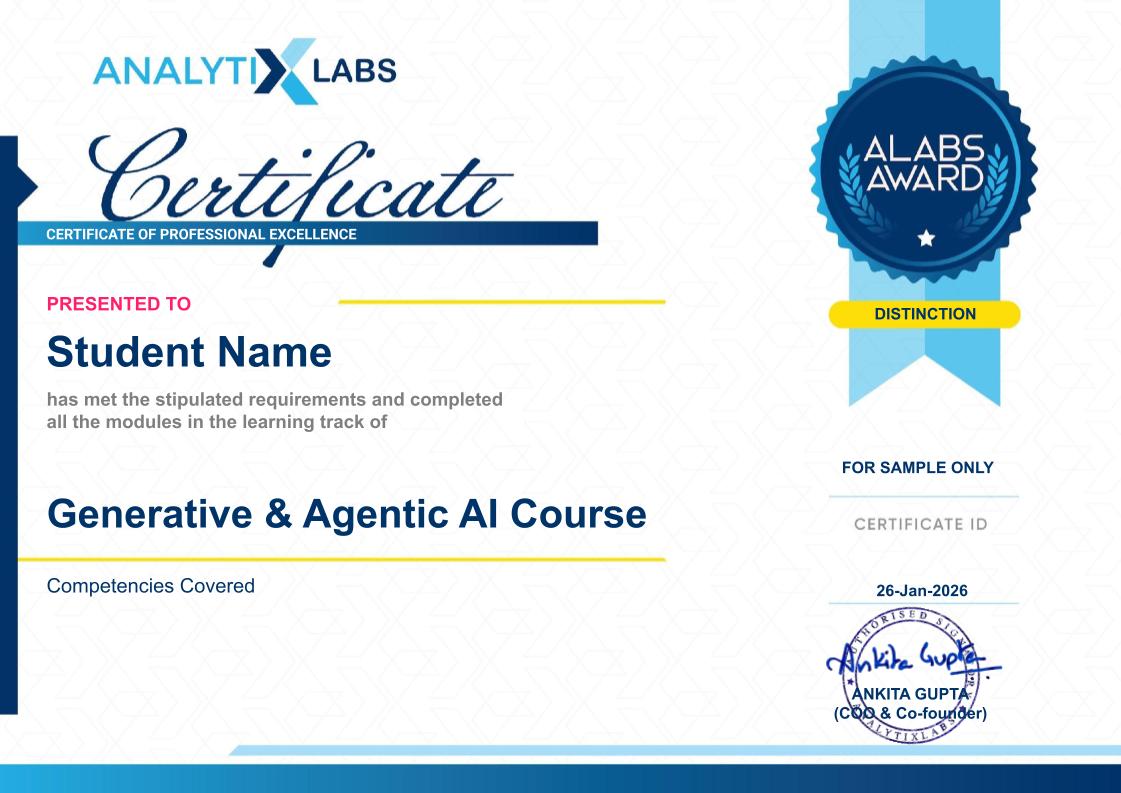
Upon successful completion of all stipulated requirements, including the final evaluation, learners will earn a Dual Certification from AnalytixLabs and NASSCOM–FutureSkills Prime. Each module is aligned with the National Occupational Standards (NOS), ensuring industry relevance and alignment with established competency benchmarks.
As a leading institute in Data Science and Artificial Intelligence in India, we uphold rigorous standards of quality, credibility, and integrity throughout our certification process.
To secure certification, you must meet the specified requirements within your course timeline. This includes:
- Completing all required case studies
- Passing multiple-choice assessments (MCQs)
- Fulfilling additional course-specific criteria
You will have two attempts to pass each assessment.
Certification must be secured within one year of your course registration. We provide essential hands-on experience throughout your learning journey to prepare you for industry challenges.
Agentic AI Course Fees & Learning Mode
Agentic AI course fees cover live instructor-led sessions, both capstone builds, the assessed case studies, and certification. You can split the fee into instalments or choose an interest-free EMI plan. Your learning advisor confirms the current fee and any batch offer before you pay.

Interactive Live Online
₹ 42,000 + taxes
Blend classroom dynamics with engaging, real-time interactive Online sessions tailored to busy schedules. This innovative approach combines traditional and digital learning, ensuring effective knowledge retention. Experience deeper understanding through flexible, responsive instruction designed for modern learners.
- Fees payable in installments
- 0% Interest EMI – Pay in Easy Installments (though education financing partners)
- Cost-effective courses with high ROI, making it worth every penny you invest.

Blended eLearning
₹ 36,000 + taxes
Fuse the rich atmosphere of classroom instruction with the flexibility and accessibility of eLearning modules, meticulously integrated to accommodate learning preferences. This unique blend ensures an optimal learning experience, empowering participants to delve into subjects deeply.
- Fees payable in installments
- 0% Interest EMI – Pay in Easy Installments (though education financing partners)
- Cost-effective courses with high ROI, making it worth every penny you invest.
3-Step Admission Process
- You start by registering your interest through the website, email, chat, or phone. A learning advisor contacts you within 24 to 72 hours.
- Your advisor reviews your background and confirms whether this course fits your goals. If a different programme suits you better, they will say so.
- You then choose your batch and learning mode, and pay the admission fee to confirm your seat.
Admission Process at AnalytixLabs
We implement a personalized enrollment process for all our courses. To enroll in our AI courses, you must express your interest through our website, email, chat, or phone. Once we receive your interest in enrolling in our artificial intelligence certification course, one of our learning advisors will contact you within 24 to 72 hours.
Our learning advisor will help you understand the industry relevance of our course and assess whether this specific course is the best fit for your profile. If our advisor determines that your educational and professional background may be better suited for other classes, they will guide you to alternative options. Additionally, our advisor will assess your preferred location, upcoming course batches, and learning preferences.
We aim to ensure that you derive the maximum benefit from our courses, which requires us to understand your goals and expectations from our learning materials. Our learning advisors will provide comprehensive guidance on course details and job prospects and evaluate both your technical and non-technical knowledge, location, and preferred learning methods to tailor the best solution for you.
By paying the admission fee, as agreed upon with your learning advisor, you can secure your spot in the course at your chosen location and upcoming batch date.
Career Support and Guidance
AnalytixLabs is committed to helping you launch a successful career in AI, Data Science, and Analytics. With comprehensive Placement Assistance integrated into our Advanced Certification programs, our dedicated team of industry professionals offers personalized support based on your educational background and work experience. The placement process is designed to equip you with both opportunity and readiness—helping you transition seamlessly into the data-driven workforce.

Placement Guidance
Our training focuses on building job-ready skills that prepare students for successful placements.
Students receive continuous guidance from our experienced faculty on job applications and interview preparation. We also conduct mock interviews, when required, and provide one-to-one feedback and personalized guidance.
We also share placement opportunities, career guidance, and industry insights to keep students informed about current hiring trends.

Diverse Job Opportunities
• Access to job opportunities through direct collaborations with organizations, reputed recruiters, and the extensive AnalytixLabs Alumni network.
• Many students receive multiple interview calls and see a significant boost in career prospects.
• Success, however, depends on a combination of the candidate’s dedication and the institute’s support. Active participation and timely course completion are essential for maximizing placement outcomes.

Continued Career Support
Your journey with AnalytixLabs doesn’t end after completing the Placement Readiness Program. We offer ongoing placement support to ensure you stay on track until you achieve your career goals.
Our dedicated team continues to assist with job opportunities, interview preparation, and personalized guidance as long as you need it. Many of our students benefit from multiple interview calls and long-term career growth, thanks to the strong foundation and in-demand skills built during the course.
How To Apply
select your course, complete the registration form, and make payment.

Submit your application
Submit your application by filling out the form, providing necessary details, and clicking submit to complete the process.

Give a selection test
Take the selection test to demonstrate your skills and knowledge. This will help us assess your readiness for the course.

Reserve your seat
Reserve your seat today to secure your spot in the course. Act fast, as spaces are limited and fill quickly!

Payment
Complete your payment to finalize your enrollment in the course. Choose your preferred payment method and follow the prompts to proceed.
What Students Say About Us?
True Stories, Transformative Career Experience
Piyush Ganar, Class of 2012 IIM Ahmedabad
(Director of Operations, Kenty.AI)
The course material is very easy to understand and the case studies were based on real time business problems. What I love the most about Sumeet and his team is that they never operated the institute like a typical commercial enterprise but more like a temple for learning. The gates of Alabs are always open for students for any kind of help and guidance. I would recommend ALabs to all.
Raajeev Kumar Sahu
(Senior Manager – Data Science, FinTech Startup)
I am from Advance Big Data Science course of Nov 2016 batch. The course was very structured and got real world problems to practice during the final case studies. It has also boosted my skills to start participating in the hackathons. Chandra sir was really helped me in preparing my resume right from very beginning of the course. Also, the placement team was very well organized and connected to industry leaders so that people get the right opportunity right after completing the course. I really recommend this institute, who are interested to transition into analytics field.
Sumit Asthana
(Assistant Manager, Senior Data Scientist)
The rapid pace at which the institutes are mushrooming all over India and Facebook newsfeed being inundated with thousands of options for analytics training, there are only handful of training institutes or rather say only couple of places where they prepare you to foray into rapidly growing analytics vertical. I have been working into legacy systems for past 5 years and was quite apprehensive if I will ever break into data science successfully.
Surbhi Sultania
(Analytics Manager, Mastercard Data & Services)
I took three months Big Data training from Analytix labs. Before joining this course, I had so many questions and doubts that will this course be worthy enough but later I found myself lucky to join this program. All trainers are amazing and always ready to help. Live examples and Case Studies are given which helps in understanding the concept and hands on practice.Not only they help in quality in depth knowledge transfer but also tend to give right direction to your career.
Vibhu Gautam
(Professor of Practice – Computer Science, UPES)
I had been associated with AnalytixLabs since 2012. This has been possible because of the mentor ship and support you get from faculty there specially from Sumeet and Chandra.I did a Business Analytic course with a focus on Marketing Analytic. The course deliver had been great and most importantly you never feel like you are part of formal classroom teaching. You are mentored there at every step, from Code Errors to Understanding Statistics behind it.
Sign up for a Free Demo Class
Benefits of Demo Account
- Get access to trial sessions to choose the most suitable course.
- SAVE UP TO 40% on specialization learning tracks.
- JOB ORIENTED COURSES crafter and delivered by industry experts.
- INDUSTRY RELEVANT programs with latest curriculum.
Want to see how it works?
Frequently Asked Questions
What are AI agents?
An AI agent perceives its environment, decides what to do next, and acts on that decision. Unlike a chatbot, it chooses its own next step. Agent types range from simple reflex agents to knowledge-based agents in AI, which reason over a stored knowledge base before acting.
How do I choose the best agentic AI course?
The best agentic AI course depends on the outcome you want to achieve. Each course serves a different career goal. Choose an agentic AI course on four things.
- Does the syllabus include LangGraph, MCP, and multi-agent orchestration, or does it stop at prompting?
- Do you build and deploy working agents, or only watch demos?
- Is the faculty named and reachable?
- Does the certification require assessed work?
Apply those four questions to every course you shortlist, including this one.
What is the Agentic AI course fees?
Full agentic AI course fees, instalment options, and interest-free EMI terms appear in the course fees section above. Your learning advisor can confirm the current fees and any batch offer before you enrol.
Is this an AI agents course or a generative AI course?
Both, in sequence. The Generative AI course focuses on prompting, LLMs, and content generation. This AI agents course focuses on systems that act: planning, tool use, memory, and coordination between agents. You cover generative AI foundations here first, because agents run on them.
Can I learn agentic AI without a coding background?
Yes, to a point. You can learn agentic AI from scratch here. Module 1 runs entirely on no-code and low-code automation tools, so you build working agents from week one. Module 2 opens with a Python foundations section covering environments, NumPy, pandas, and APIs. You need willingness to code, not prior experience.
What does the Agentic AI certification cover?
The Agentic AI certification confirms you completed the assessed case studies and cleared the module assessments across both modules. It covers no-code automation, prompt engineering, LangChain, LangGraph, CrewAI, RAG pipelines, and deployment.
Do you offer Agentic AI courses in India outside the metros?
Yes. Agentic AI courses in India are available fully online through this programme. You attend the same live sessions as classroom batches and get the same faculty access.
Does the course include placement support?
Yes. You get interview preparation, mock interviews, resume guidance, and access to openings through our recruiter network and alumni base. Support continues after the course ends. Outcomes depend on your participation and timely completion.
Excited?
Talk to Expert
Counselor
to gain insights into your profile and
strategize your next career move!
