

Forward Deployed Engineer Course
Deploy AI Inside the Customer’s Business. The Role AI Companies Are Building Teams Around.
72 Hours
1.5 Months
15 Mar
Interactive Live Online
29 Mar
Gurgaon
18 Oct
Interactive Live Online
29 Mar
Gurgaon

08 Nov
Noida
08 Nov
Gurgaon
28 Sept
Noida
Learning Modes

Classroom Sessions
INR 86,440/-*
(Pay in Easy Installments)

Interactive Live Online
INR 77,000/-*
(Pay in Easy Installments)

Blended eLearning
INR 71,100/-*
(Pay in Easy Installments)



Applied AI Course Overview
Artificial Intelligence Engineering
₹ 20000/-
Artificial Intelligence Engineering
₹ 20000/-
Artificial Intelligence Engineering
₹ 20000/-
₹ 65000/-
₹ 48000*/-
Optional Course
Data Science using R
₹ 20,000
₹ 4000/-
Applied AI Course Overview
Program Fees
INR 20,000/-*
INR 15,000/-*
Learning Modes
Interactive Live Online
INR 80,240/-*
(Pay in Easy Installments)
INR 68,440/-*
(Pay in Easy Installments)
Blended eLearning
INR 70,800/-*
(Pay in Easy Installments)
INR 53,100/-*
(Pay in Easy Installments)
Course Overview

105 Hours Live Training
+ 35 Hours e-learning

Self Study & Practice
Projects & Assignments

Assessments & Projects
19 Hours
A forward deployed engineer is embedded with a customer to build and run AI systems inside that customer’s environment. The role combines production engineering with direct client work. You scope the problem with stakeholders, integrate with systems you did not design, and deploy into production. Then you answer for the result.
This forward deployed engineer course teaches that work as a 12-class specialization. It extends the Full Stack Applied AI Course, which covers the engineering foundation underneath.
A forward deployed engineer works inside the customer’s business, not alongside it. As an FDE, you join their delivery calls and build in their cloud. You work against their data and under their access rules.
You step in before any code starts. A stakeholder describes the problem in business terms, and you convert that into scope, success criteria, and constraints. Then you build, deploy, and stay accountable for whether the system holds up in daily use.
Palantir created the role and the title, and the pattern has spread since. AWS, Microsoft, OpenAI, and Databricks now hire embedded engineers to take AI systems into customer operations.
Read our guide on how to become a forward deployed engineer in India for the wider role and pay picture.
Two Ways to Take This Course
This FDE course runs 12 classes. It sits inside the Full Stack Applied AI Course as Module 4, and it is also available on its own. Pick the route that matches where you are now.
Route 1. The full program
You take the Full Stack Applied AI Course, which now runs 52 live classes across four modules and includes this specialization as Module 4.
Module 1 covers generative AI and no-code agentic AI across 12 classes. Module 2 builds applied agentic AI systems in Python across 20 classes. Module 3 takes those systems to production across 8 classes, covering deployment, evaluation, LLM security, MLOps and LLMOps. Module 4 is this specialization, and it puts all of it inside a customer’s environment.
Take this route if you are early in your career, or moving across from another engineering discipline. It is also the only route that carries the dual certification.
Route 2. Module 4 on its own
You already build and deploy applied AI systems in production. You take the 12 classes on their own and finish in a single block. Forward deployed engineer training works in this order, because the build layer is already in place.
This route suits working engineers and AnalytixLabs alumni who have the foundation and want the delivery half.
Both routes end in the same capstone deployment, defended live to a panel.
Learning Outcomes
Every class in this specialization ends in something you can show. The capstone in Classes 11 and 12 assesses them together, in front of a panel.
On completing the specialization, you will be able to:
- Place the FDE role precisely against AI engineer, solutions architect, and ML engineer, and explain what each one owns
- Run a structured discovery session and turn a business conversation into a scoped brief, even when the problem starts ambiguous
- Produce and document a customer-ready architecture that engineers can review and a non-technical stakeholder can follow
- Ship production-grade integrations across third-party vendors and messaging platforms, generalized into a reusable adapter
- Scope a deployment inside a regulated domain across fintech, healthcare, and insurance, and choose between retrieval, agents, fine-tuning, and rules
- Handle a live outage that involves more than one vendor’s system, find the cause quickly, and write an incident report that stays neutral about who was at fault
- Defend a portfolio-grade deployment to a subject-matter-expert panel, with evaluation evidence and an outcome-framed executive demo
Forward Deployed Engineer Course Syllabus
Before you read the syllabus, understand how the FDE role differs from an AI engineer. The skills overlap heavily. The working environment and the accountability do not.
| AI Engineer | Forward Deployed Engineer | |
|---|---|---|
| Who you build for | Your own product team | A named customer, in their business |
| Whose systems you work in | Your company’s stack, which you helped design | The customer’s stack, which you inherit undocumented |
| How success is measured | The system ships and performs to spec | The customer’s team uses it and keeps using it |
This specialization runs 12 classes. Ten are taught, and two are dedicated capstone classes. We built it as one continuous customer engagement, not a set of separate assignments.
What you scope in Class 1 constrains what you design in Class 2. What you design decides what you defend in Class 12. Each class closes with a 10-question recap test on the previous class.
- What a forward deployed engineer actually does. Origin at Palantir, now standard at OpenAI, Google, and Anthropic-style AI labs
- FDE vs. AI engineer vs. solutions architect vs. ML engineer: what each owns, customer-facing exposure, success metrics
- Why most enterprise AI pilots fail to reach production
- Running a discovery session: structuring the conversation, the questions that surface a high-impact use case
- Stakeholder mapping: CTO, CISO, business owner. What each cares about and how to speak to them
- Translating business language into technical requirements and back. Writing a scoping brief
- Defining system architecture, integrations and infrastructure for a named customer scenario
- Single-tenant vs. multi-tenant AI deployment patterns, and when each applies
- Choosing managed vs. self-hosted components. Capacity planning basics: expected load, data volume, latency budget
- Architecture decision framework: weighing cost, compliance, latency, and data residency against options
- Writing a solution-design doc a customer’s engineering team can review
- Architecture diagramming conventions: component, sequence, and data-flow diagrams
- Communicating technical trade-offs to non-technical stakeholders. Scoping pilot-grade vs. production-grade architecture for the same use case
- Peer review as a documentation quality check
- Designing integrations across many third-party providers. Webhook design, event-driven integration patterns, idempotency
- Authentication patterns at enterprise scale: OAuth2, API-key rotation, per-customer credentials
- Rate limiting, pagination and retry/backoff design for high-volume vendor APIs
- Designing a reusable ‘vendor adapter’ abstraction, so the next integration ships faster than the last
- Messaging-platform integration: WhatsApp Business API concepts, message templates, webhooks
- CRM and ERP integration patterns for customer deployments
- Handling platform-specific quirks such as rate limits, template approval workflows and delivery guarantees, without those quirks leaking into the rest of the system
- KYC/KYB, AML and sanctions-screening concepts: what an FDE working with a compliance-tech customer needs to understand
- Risk scoring concepts, and how AI assists rather than replaces a compliance analyst’s judgment
- How a compliance-tech FDE scopes a customer problem within these constraints
- Healthcare: HIPAA-aware RAG design considerations
- Banking and insurance: additional regulatory texture and common AI use cases beyond fintech-specific compliance
- A decision framework for choosing the right AI pattern inside any regulated domain: RAG vs. agent vs. fine-tune vs. rules engine
- Debugging production issues in real time: isolate, reproduce, fix, verify
- Observability for agentic systems: logs, traces, and metrics
- Reading a stack trace and a trace timeline under time pressure, without losing composure
- War-room practices: roles, communication cadence, when to escalate
- Triaging failures across many third-party vendor integrations. Isolating which vendor actually failed
- Writing a clear, blameless postmortem
- Presenting outcomes and business impact rather than technical feature lists
- Translating technical trade-offs for non-technical stakeholders
- Handling pushback and objections without getting defensive
- Demoing to a senior, non-technical executive audience: pacing, framing, what to show and what to skip
- Portfolio storytelling: turning a project into a narrative for interviews and client pitches
- Professional branding for an FDE on LinkedIn and in a resume
- Why FDEs cannot wait for a perfect spec. Scoping techniques for genuine ambiguity
- Rapid-scoping heuristics for the smallest slice that proves the concept
- Choosing a final-capstone industry vertical and customer scenario: fintech and compliance, healthcare, retail, SaaS ops, or a learner-proposed scenario
- A decision framework for scoping under time pressure, before any building starts
- Full end-to-end build day. Apply the entire specialization to the scenario scoped in Class 10: discovery, architecture, integration, regulated-domain scoping, incident response readiness
- Structured check-ins: a midpoint architecture check and a midpoint evaluation check, so problems surface while there is time to fix them
- No new teaching content. Dedicated, mentor-supported build time
- Integration testing the full deployment
- Preparing the deployment plan, evaluation proof-point, and documentation package for the executive demo
- Live defense to a subject-matter-expert panel: architecture walkthrough, live demo with evaluation evidence, Q&A, defending design decisions and trade-offs
Generative AI & Nocode Agentic AI
AI Foundations
- AI vs. Automation vs. Analytics
- AI, Machine Learning (ML), Deep Learning (DL) – differences & connections
- Narrow AI vs. General AI vs. Super AI
- Core AI applications (NLP, CV, Robotics, Predictive Analytics)
Generative AI Basics
- Traditional AI vs. Gen AI
- Every day, GenAI applications
- How does GenAI work?
- Key models (GPT, Claude, Gemini, LLaMA)
- Text generation & completion techniques
- Prompt Engineering basics: role, task, context
- Core Prompting Tasks (Text generation & completion, Summarization (short & detailed), Rewriting in different tones/styles)
- Prompt Structures (instructional, role-based)
- Prompting Techniques (Zero-shot prompting, Few-shot prompting, Chain of Thought (CoT) prompting
- Role Prompting, Multi-turn interactions (context retention), etc..
- Limitations of prompting
- Evaluating GenAI output quality
Large Language Models (LLMs): How They Work
- Introduction to transformers
- LLMs vs. SLMs
- Popular LLMs (GPT, Claude, Gemini, LLaMA) – Overview – Strengths & Limitations
- Introduction to Embeddings
Introduction to Agentic AI
- No-code AI overview
- Intro to workflow automation tools
- Introduction to Zapier basics (triggers & actions), n8n workflow design, Make.com integrations
- AI-powered productivity with Notion AI for task automation & summarization, Airtable for data storage & automation, Glide for mobile app prototyping, etc.
- Design & Storytelling Tools
- Integrating AI into everyday workflows – Linking AI workflows with business processes
- Prototyping with no-code/low-code tools
What is an AI Agent? How it differs from chatbots
- Agentic AI vs. AI Agents
- Key components of Agentic AI: memory, planning, tool use, autonomy
- AI Orchestration with no-code tools
- Agent frameworks (LangChain, AutoGen, CrewAI – overview)
AI challenges: Bias, hallucination, privacy & security issues
- Responsible AI principles: Fairness, Accountability, Transparency, Explainability
- Global AI Ethics Frameworks
- Safe & Responsible usage
- Responsible AI: Guardrails
Applied Agentic AI (Agentic AI Systems using Python)
Setting up the development environment
- Installing and configuring tools like VS CODE, JUPYTER LAB, GitHub
- Best practice for managing dependencies and optimizing the workspace
- Numpy & Pandas for AI workflows
- Functions & Classes in Python
- Working with APIs (REST APIs, JSON handling, requests library)
Transformers & Fine-Tuning
- Transformers Architecture Basics(Introduction, attention, multihead attention, encoder-decoder with context)
- The Main Idea behind the Transformer
- Coding self-attention in Pytorch
- Self-attention and Masked Self-attention
- Hugging Face Transformers basics
- Pre-trained vs fine-tuned models
- Fine-tuning pre-trained models (BERT, GPT-style)
- Parameter-efficient fine-tuning (PEFT, LoRA, adapters)
GPT from Scratch
- Language modeling concepts
- Tokenization & embeddings
- Implementing a simple GPT model step by step
- Training with a toy dataset
- Training loop & loss function
Multi-Modal LLMs
- Text-to-Image models (Stable Diffusion, DALL·E)
- Image-to-text models (BLIP, CLIP, Flamingo)
- Text-to-Speech and
- Speech-to-Text APIs
- Speech-to-text (Whisper)
- Combining modalities (vision + text)
- Multi-modal pipelines (text+image, text+audio)
LLM Prompting & LangChain Basics
- LLM Wrappers & APIs
- Prompt engineering strategies
- LangChain components: Memory, Tools, Chains, Agents
- LangChain wrappers and memory
- Orchestrating LLM workflows
- Building basic agents
Vector Databases & RAG (Retrieval-Augmented Generation)
- Introduction to embeddings (SBERT, OpenAI, Cohere)
- Vector embeddings and similarity search
- FAISS & Pinecone, Weaviate for vector search
- Chunking & indexing documents
- Building RAG(Retrieval-Augmented Generation) pipelines
- Integrating Fusion & Re-ranking (Practical Sketch)
Autonomous Agents (Agentic AI)
- Introduction to LLM Agent Systems
- CrewAI & AutoGen frameworks
- Multi-agent coordination
- Task decomposition & delegation
- Building workflow-driven AI agents
- Tools, memory, reasoning
- Deployment & Use Cases
LangGraph & Model Context Protocols (MCP)
- LangGraph introduction
- Designing agent workflows with graphs
- State management in multi-agent systems
- MCP for standardized context sharing
- Future of agentic AI ecosystems
- Agent to Agent Protocols (A2A)
Testing & Evaluating LLM Apps/outputs (metrics, hallucination checks & frameworks)
- Monitoring & debugging with LangSmith
- App deployment with Streamlit, Gradio
- API deployment with FastAPI
Production Deployment, Evaluation, LLM Security, MLOps & LLMOps Basics
Packaging & Containerizing an AI Service
- Why deployment is different for AI systems: batch vs. real-time inference, self-hosted vs. managed serving and how to choose
- Packaging an LLM or agent pipeline behind a clean, versioned API contract
- Environment reproducibility: pinning dependencies and avoiding works-on-my-machine failures in an AI stack
- Docker fundamentals for AI workloads: base images, layer caching, handling large model weights and dependencies
- Writing a production-sane Dockerfile using multi-stage builds and slim images
- Local testing of a containerised service before it reaches a cluster
Kubernetes & Cloud AI Platforms
- Kubernetes core concepts for AI workloads: Deployments, Services, Ingress
- Autoscaling for variable, bursty AI traffic, and resource requests and limits for GPU or CPU-heavy workloads
- AWS Bedrock, Azure OpenAI and GCP Vertex AI: what a managed platform buys you against a direct provider
- API call
- Cost and latency trade-offs across deployment options
- A decision framework for choosing a deployment target given real project constraints
Evaluation Foundations: Why Metrics Fail & Golden Datasets
- Why accuracy, BLEU and ROUGE do not capture generative AI quality
- Failure-mode taxonomy: hallucination, drift and silent degradation, and why AI systems fail quietly instead of
- crashing
- Evaluation as a required production artefact, not an academic afterthought
- Building a golden dataset: ground-truth curation, sampling strategy, edge-case coverage
- Core metrics: task success rate, faithfulness and groundedness, relevance, toxicity and bias, cost per quality
LLM-as-Judge & Automated Evaluation Harnesses
- Building a rubric-based LLM judge and sanity-checking it against human-labelled examples
- Harness architecture: dataset, scorer, report. Batch testing and result aggregation
- Before and after comparison reporting to prove a change actually improved quality
- Regression testing basics: gating a release on evaluation scores so quality cannot silently slip backward
- Building a lightweight evaluation summary a non-technical stakeholder will actually read
MLOps, LLMOps & Observability
- MLOps fundamentals recap, and where LLMOps departs from it
- Prompt and pipeline versioning: treating prompts, chains and RAG configurations as versioned artefacts
- Why the model in an LLM system is really model plus prompt plus retrieval config plus tools, and why all four
- need version control
- What to log and trace beyond standard application logs: prompts, retrieved context, tool calls, token usage
- Tracing tools and reading a trace to understand why an agent did what it did
Monitoring, Drift & Security Basics
- Defining SLOs and SLIs for an AI feature that go beyond uptime: quality, hallucination rate, latency
- Alerting on drift: model drift and data drift basics, and simple detection approaches suitable for a small team
- Turning a production trace into a new evaluation test case
- OWASP Top 10 for LLM applications: prompt injection, insecure output handling, excessive agency
- PII detection and redaction basics, and an audit-trail and logging checklist for compliance-sensitive deployments
Product Design for AI, Without Writing Frontend Code
- UI and UX principles for AI-powered interfaces: managing latency, uncertainty and streaming output
- Translating a workflow into a usable, efficient product design, and heuristics for good against confusing AI-
- product UX
- Rapid, code-free prototyping using AI prototyping tools
- When to hand a UI need to a design or frontend specialist, and when a lightweight engineer-built mock-up is
- enough
- Feedback loops: what to instrument so you learn what users actually do with an AI feature
- Product thinking: a build, configure or escalate decision framework
Runbooks & Internal Tooling
- Recognising when a project-specific fix should become a reusable pattern
- Writing runbooks and deployment playbooks another engineer can follow without you in the room
- Documentation standards that scale a solution across projects
- Building small internal tools, CLI scripts and lightweight dashboards that speed up the next project
- Contributing a pattern back to a shared internal library, and what makes a pattern genuinely reusable
- Balancing delivery speed against the discipline of writing things down
Advanced AI (Optional Self-Paced Learning)
Advanced AI, Computer Vision & Reinforcement Learning
- Introduction to AI & Deep Learning (AI)
- Artificial Neural Network
- Introduction to Cloud Keras, Pytorch
- Computer Vision & Applications
- Convolution Neural Nets – Architecture – Implémentation
- Popular ImageNet models & Transfer Learning
- E2E Custom Data training framework in Pytorch
- Computer Vision – Object Detection, Encoders
- Reinforcement Learning
Request a Call back
Download the brochure to view the complete course curriculum and module details.
Why Companies Are Hiring for This Role Now
Enterprises have stopped asking whether AI works. They are asking why it is not running in their business. That shifts the constraint from model capability to deployment inside real organizations.
Demand follows. The largest technology companies now fund this capability directly. AWS committed around USD 1 billion to a dedicated forward deployed engineering organization in late June 2026.
Microsoft launched Microsoft Frontier Company on 2 July 2026, at around USD 2.5 billion and roughly 6,000 embedded experts. The headcount figure matters more than the spend, because it converts a budget line into jobs.
Supply has not caught up. The role needs production engineering judgment and customer-facing capability in the same person. Very few candidates have both, which is why the role commands a pay premium.
Where the India market stands today
India looks smaller than the global picture. TeamLease Digital estimated roughly 250 to 270 active openings in India at any given time in June 2026. Glassdoor India showed 68 postings for the exact title in August 2026.
The role is early in India, and that is the opportunity rather than the caveat. Every major hirer already runs India delivery or GCC operations. That list includes Databricks, Palantir, Snowflake, Salesforce, IBM, ServiceNow, Qualys, and McKinsey QuantumBlack, per public company presence in August 2026.
Two hyperscalers have funded embedded engineering organizations at scale. Work at that scale can not be staffed with US headcount alone. The India numbers start small because the title is new, not because the demand is.
Two qualifiers are worth stating plainly. Customer proximity keeps some of this work physically close to the customer, so not all global demand routes to India. And because the title is still consolidating, you will find most of these roles advertised under adjacent names.
We are showing you the reasoning behind that view, not a projected number.
Our own posting census puts Bengaluru at roughly 30 percent of India openings. NCR sits at 14 percent and Hyderabad at 12.5 percent. Mumbai, Chennai and Pune account for most of the remainder.
Reported pay bands in India
| Segment | Band |
|---|---|
| 0 to 2 years experience | 18 to 28 LPA |
| 3 to 6 years experience | 28 to 55 LPA |
| Senior and global remote | 55 to 90 LPA and above |
| Bengaluru average | Around 17 LPA, range 11 to 36 LPA |
| All-India average | Around 13.2 LPA |
OYC Labs normalizes these bands from self-reported inputs. The Glassdoor figures sit below them and rest on very thin samples. We show both rather than averaging them, because a wide spread is what a new title produces.
Neeti Sharma, CEO of TeamLease Digital, puts experienced forward deployed engineers at around 40 LPA.
Read the two together, and the implication is clear. Pay is high, and the candidate pool is small. That is why we built this as a specialization inside an existing program. We did not launch a standalone track into a hype cycle.
Who Should Do the Forward Deployed Engineer Course?
This role suits a specific profile, and saying so saves you time.
- Backend and full-stack engineers: You already ship systems and keep them stable under real complexity. You need the customer-delivery half.
- Data engineers moving toward AI delivery: You already handle the customer’s data estate, which most engineers underestimate.
- Consultants and solution architects who want to ship rather than advise: You have the delivery half. Now you want the engineering depth underneath it.
- Applied AI practitioners who have never deployed inside a customer environment: You build well. Now you want a stakeholder to depend on what you built.
A note on experience. Two to five years of engineering work makes the delivery half land properly. You have shipped something someone depended on. It is not a hard requirement.
Starting out? Take Route 1. The full program builds the engineering foundation across Modules 1 to 3, then adds this specialization as Module 4. No waiting period and no rejection.
Forward Deployed Engineer Skills
Forward deployed engineer skills fall into two halves. Most candidates have one. The role needs both at once, in the same person, on the same call.
- Run customer discovery sessions and translate business requirements into technical scope
- Design and document customer-ready AI architectures with defensible trade-offs
- Build enterprise integrations across many vendors into reusable, production-grade adapters
- Scope and deploy AI inside regulated domains, including fintech, compliance and healthcare
- Diagnose live multi-vendor incidents under time pressure and run a blameless postmortem
- Present business outcomes and deliver executive demos backed by evaluation evidence
The Engineering Half
You build and run production systems, not prototypes. That means production Python, APIs, data pipelines against messy sources, and cloud deployment. You need working command of Agentic AI systems and retrieval. Add the operational layer: monitoring, tracing, error handling, and access control.
The Delivery Half
You run a discovery session and leave with a scoped brief. You design for a named customer under their real constraints. Then you write a solution document their engineers will review.
You integrate across many third-party vendors without their quirks leaking into your system. In regulated domains, compliance shapes the design. You triage live failures, then present outcomes to an executive who will never read the code.
The bridge. Modules 1 to 3 of the Full Stack Applied AI Course cover the engineering half. They run from generative AI in Python through agentic systems, retrieval, evaluation, and production deployment. Module 4 adds the delivery half, class by class.
Job Roles to Explore
- AI Engineer
- Data Scientist
- Machine Learning Engineer
- AI-ML Specialist
- Robotics Specialist
- Data Science Consultant
- Computer Vision Engineer
- Analytics Consultant
Key Skills You Will Learn
This artificial intelligence certification course includes a comprehensive range of skills, including but not limited to the following.
- Large-Scale Analytics on Cloud
- Deep Learning Modelling for AI Applications
- Predictive Modelling using Neural Network
- Data Science Methods
- Image Processing Using Deep Learning Techniques
- Supervised Learning Models
- Natural Language Processing & Generation (Chatbots)
- Unsupervised Learning Models
- Check your eligibility
AI engineering Capstone Projects
Our artificial intelligence courses in India include multiple case studies and assignments for self-study and hands-on skills, in addition to multiple case studies.
Assignments
- 10 short exercises on NumPy & Pandas
- 4 case studies on Pandas for data munging, descriptive & visual analysis
- 3 Basic exercises (Excel, SQL & Tableau)
- 1 Assignment on basic Python
- 2 exercises for statistical analysis
Projects
- Image classification for inventory management (AI DL)
- Machine Language Translation (French to English & Hindi to English)
- Stock price forecasting (Deep Learning)
- Image classification project (AI DL)
- Credit Card fraud detection (Deep Learning)
- Automated image captioning (AI DL)
- Age detection using images (AI DL)
- Toxic comments classification (Deep Learning)
- Image classification & localization (Using YOLO)
- Network intrusion detection (Supervised machine learning)
- Online job posting analysis (Text mining & NLP)
- Banking customer cluster (Unsupervised machine learning)
- Retail chain sales forecasting (multivariate time series)
- Predicting credit card spend (regression methods)
- E-commerce recommendation engine (MBA)
- Chatbot creation (Seq2seq Deep Learning)
- Bank reviews analysis (Text mining & NLP)
Programming Tools and Languages







Forward Deployed Engineer Course Fees
Interactive Live Online
EMI starts @ 8,260
EMI Options
*Pay in easy EMIs starting at INR ₹6387 per month.
₹ 20,000/- plus taxes
Blend the dynamic experience of traditional classroom with engaging, real-time interactive sessions, carefully tailored to meet the demand of busy schedules. This innovative approach ensures effective learning, fostering a deeper understanding and retention of knowledge.
Blended eLearning
EMI starts @ 8,260
EMI Options
*Pay in easy EMIs starting at INR ₹6387 per month.
₹ 15,000/- plus taxes
Fuse the rich atmosphere of classroom instruction with the flexibility and accessibility of eLearning modules, meticulously integrated to accommodate learning preferences. This unique blend ensures an optimal learning experience, empowering participants to delve into subjects deeply.
Flexible Payment Options Across All Plans
Pay in up to 3 instalments · 0% Interest EMI via education financing partners · High-ROI programmes designed to deliver measurable career outcomes
Artificial Intelligence Course Fees

Interactive Live Online with Blended eLearning
₹ 58,000 + taxes
Blend the dynamic experience of traditional classroom with engaging, real-time interactive sessions, carefully tailored to meet the demand of busy schedules. This innovative approach ensures effective learning, fostering a deeper understanding and retention of knowledge.
- Fees payable in installments
- 0% Interest EMI – Pay in Easy Installments (though education financing partners)
- Cost-effective courses with high ROI, making it worth every penny you invest.
Forward Deployed Engineer Roadmap
This FDE course prepares you for five roles. The table below shows what each one owns.
The title itself is still consolidating. Palantir made it a recognized category, and AI labs use it directly. Across the wider market, employers advertise the same job under several other names. Filtering your search on the exact phrase will hide most of the openings you qualify for.
The description defines the role, not the title. You embed with a named customer, own an outcome, and do customer-facing work. Adjacent titles worth exploring include customer engineer, solutions architect, and technical account manager.
| Role | What you do | Key skills |
|---|---|---|
| Forward deployed AI engineer | Embed with a customer, scope and ship AI systems inside their environment | Discovery and scoping, customer architecture, production Python, agent frameworks |
| AI solutions engineer | Design and adapt the solution for a named customer, often with a pre-sales component | Solution documentation, trade-off communication, executive demo craft |
| AI implementation engineer | Roll out and harden AI systems for a client, then enable their team | Vendor integration, runbooks, incident response |
| AI deployment engineer | Take built AI systems into production in customer infrastructure | Cloud deployment, tracing and monitoring, access control |
| AI integration engineer | Connect AI systems to the enterprise software and data a customer already runs | Webhooks and event-driven patterns, adapter design, authentication at scale |
Forward Deployed Engineer Certification
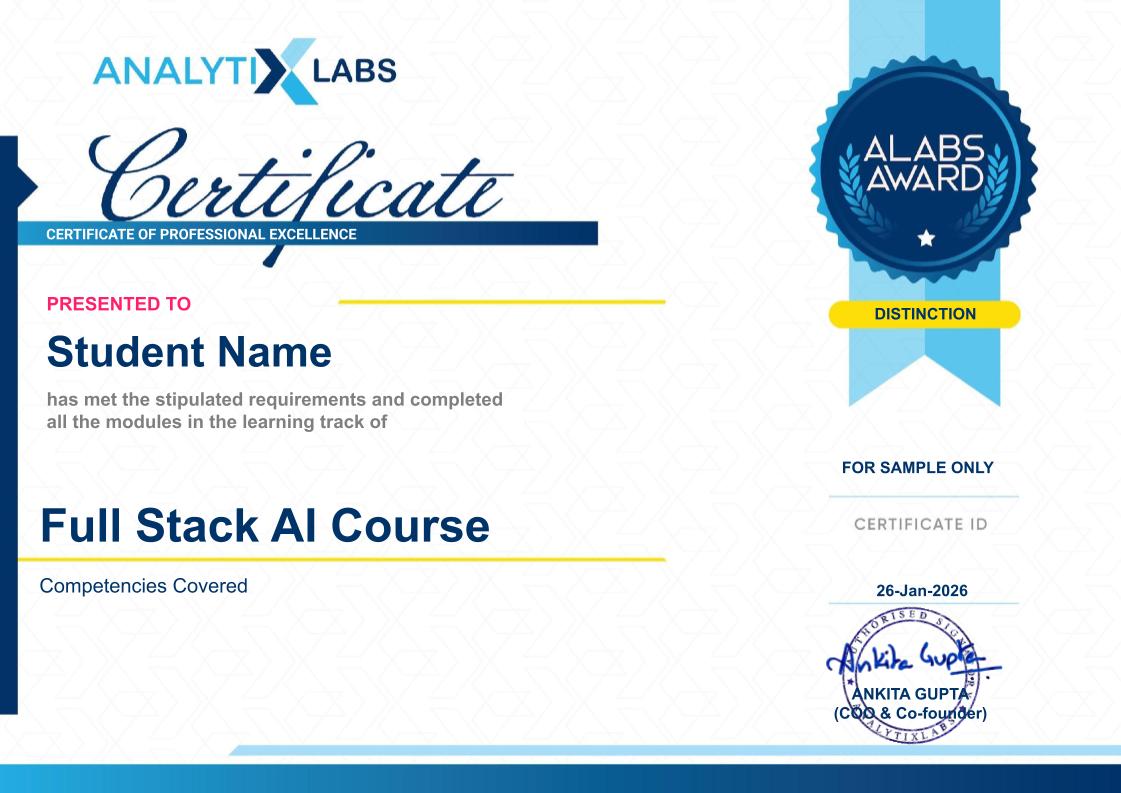
This specialization carries the Advanced Certification in AI Forward Deployed Engineering. Both routes earn it.
You earn it through assessment, not attendance. Each class carries a recap test. The specialization closes with a comprehensive assessment plus a live capstone defense to a subject-matter-expert panel.
At that defense, you demo a working deployment and answer for your design decisions.
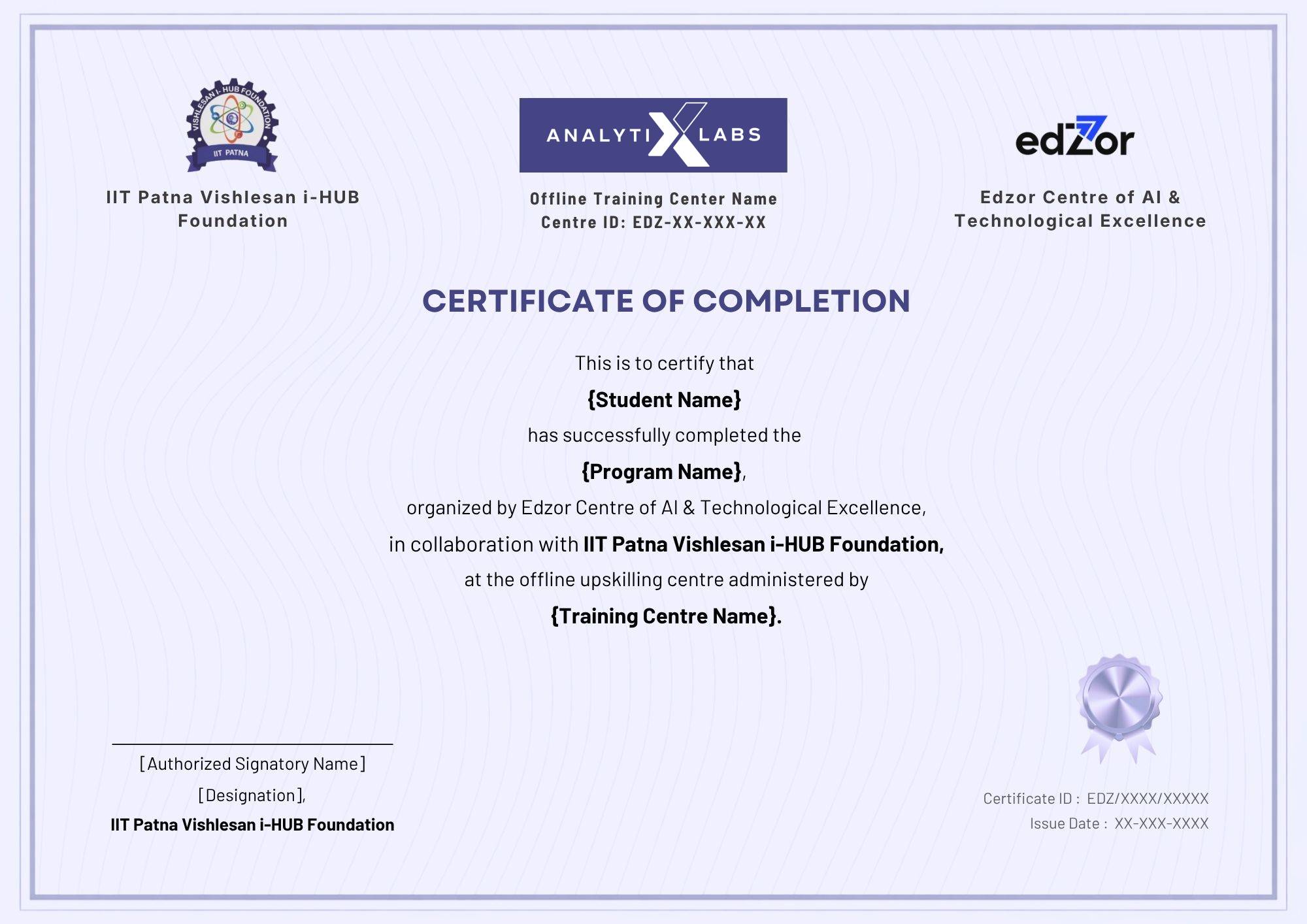
Route 1 carries a second credential on top. The Full Stack Applied AI Course holds dual certification from TIH at IIT Patna. Complete the full program and you earn both.
Route 2 earns the Advanced Certification in AI Forward Deployed Engineering on its own. This is an AnalytixLabs certification, with no external certifying body attached.
Employers hiring for this role screen for evidence of shipped systems. That is why the specialization ends in a defended deployment rather than a written plan.

Placement Support
At AnalytixLabs, we’re committed to helping you build successful careers in AI, Data Science, and Analytics. With comprehensive placement assistance integrated into our certification programs, our dedicated team of industry professionals offers personalized support based on your educational background and work experience. The placement process is designed to equip you with both opportunity and readiness—helping you transition seamlessly into the data-driven workforce.

Resume building and profile review, so your resume and LinkedIn reflect your actual skills and projects the way hiring teams scan for them.

Mock interviews with one-to-one feedback, giving you realistic practice and specific, personal input on what to sharpen.

Interview preparation and a structured placement readiness program that takes you through technical and case-style rounds until you can walk in prepared.
Register Your Interest Now
The syllabus is ready. Cohort dates are not set yet. Registering tells us you want this specialization.
It does not enroll you, hold a seat, or commit you to a payment. You get first access to cohort details once they are scheduled, plus the FDE Role Brief now.
If you want to start on the foundation this specialization builds on, the Full Stack Applied AI Course is open.
How To Apply
select your course, complete the registration form, and make payment.

Submit your application
Submit your application by filling out the form, providing necessary details, and clicking submit to complete the process.

Give a selection test
Take the selection test to demonstrate your skills and knowledge. This will help us assess your readiness for the course.

Reserve your seat
Reserve your seat today to secure your spot in the course. Act fast, as spaces are limited and fill quickly!

Payment
Complete your payment to finalize your enrollment in the course. Choose your preferred payment method and follow the prompts to proceed.
What Students Say About Us?
True Stories, Transformative Career Experience
Piyush Ganar, Class of 2012 IIM Ahmedabad
(Director of Operations, Kenty.AI)
The course material is very easy to understand and the case studies were based on real time business problems. What I love the most about Sumeet and his team is that they never operated the institute like a typical commercial enterprise but more like a temple for learning. The gates of Alabs are always open for students for any kind of help and guidance. I would recommend ALabs to all.
Raajeev Kumar Sahu
(Senior Manager – Data Science, FinTech Startup)
I am from Advance Big Data Science course of Nov 2016 batch. The course was very structured and got real world problems to practice during the final case studies. It has also boosted my skills to start participating in the hackathons. Chandra sir was really helped me in preparing my resume right from very beginning of the course. Also, the placement team was very well organized and connected to industry leaders so that people get the right opportunity right after completing the course. I really recommend this institute, who are interested to transition into analytics field.
Sumit Asthana
(Assistant Manager, Senior Data Scientist)
The rapid pace at which the institutes are mushrooming all over India and Facebook newsfeed being inundated with thousands of options for analytics training, there are only handful of training institutes or rather say only couple of places where they prepare you to foray into rapidly growing analytics vertical. I have been working into legacy systems for past 5 years and was quite apprehensive if I will ever break into data science successfully.
Surbhi Sultania
(Analytics Manager, Mastercard Data & Services)
I took three months Big Data training from Analytix labs. Before joining this course, I had so many questions and doubts that will this course be worthy enough but later I found myself lucky to join this program. All trainers are amazing and always ready to help. Live examples and Case Studies are given which helps in understanding the concept and hands on practice.Not only they help in quality in depth knowledge transfer but also tend to give right direction to your career.
Vibhu Gautam
(Professor of Practice – Computer Science, UPES)
I had been associated with AnalytixLabs since 2012. This has been possible because of the mentor ship and support you get from faculty there specially from Sumeet and Chandra.I did a Business Analytic course with a focus on Marketing Analytic. The course deliver had been great and most importantly you never feel like you are part of formal classroom teaching. You are mentored there at every step, from Code Errors to Understanding Statistics behind it.
Demo & Brochure
Benefits of Demo Account
- Get access to trial sessions to choose the most suitable course.
- SAVE UP TO 40% on specialization learning tracks.
- JOB ORIENTED COURSES crafter and delivered by industry experts.
- INDUSTRY RELEVANT programs with latest curriculum.
Want to see how it works?
Frequently Asked Questions
What does a forward deployed engineer course cover?
This forward deployed engineer training course covers the delivery half of AI engineering across 12 classes. You work through customer discovery and scoping, architecture for a named customer, and solution-design documentation. It also covers enterprise vendor integration, regulated-domain delivery, incident response, and executive demo craft. It closes with a capstone deployment you defend live to a panel.
How long is the forward deployed engineer course?
The specialization runs 12 classes. Ten are taught, and two are dedicated capstone classes, all delivered live. If you take the full learning track, the Full Stack Applied AI Course schedule sits ahead of it.
What are the forward deployed engineer course fees?
The course fees is ₹20,000 for Interactive Live Onlines sessions and ₹15,000 for Blended E-Learning.
Cohort dates are not scheduled yet, so nothing is payable when you register your interest. We send fees and dates together once the first cohort opens.
What are the prerequisites for this course?
There are two routes. If you already build and deploy applied AI systems in production, take Module 4 on its own. If you are earlier in your career, take the full program. That runs 52 classes across four modules and builds the foundation before this specialization begins. Two to five years of engineering experience helps, but it is not a hard requirement.
How is a forward deployed engineer different from an AI engineer?
An AI engineer builds for their own product team, inside a stack their company designed. A forward deployed engineer builds for a named customer, inside systems they inherit. The measure differs too. An FDE succeeds when the customer’s team keeps using what shipped.
Is the forward deployed engineer specialization open for enrollment?
Not yet. The curriculum is complete, but we have not scheduled first-cohort dates. Register your interest, and we will contact you once they are set. The Full Stack Applied AI Course is open and enrolling now, in interactive live online modes.
Does Palantir hire forward deployed engineers in India?
Palantir originated the role and hires for it globally. The company has an India presence, per public company presence in August 2026. We have not verified a specific India-based opening at Palantir. Treat India availability as unconfirmed, not assumed.
What certification do you get after this course?
You earn the Advanced Certification in AI Forward Deployed Engineering from AnalytixLabs. You earn it through assessment, not attendance. That means recap tests, a comprehensive assessment, and a live capstone defense to a subject-matter-expert panel. Complete the full program and you also earn the dual certification from TIH at IIT Patna.
Excited?
Talk to Expert
Counselor
to gain insights into your profile and
strategize your next career move!
