India is no longer just watching the global AI wave from the shore. It is building the infrastructure, training the talent, and deploying the systems that will define how artificial intelligence operates at population scale. The Agentic AI in India's Growth 2026 report by AnalytixLabs maps this transformation across markets, jobs, salaries, and strategy; and the data tells a story that is both exciting and urgent.
Our Agentic AI in India's Growth report examines the rapid rise of agentic AI across India's enterprise, talent, and policy landscape. It maps the full spectrum of India’s agentic AI transformation: market sizing, enterprise adoption realities, job market shifts, in-demand skills, salary benchmarks, and sector-specific use cases.
What's Inside the Report?
Designed for hiring managers, data professionals, career transitioners, and fresh graduates, this report delivers data-backed career pathways and role-specific action playbooks. Its end goal is to equip you with the actionable intelligence needed to navigate and capitalize on India’s evolving agentic AI economy.
Inside the report, you will find -
Overview on the Geo-political situation and India's stand
Agentic AI paradigm
The evolution of AI from rules to autonomy
India's AI market, IT spend, and investments
The Job market transformation: fastest growing AI roles, hiring trends, and gender inclusions
Enterprise adoption: Where India stands in 2026, key challenges, and enterprise to-do's
Agentic AI Skills and Salary insights
Roadmap to building an agentic AI career
Policies and Governance
Future of Agentic AI in India
Role-specific actionable playbooks
The complete Agentic AI in India's Growth 2026 report covers the full agentic AI paradigm and evolution timeline; India's AI market sizing by segment through 2031; the job market transformation with role-specific hiring data; a detailed skills map showing what's rising and what's declining; enterprise adoption realities and case studies; salary benchmarks across eight cities and eight roles; career roadmaps for six distinct professional profiles; India's governance and policy landscape; and a forward outlook through 2030.
Each chapter is designed to translate into immediate, actionable decisions whether you are a CXO evaluating AI investment, a hiring manager building a team, or a professional charting your next career move.
The Skill Shift in India
India occupies a paradoxical position in the global AI talent landscape. On the supply side, the country has 1.3 million AI learners, the largest pool globally, and ranks first in AI skill penetration according to NASSCOM. At the same time, 33% of India’s data science and AI developer talent is aged 18–21, indicating a young and rapidly growing pipeline.
On the demand side, however, the picture is starkly different. India ranks just 89th out of 109 nations in measured AI proficiency.
The installed base of approximately 416,000 AI professionals falls dramatically short of the projected demand for nearly one million by 2026, leaving a 50–55% talent gap that is expected to widen to 53% by end of 2026. Infact, market research reveals that 82% of Indian employers report difficulty filling roles, significantly above the global average of 72% and up from previous years.
Not all skills are ascending. Basic business intelligence, SQL-only data roles, and Hadoop-era big data skills are experiencing oversupply and declining interest from top-tier employers.
The shift is not about these skills becoming irrelevant.
For instance, SQL remains a foundational requirement, but that they are no longer sufficient as standalone qualifications. Pure machine learning hiring is also softening; increasingly, employers seek hybrid profiles that combine traditional ML competence with generative AI and agentic capabilities.
Hiring managers in India have watched the AI skill map change faster than any normal hiring cycle. Between 2019 and 2025 the conversation shifted from data wrangling and batch analytics to model productization, operational resilience, and generative AI.
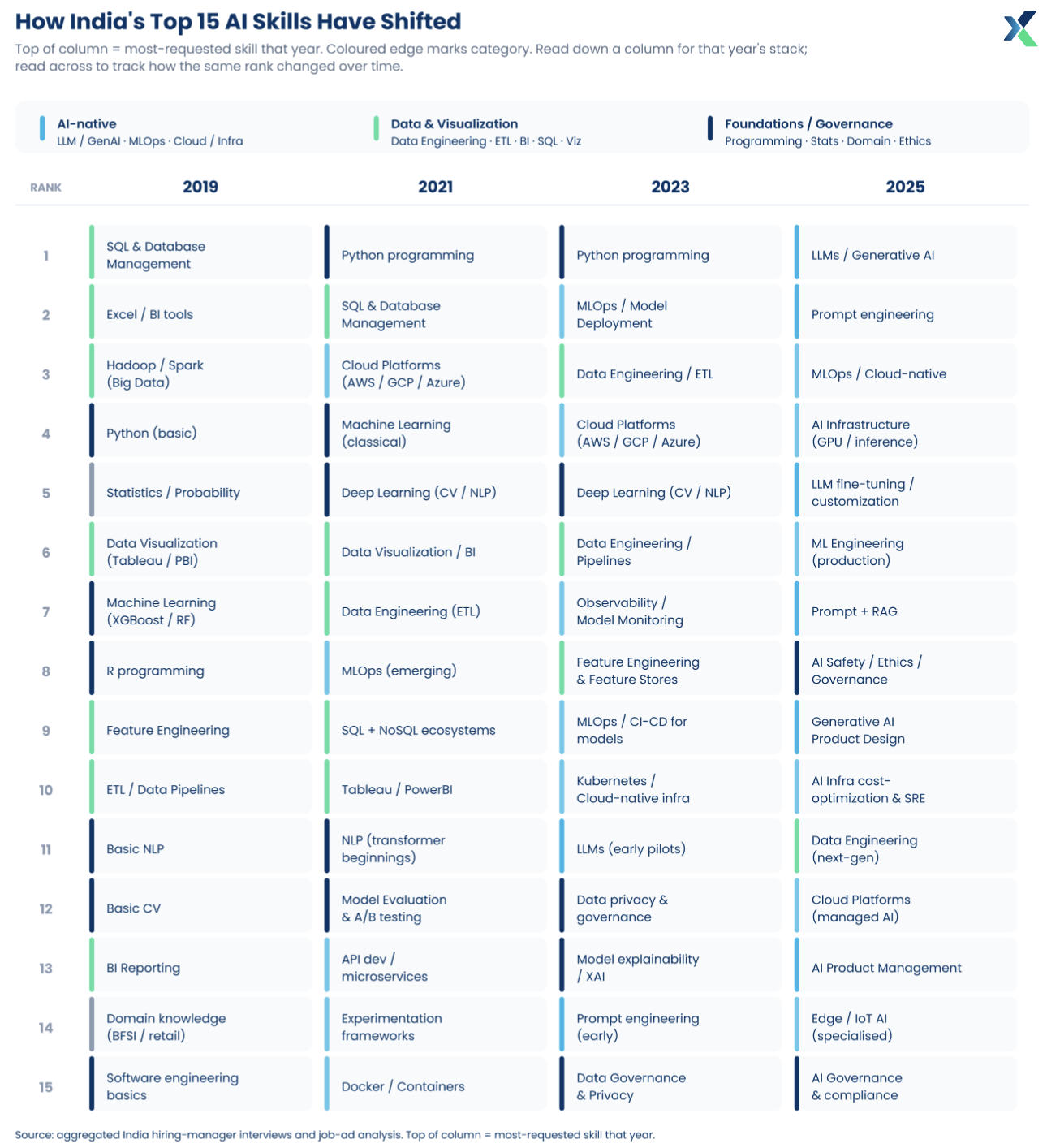
Now, hiring decisions are driven not just by algorithmic knowledge but by the candidate’s ability to deliver models to production, control inference costs, and integrate LLMs into customer-facing products, plus the governance and safety practices that keep organizations out of regulatory trouble.
Key Insights:
Shift from batch/tools → production → generative AI: Early years (2019) emphasized SQL, Hadoop, and BI. By 2021–23, cloud, deep learning and MLOps exploded. By 2024–25 the center of gravity moved to LLMs, prompt engineering, productive GenAI features, and infra-level cost/latency concerns.
MLOps is the bridge skill: MLOps appears as an emerging skill in 2021 and as a core top skill by 2023–25, hiring managers treat it as a differentiators between prototypes and revenue-generating AI.
Ethics & governance climbed the ranks: From near-invisibility in 2019 to a top-15 presence in 2025, reflecting regulatory, compliance and brand-risk drivers.
Classic Big Data (Hadoop) fell back: Skills tied to legacy Hadoop clusters declined as managed cloud services and data lakehouse patterns took over.
The implication for professionals is clear: Foundational data skills remain necessary, but the value premium now accrues to those who layer production AI skills on top of that foundation.
Hiring managers now prioritize systems skills over pure algorithmic novelty. They look for people who can ship, monitor, and cost-optimize models end-to-end.
Governance and observability gained importance as firms recognized the operational, legal and reputation exposures of AI features.
Salary Landscape in India
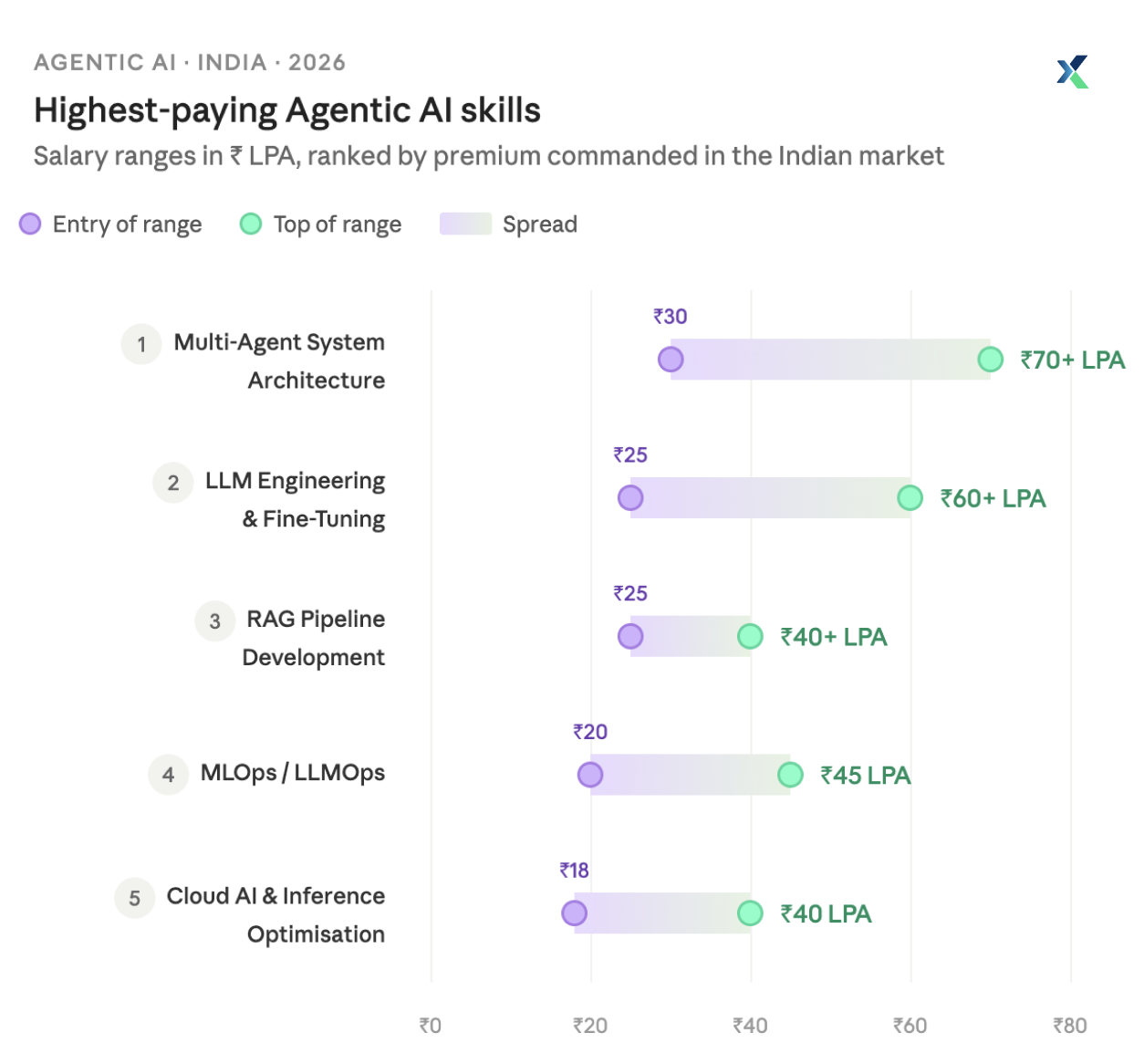
The emergence of agentic AI has not merely added a new specialization to India’s technology workforce. It has fundamentally restructured the relationship between skills, geography, and compensation.
Notably, the “agentic premium” (i.e. the additional compensation commanded by professionals who can architect autonomous AI systems) has emerged as a distinct category, separate from and significantly above standard generative AI roles.
KEY INSIGHT:
The salary ceiling for multi-agent system architects (₹70+ LPA at senior levels) now rivals compensation packages historically reserved for engineering leadership at global MNCs.
This reflects an acute supply-demand imbalance:
LinkedIn India data shows 300%+ growth in agentic AI job postings, while NASSCOM estimates the specialized talent pool covers less than 20% of current demand.
For more insights on how Agentic AI is shaping enterprises, talent, and salary structures in India, download our free report now.
-> Download Agentic AI in India's Growth 2026 Report