Only two years ago, anyone preparing for an agentic AI role would practice answering "what can an autonomous agent do". Fast-forward to 2026, agentic AI interview questions are now more around how capable you are to keep the momentum going even when an agent breaks in production. The questions have moved from theory to tracing logs, cost ceilings, and failure recovery.
We reached out to several hiring managers and stakeholders across multiple industries to understand what kind of questions they are asking for agentic AI job roles. Since AI roles often overlap with one another, we wanted to understand what skills they are looking for, what kind of answers they expect, and what are the core challenges or roadblocks they face when hiring the right talent for such roles.
Let's start rightaway.
Agentic AI Interview Questions (with Answers)
Throughout our conversations with management people across all bands, we discovered the problem was never in "what is the right answer" to a particular question. The real signal sat in how candidates reasoned. It showed in whether they had actually built, broken, and fixed an agent, or only read about one.
Two people can recite the same textbook definition. The difference is how one clearly understands why it matters in production and the other does not. That gap, not the answer itself, decides who will move forward in an interview in agentic ai.
Their biggest roadblock echoed this. Almost every manager told us the same thing. Resumes now list the identical frameworks, so screening for genuine hands-on depth is harder than it has ever been.
The agentic AI interview questions and answers in this guide are built to surface exactly that depth. They are organized by experience band, so you can see what interviewers expect at every stage, and answer in a way that proves you have done the work.
Whether you are chasing your first role or planning your next one, the sections below map every stage of an interview in agentic AI to the experience it expects
We have grouped the questions in four sections: Beginners (0-3yrs experience), Intermediate (4-6yrs experience), Advanced (7-10yrs experience), and stakeholder level (11-15+yrs experience). Why did we do this?
Interviewers scale the same scenario up or down by seniority. A fresher is asked what an agent is. A mid-level engineer is asked why it failed. A senior engineer is asked how to stop it from failing. A stakeholder is asked whether it should have been built at all.
The job title barely existed 24 months ago, so companies rarely find a perfect match. They hire from adjacent pools like backend, MLOps, and machine learning engineering, then test how you reason about autonomy, tools, and risk.
Gartner projects that up to 40% of enterprise applications will include task-specific agents by the end of 2026, up from under 5% at the start of 2024. This demand curve is why interviews reward practitioners who have shipped, not candidates who have only read.
Also Read: Agentic AI Job Roles in India: A Market Analysis Report
Use the map below to place yourself, then jump to your band.
Experience band | Interview centre of gravity | What the interviewer is really testing |
|---|---|---|
0 to 3 years | Fundamentals and vocabulary | Do you understand what an agent is and how its parts fit together? |
4 to 6 years | Trade-offs and debugging | Can you tell why a design fails and choose between options? |
7 to 10 years | Production, cost, and security | Can you make agents reliable, observable, and safe at scale? |
11 to 15+ years | Strategy, governance, and ROI | Should this be built, who owns the risk, and what is the business return? |
Beginners' Agentic AI Interview Questions [0-3yrs Exp.]
What interviewers want?
Interviewers want clean fundamentals and clear vocabulary. Answer agentic AI interview questions directly, define terms on first use, and show that you understand how the pieces connect.
PRO TIP FROM THE HIRING FLOOR “At the entry level, I am not testing whether you memorized definitions. I want to see one agent you actually built, even a rough one, and hear you explain why it failed the first time. A candidate who has debugged their own agent once is worth more to me than one who has watched ten tutorials.” — Head of AI Practice at an Analytics Consulting Firm |
1. What is agentic AI, and how is it different from generative AI?
Answer: Agentic AI describes systems that plan and take actions to reach a goal, using tools, memory, and multi-step reasoning with limited human input. Generative AI simply produces content, such as text or images, in response to a prompt. The difference is autonomy: generative AI answers, while agentic AI acts.
Pro Tip: Add example: Generative AI writes the email, agentic AI reads your inbox, drafts the reply, checks your calendar, and schedules the meeting. The second one loops, decides, and uses external tools.
2. What are the core components of an AI agent?
Answer: An AI agent has four core components:
Reasoning engine (the LLM) that decides what to do next
Planning layer that breaks a goal into steps
Memory store that holds context across steps
Tool interface that lets the agent call external functions, APIs, or databases to act on the world
Pro Tip: Interviewers listen for whether you separate LLM from the system around it. The model is one part; the scaffolding of planning, memory, and tools is what turns a chatbot into an agent.
3. What is the ReAct pattern?
Answer: ReAct stands for Reason and Act. The agent alternates between a reasoning step, where it thinks about what to do, and an action step, where it calls a tool and observes the result. It repeats this loop until it reaches the goal. ReAct made early agents far more reliable than single-shot prompting.
Pro Tip: Say the loop plainly: Thought, then Action, then Observation, then repeat. That sequence is the backbone of most first-generation agent frameworks.
4. What is RAG, and how does it relate to agents?
Answer: RAG, or retrieval augmented generation, fetches relevant documents from a knowledge base and feeds them to the LLM before it answers. This grounds responses in real data and reduces hallucination. In an agent, retrieval becomes one tool among many, and the agent decides when to retrieve rather than retrieving on every query.
Pro Tip: This is one of the most common rag interview questions at entry level. Keep the distinction crisp: basic RAG retrieves once, then generates but an agent can retrieve, reason, retrieve again, and only then answer.
5. What is a tool call, and why do agents need tools?
Answer: A tool call is when an agent invokes an external function, such as a search API, a calculator, or a database query, and uses the result to continue its task. Agents need tools because an LLM alone cannot fetch live data, run code, or change anything. Tools give the agent hands, not just a voice.
6. Python: how do you handle a failed tool call in an agent? (entry level)
Answer: Wrap the tool call in a try and except block, catch the specific error, and return a clear message the agent can reason about instead of crashing.
Pro Tip: At this level, interviewers want to see graceful handling and a sensible fallback, not a silent failure. A minimal, readable version looks like this. Notice the specific exception and the structured return value the agent can act on. You might be asked to input the lines of code. Use the below as a sample.
def call_weather_tool(city: str) -> dict:
    try:
        response = weather_api.get(city, timeout=5)
        return {"ok": True, "data": response.json()}
    except requests.Timeout:
        return {"ok": False, "error": "timeout"}
    except requests.RequestException as e:
        return {"ok": False, "error": str(e)}
Python interview questions at this band stay practical. You are not writing an orchestration engine yet. You are showing that your code fails loudly, returns something usable, and never leaves the agent guessing.
Also Read: How Python-powered AI Agents are Transforming Business Decision-Making.
What to learn before a beginner agentic AI interview
Python fundamentals: functions, classes, type hints, and clean error handling.
LLM basics: prompts, tokens, context windows, temperature, and why models hallucinate.
One agent framework end to end: LangChain or LangGraph, built into a small working project.
RAG basics: embeddings, vector stores, chunking, and semantic search.
The ReAct loop and simple tool use, demonstrated in a project you can walk through.
Intermediate Agentic AI Interview Questions [4 to 6 Yrs Exp.]
Here agentic AI interview questions turn from what to why and when. Interviewers stop rewarding definitions and start rewarding judgement. You can expect trade-off questions, debugging scenarios, and one or two red-flag traps.
PRO TIP FROM THE HIRING FLOOR “My favorite screening question is simple. Your agent approved something it should not have. Walk me through the trace. Where do you look first, retrieval, the tool call, or the reasoning? Candidates who have never read an agent trace loose me in the first two minutes.” — Senior VP of Engineering at a Digital Lending Platform |
Let's go.
7. When would you NOT use a multi-agent system?
Answer: You avoid a multi-agent system when the task is linear, well defined, and completable by a single agent with the right tools. Multiple agents add latency, cost, coordination overhead, and new failure points. Use them only when subtasks are genuinely parallel or need distinct, specialized roles.
Pro Tip: This is a deliberate trap. Reaching for a crew of specialized agents on a simple workflow is one of the fastest ways to fail an intermediate interview. It signals that you learned agents from tutorials, not from production. Name the costs first, then justify the complexity only if it earns its place.
8. How do you debug an agent that produces a wrong result?
Answer: You start with the execution trace, not the final output. Read each step in order: the reasoning, the tool call, the tool input, and the observation returned. Find the first step where the agent diverged. Most agent failures trace back to a bad tool result or a retrieval step that returned the wrong context, not to the model itself.
Pro Tip: Interviewers want to hear you look at retrieval, tool inputs, and reasoning in sequence. Candidates who say they would just tweak the prompt reveal that they have never debugged an agent in anger.
9. How do you handle a tool call that fails with a rate-limit error?
Answer: You retry with exponential backoff and jitter, cap the number of retries, and fall back to an alternative tool or a graceful degradation path if retries are exhausted. A blind, immediate retry makes the rate limit worse. The goal is resilience without hammering the failing service.
Pro Tip: A clean implementation shows the backoff, the cap, and the fallback. This exact scenario separates bands, so make the intent obvious in your code.
import time, random

def call_with_backoff(fn, max_retries=4, base=1.0):
    for attempt in range(max_retries):
        try:
            return fn()
        except RateLimitError:
            if attempt == max_retries - 1:
                raise
            sleep = base * (2 ** attempt) + random.uniform(0, 0.5)
            time.sleep(sleep)   # exponential backoff with jitter
10. Python question: how do you run multiple tool calls concurrently?
Answer: You use asyncio to run independent tool calls concurrently with asyncio.gather, so the agent does not wait for each call in series. Concurrency matters when an agent needs several independent lookups, because it cuts total latency from the sum of all calls to the slowest single call.
Pro Tip: The detail that impresses: return_exceptions=True. It shows you have thought about what happens when one of five concurrent calls fails.
import asyncio

async def gather_context(queries: list[str]) -> list[dict]:
    tasks = [search_tool(q) for q in queries]
    return await asyncio.gather(*tasks, return_exceptions=True)

# return_exceptions=True keeps one failed call
# from cancelling the rest
11. What is agentic RAG, and how is it different from naive RAG?
Answer: Naive RAG retrieves once and generates an answer in a single pass. Agentic RAG lets the agent decide whether to retrieve, reformulate the query, retrieve again, and validate the result before answering. Agentic RAG handles multi-hop questions and catches cases where the first retrieval returned nothing useful.
Pro Tip: A strong follow-up point is that retrieval can fail silently. The vector store returns the closest chunks even when none are actually relevant. Agentic RAG adds a relevance check so the agent notices bad context instead of confidently building an answer on top of it.
12. How do you evaluate an agent before shipping it?
Answer: You build an evaluation set of representative tasks with known good outcomes, then measure task success rate, tool-call accuracy, cost per run, and latency. You supplement automated checks with an LLM-as-judge for open-ended outputs and a human review sample. You never ship an agent whose only test is that the demo worked once.
What to learn to move from beginner to intermediate
Async Python, concurrency, and robust retry patterns with backoff.
Observability: reading traces in tools such as LangSmith, and logging every step.
Evaluation frameworks: building test sets, scoring, and LLM-as-judge patterns.
Agentic RAG: query rewriting, re-ranking, and relevance validation.
Cost and latency awareness: knowing what each model call and tool call costs you.
Advanced Agentic AI Interview Questions [7 to 10yrs Exp.]
At the senior band, interviewers pick a few agentic AI interview questions and drill deep. They want architecture diagrams, war stories, and clear reasoning about reliability, cost, and security at scale. Vague answers will end the interview before you know.
PRO TIP FROM THE HIRING FLOOR “Every senior candidate now gets one prompt injection question. If they cannot describe an indirect injection attack without me prompting them, they are not ready to secure an agent, let alone hand it tools and production access.” — CISO at a managed security services provider |
13. How do you design memory for a long-horizon agent?
Answer: You separate memory into short-term working context and long-term persistent memory. Short-term memory holds the current task and recent steps within the context window. Long-term memory stores facts, past interactions, and learned preferences in an external store, retrieved on demand. The hard part is deciding what to write, what to summarize, and what to forget, because context windows and cost both have limits.
Pro Tip: Strong answers name specific strategies: summarization of old turns, vector retrieval of relevant memories, and explicit state objects for task progress. Weak answers assume the whole history fits in the prompt.
14. How do you optimize cost across thousands of agent calls?
Answer: You route each step to the cheapest model that can handle it, cache repeated calls and retrievals, trim context aggressively, and cut unnecessary reasoning loops. You measure cost per successful task, not cost per call, because a cheaper model that fails and retries is more expensive overall. Model routing and caching usually deliver the largest savings.
Pro Tip: Interviewers reward candidates who have watched a bill grow. Mention token budgets, semantic caching, and using a small model for classification and a large model only for hard reasoning.
15. How do you make an agent observable in production?
Answer: You instrument every step with structured tracing that captures the reasoning, tool inputs, tool outputs, latency, and cost. You add alerting on failure rates, latency spikes, and cost anomalies. You keep replayable traces so you can reproduce any bad run. Without full traces, debugging a non-deterministic agent in production is guesswork.
16. You give an agent read access to email and a web-browsing tool. Describe an attack.
Answer: This is an indirect prompt injection. An attacker sends an email or plants a web page containing hidden instructions. When the agent reads that content, it treats the injected text as a command and may leak data, send messages, or misuse other tools. The defence is to treat all retrieved content as untrusted data, never as instructions, and to constrain tool permissions.
Pro Tip: If you cannot describe indirect prompt injection unprompted at this band, you are not ready to secure agents. Follow up with defences: least-privilege tool access, output validation, human approval for sensitive actions, and sandboxing anything that touches money or production systems.
17. How do you design human-in-the-loop checkpoints?
Answer: You insert human approval at points where an action is irreversible, high cost, or high risk, such as sending money, deleting data, or contacting a customer. Low-risk, reversible steps run autonomously. The design principle is that autonomy should scale down as the cost of a mistake scales up.
18. How do you recover from partial failure in a multi-agent workflow?
Answer: You make each step idempotent, checkpoint state after every completed step, and design the workflow to resume from the last good checkpoint rather than restarting. You add compensating actions to undo partial work when a step cannot complete. The goal is that a failure at step four never forces you to redo steps one through three or leave the system in a broken state.
What to learn to reach the advanced band
|
Stakeholder-Level Agentic AI Questions [11 to 15+ yrs Exp.]
At leadership level, the code fades and the judgement takes over. These agentic AI interview questions test whether you can decide what to build, own the risk when it goes wrong, and connect agentic AI to business outcomes. Interviewers here are peers, founders, and boards.
PRO TIP FROM THE HIRING FLOOR “At this level I don't want to ask what an agent can do. I ask what it should never be allowed to do on its own. The people who answer that clearly, before I raise it, are the ones I trust to own a roadmap and a budget.” — Chief Product and Technology Officer at a travel platform |
19. How do you decide whether agentic AI is the right investment for a business problem?
Answer: You start from the problem, not the technology. Agentic AI fits when a task is repetitive, involves multiple steps and tools, has a tolerance for occasional error, and carries enough volume to justify the build and governance cost. If a simple workflow or a single model call solves it, agents are the wrong choice. You weigh expected value against build cost, failure cost, and ongoing oversight.
Pro Tip: Leaders who pass this question talk about opportunity cost and total cost of ownership, not model capability. They can say no to an agent project confidently.
20. How do you govern autonomous agents in a regulated industry?
Answer: You put a governance framework around every agent: clear autonomy boundaries, mandatory audit trails, human approval for regulated actions, and documented accountability for each decision. You align agent behaviour with the same compliance rules that bind human employees. In finance, healthcare, and similar sectors, an unauditable agent decision is a liability, not a feature.
Pro Tip: Did you know? Deloitte's enterprise research found that the AI skills gap is seen as the single biggest barrier to adoption, and that only about one in five organizations has a mature governance model for autonomous agents. That gap is exactly what leadership interviews probe. They want someone who brings governance thinking rather than waiting for policy to catch up.
21. An agent makes a costly mistake in front of a customer. Whose fault is it?
Answer: Accountability sits with the organization that deployed the agent, and specifically with the design of its autonomy boundaries and guardrails. Blaming the model is not an acceptable answer. The right response examines whether the agent should have had that authority, whether a human checkpoint was missing, and how the guardrail design allowed the action. Ownership is a design decision made before deployment, not a search for blame after.
22. How do you hire and build a team for a role that barely exists?
Answer: You hire for reasoning and adaptability over a fixed tool list, because the frameworks change every few months. You recruit from adjacent pools such as backend, MLOps, and machine learning, then upskill them on agent-specific patterns. You value one strong production project over a long list of tutorials. You design interviews around failure-mode scenarios, not framework trivia.
Pro Tip: This mirrors the market reality. Only a few thousand professionals worldwide have genuine hands-on agentic AI development experience. That scarcity is why smart teams choose to hire agentic AI potential and train for it, rather than waiting for a finished expert who may not exist yet.
23. How do you measure the ROI of an agentic AI initiative?
Answer: You define success metrics before you build: tasks automated, hours saved, error rate versus the human baseline, and cost per completed task. You track adoption and the cost of oversight, because a technically successful agent that no one trusts delivers no return. ROI is the value of automated work minus build, running, and governance costs, measured against the human baseline it replaced or augmented.
24. Where do you refuse to let an agent act autonomously?
Answer: You refuse autonomy wherever a mistake is irreversible, unbounded in cost, or legally binding without recourse. Examples include executing large financial transactions, deleting production data, making medical or credit decisions without review, and any on-chain action that cannot be undone. In those cases you design kill switches, spend limits, and simulate-before-execute checks by default.
What to learn to operate at stakeholder level
|
Want to lead the AI transformation? We have two learning programs that can help you build teams and govern agents with confidence, respectively.
FullStack AI Course : You will gain Applied AI Mastery in GenAI, Computer Vison & Deep Learning.
AI for Managers & Leaders : It is a comprehensive program built on core AI management concepts and their diverse applications across multiple industries and domains.
AI Skills to Learn at Each Experience Band
Use this as a quick self-audit. If you cannot confidently claim the skills in your band, then you have identenfied your study list before the next agentic AI interview.
Band | Core skills to own | The skill that unlocks the next band |
|---|---|---|
0 to 3 yrs | Python, LLM basics, one agent framework, RAG fundamentals, ReAct loop | Reading and debugging an agent trace |
4 to 6 yrs | Async Python, evaluation, agentic RAG, observability, cost awareness | Designing for failure and naming trade-offs |
7 to 10 yrs | Memory design, cost engineering, security, reliability patterns, multi-agent orchestration | System design that stops incidents before they page anyone |
11 to 15+ yrs | Governance, ROI modelling, risk and autonomy design, team strategy | Deciding what not to build |
Agentic AI Jobs and Growth Map Across Experience Bands
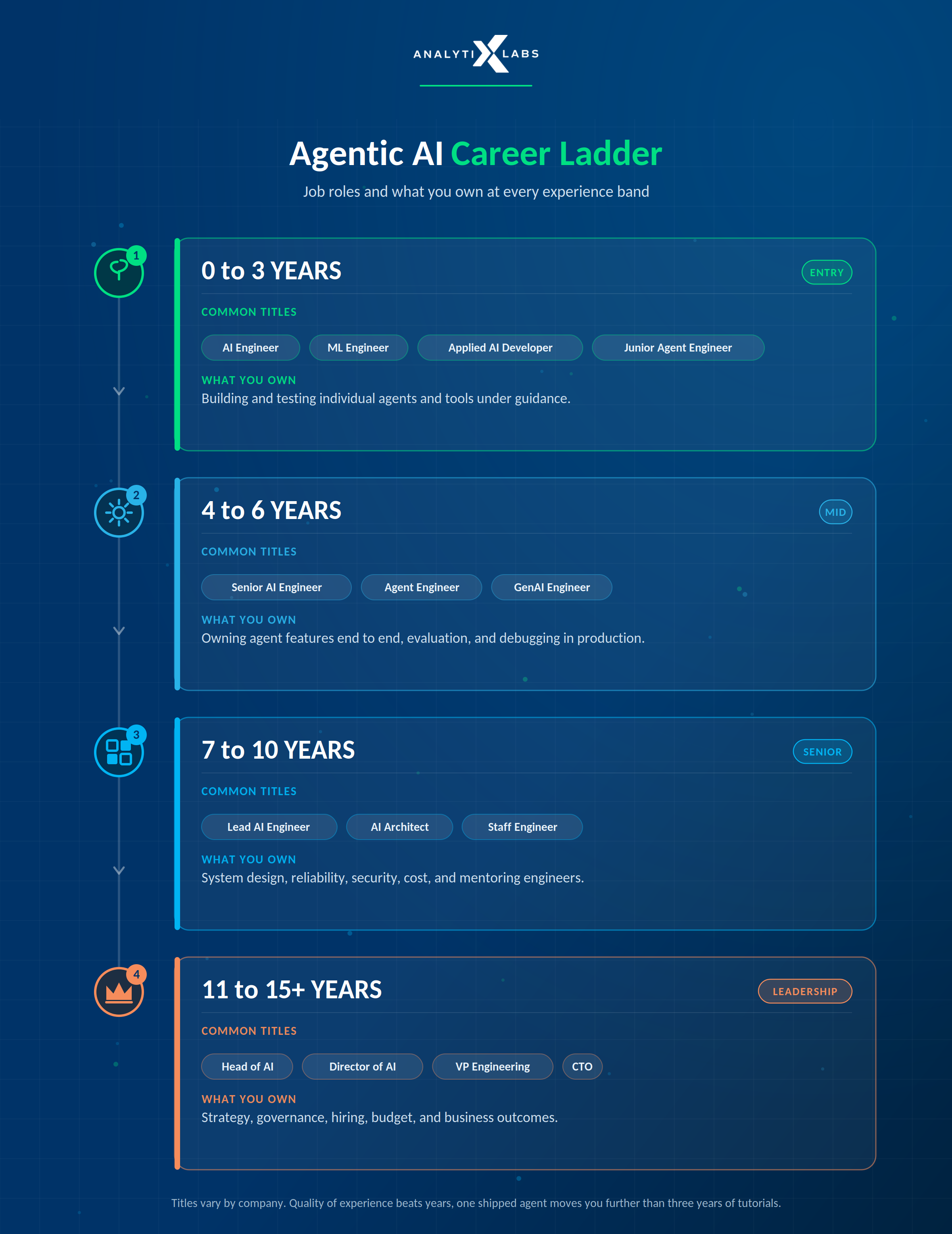
An agentic AI career typically progresses from AI or ML engineer, to senior or agent engineer, to AI architect or lead, to head of AI or CTO. Titles vary by company, but the responsibility shifts predictably. You move from building agents, to making them reliable, to deciding which agents a business should run at all.
Agentic AI jobs are multiplying as enterprise adoption climbs, and each agentic AI job role carries a different centre of gravity. The map below shows what you own at every stage, so you can see where a job in agentic AI leads next.
Things to keep in mind:
The bands blur, because a strong three-year engineer with a real production project can interview at the intermediate band.
The quality of experience beats years. One shipped, defended, failure-tested agent moves you further than three years of tutorials.
How Agentic AI Salaries Are Evolving Across Indian Cities?
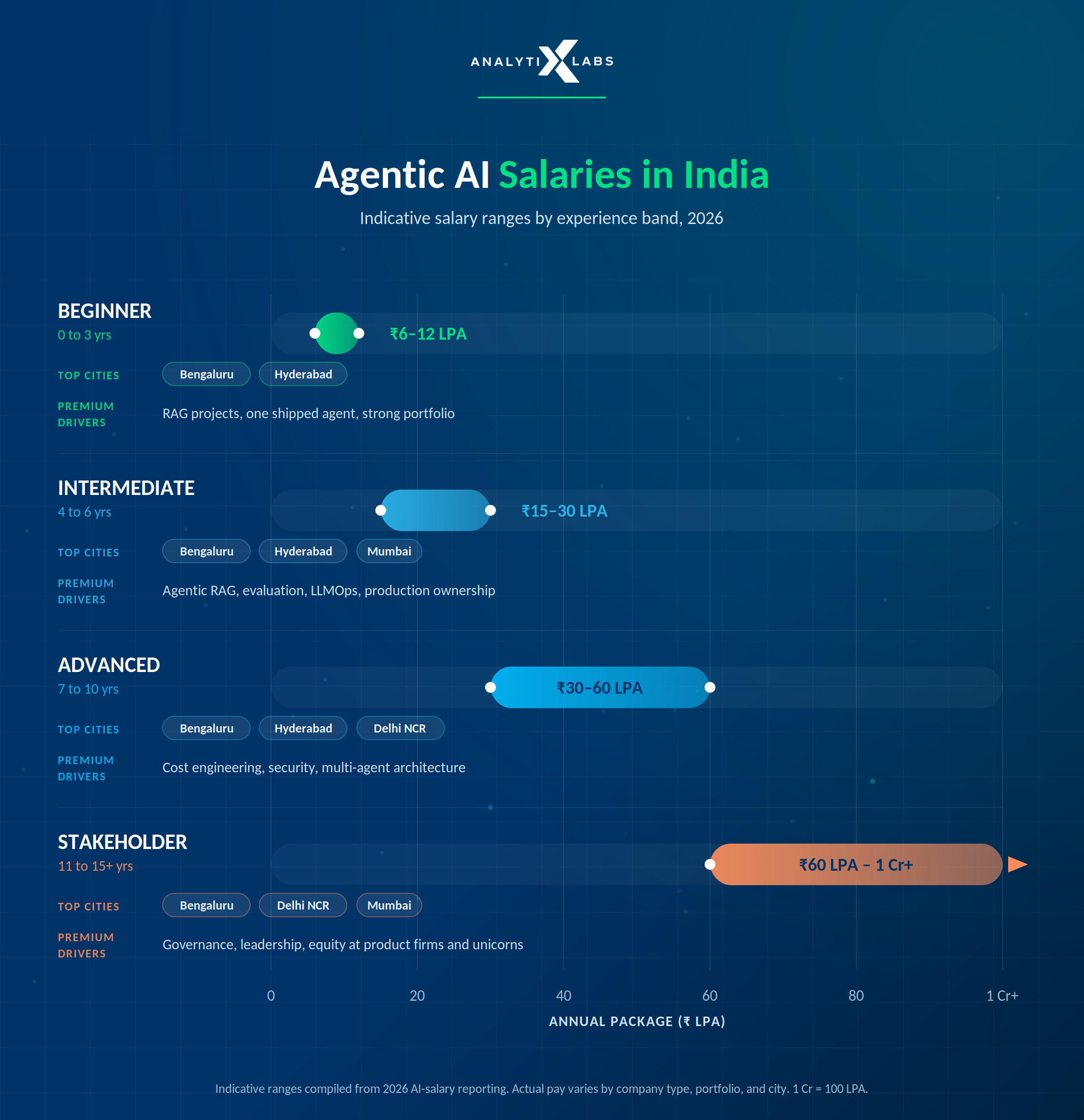
Agentic AI salaries in India broadly track AI engineer pay, with a premium for LLM, RAG, and agent skills. Freshers earn roughly 6 to 12 LPA, mid-level engineers 15 to 30 LPA, and senior engineers 30 to 60 LPA, with principal and leadership roles crossing 80 LPA at top firms. In terms of cities, Bengaluru and Hyderabad pay the highest, ahead of Pune and Chennai.
Agentic AI is too new to have clean, isolated salary data, so these ranges are indicative and drawn from 2026 AI engineer compensation reporting. Multiple sources point the same way:
Engineers with hands-on LLM fine-tuning, RAG, or LLMOps experience command a premium of roughly 20 to 40% over generalist ML engineers. Agent-specific skills sit inside that premium band and are among the fastest growing in the market.
This is why agentic AI jobs increasingly outpay generalist roles at the same experience level.
Band (experience) | Indicative range | Top-paying cities | Skill premium drivers |
|---|---|---|---|
Beginner (0 to 3 yrs) | 6 to 12 LPA | Bengaluru, Hyderabad | RAG projects, one shipped agent, strong portfolio |
Intermediate (4 to 6 yrs) | 15 to 30 LPA | Bengaluru, Hyderabad, Mumbai | Agentic RAG, evaluation, LLMOps, production ownership |
Advanced (7 to 10 yrs) | 30 to 60 LPA | Bengaluru, Hyderabad, Delhi NCR | Cost engineering, security, multi-agent architecture |
Stakeholder (11 to 15+ yrs) | 60 LPA to 1 crore+ | Bengaluru, Delhi NCR, Mumbai | Governance, leadership, equity at product firms and unicorns |
Ranges are indicative, not offers. Actual pay depends on company type, portfolio, and negotiation.
Product companies and GCCs pay well above service firms at every band.
The single biggest lever is a strong, defensible project, followed by in-demand skills, then city.
City patterns are worth knowing. Bengaluru pays the highest average AI salaries, followed by Hyderabad, which offers comparable senior pay with a lower cost of living and stronger real purchasing power. Mumbai adds a fintech premium of roughly 35 to 50% for financial AI roles. Pune and Chennai sit below Bengaluru and Hyderabad on the ceiling, though the gap narrows with strong specialization.
For more details, download our detailed market analysis report on Agentic AI Jobs in India (and more such reports) that dissects, compares, and analyzes how roles, salaries, and demands have changed in the last five to seven years.
Frequently Asked Questions
How do I prepare for an agentic AI interview?
Build one production-style agent that plans, uses tools, and recovers from failure. Prepare specific stories about what broke and how you fixed it. Review traces, evaluation, cost, and prompt-injection basics. One defended project beats ten tutorial chatbots.
What agentic AI interview questions are asked for freshers?
Freshers face fundamentals: what an agent is, how agentic AI differs from generative AI, the core components of an agent, the ReAct loop, and basic RAG. Interviewers weigh a working project more heavily than years of experience.
Do agentic AI interviews include Python coding?
Yes, but scoped to agent work. Expect async tool calls, error handling with retries and backoff, structured tool schemas, and debugging a LangChain or LangGraph workflow. Clean, resilient code matters more than clever code.
How are gen AI and agentic AI interview questions different?
Gen AI interview questions test prompting, model behaviour, and hallucination handling. Agentic AI questions add planning, tool orchestration, memory, and autonomy boundaries. Agentic interviews focus on what happens when the system acts, not just what it generates.
Which frameworks should I know for agentic AI interviews?
Know LangChain and LangGraph well, and be familiar with CrewAI and AutoGen. Interviewers care far more about your trade-off reasoning, such as when to use a single agent versus many, than about loyalty to any one framework.
Turn Interview Prep Into a Career in Agentic AI
Every interview in agentic AI rewards the same thing. Interviewers back people who have built, broken, and fixed real agents. Reading gets you vocabulary. Shipping gets you offers.
Building a career in agentic AI starts with one defensible project. If you want structured, project-led training that maps to exactly these bands and prepares you for a job in agentic AI, explore the AnalytixLabs Agentic AI course and build the portfolio that interviewers ask to see.