Updated on 21 September 2026.
John McCarthy is the father of AI. The American computer scientist coined the term artificial intelligence in a 1955 funding proposal. He then organized the 1956 Dartmouth conference, the event that founded the field. Alan Turing shares the credit for asking, in 1950, whether machines could think at all.
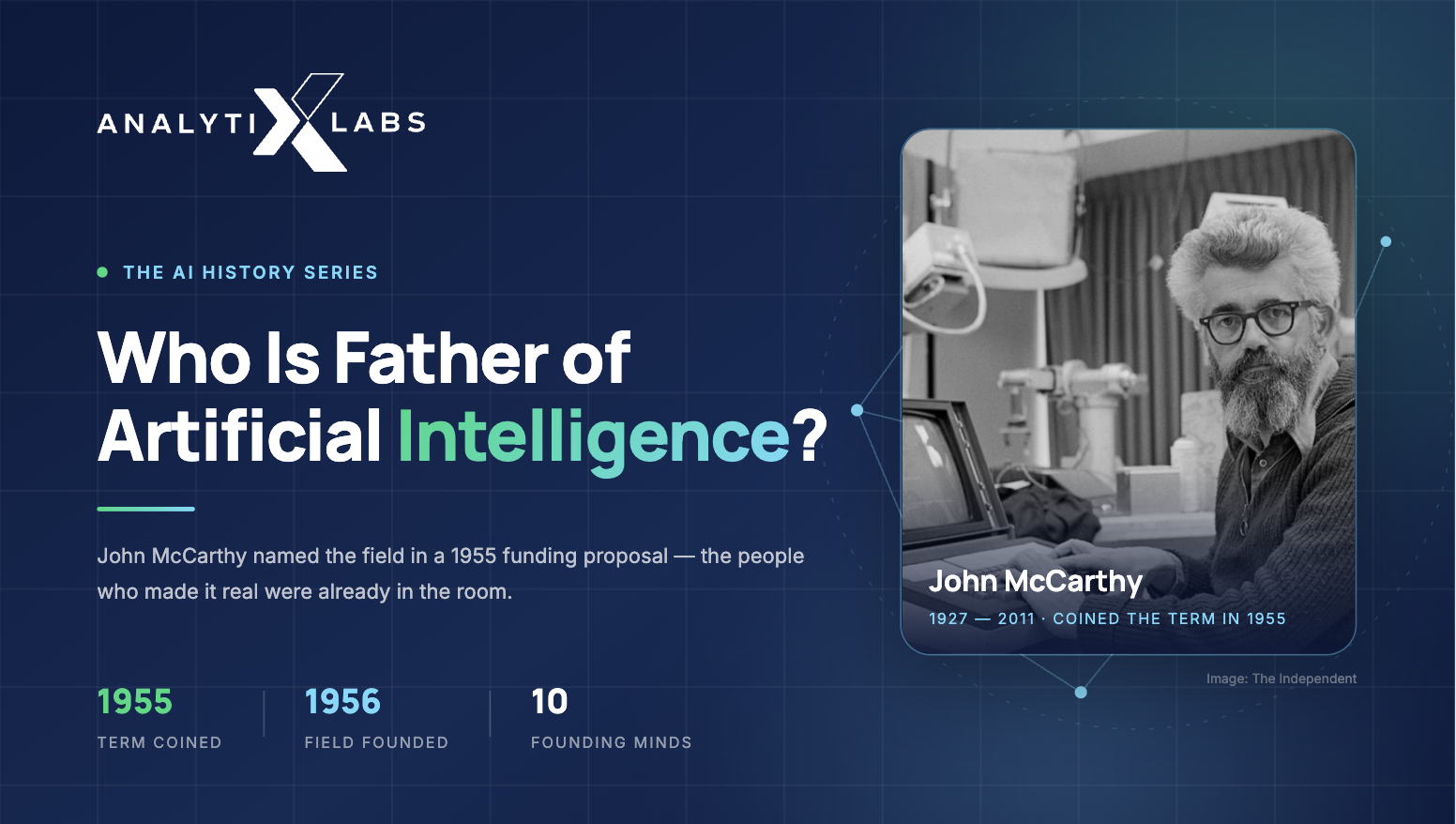
Artificial Intelligence is everywhere. From robots serving food to vibe coding to handling complex business challenges, we use AI in everything. But this article isn't about how glued we are to what AI will do next. Rather, we go back in history to see where it all began, asking the most basic question: who is the father of AI? Who founded AI, the tech that we can't think of doing without?
Often, this question leads to two names: Alan Turing and John McCarthy, and both answers hold up. Ask who is known as the father of AI, and almost every source returns John McCarthy. He coined the term in 1955 and then organized the Dartmouth conference that turned scattered ideas into a named discipline.
Alan Turing also carries a version of the title. Turing asked whether machines could think in 1950, which was six years before the field had a name. So the honest answer depends on what you mean by "father," because one man imagined the field while the other named it and built its tools.
This article settles the question properly and does justice to both names. We give you the reasoning behind each claim, the documented history that supports it, and the part most articles skip entirely: what McCarthy actually built, and why several of his inventions are still running inside tools you used this week. Let's start.
Why is John McCarthy the Father of AI?
McCarthy was born in Boston in 1927. He completed his undergraduate degree at Caltech in 1948 and earned his mathematics doctorate at Princeton in 1951. His interest started at a symposium on cerebral mechanisms and human behavior. One question stayed with him: Can a machine learn? In August 1955, McCarthy co-wrote a funding proposal with three collaborators - Marvin Minsky, Nathaniel Rochester, and Claude Shannon- who signed it with him.
The document requested support for a two-month study at Dartmouth College. It used the phrase "artificial intelligence" in print for the first time. The proposal made one specific bet - You could describe every aspect of learning precisely enough for a machine to simulate it. That claim founded the field; a claim that still frames the debate seventy years later.
The workshop ran through the summer of 1956 in Hanover, New Hampshire. Around ten researchers attended, though the group shifted week to week. No single breakthrough emerged, but the value sat in the name and the network.
What emerged instead was a field. Allen Newell and Herbert Simon turned up with Logic Theorist, a program that proved theorems from Principia Mathematica and is usually called the first working AI program. More consequentially, the people in that room spent the following three decades running the laboratories that defined the discipline: McCarthy at MIT and later Stanford, Minsky at MIT, and Newell and Simon at Carnegie Mellon.
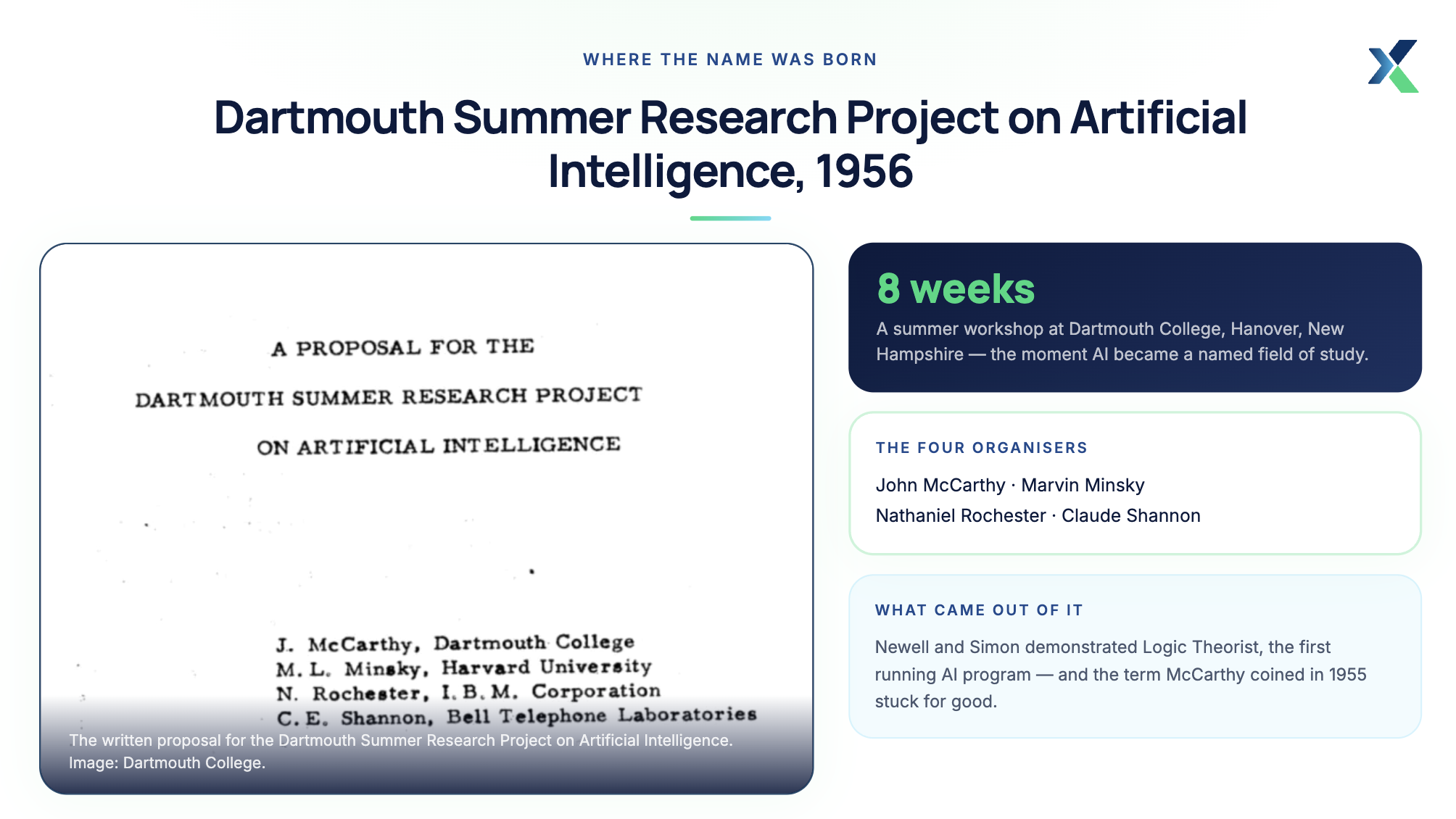
The conference did not produce results, but it produced the institutions that did, which turned out to matter more.
Why The Name Stuck with McCarthy?
It is tempting to read "he only came up with the name" as a minor contribution beside Turing's theoretical work. That reading badly underestimates what naming does to a research area.
Before a field has a name, it cannot accumulate. You cannot apply for funding in a category that does not exist, hire into a department with no title, or tell a graduate student what they are enrolling in. Work still gets done, but it scatters across neighboring disciplines and gets judged by their standards, so nothing compounds.
The moment McCarthy's phrase entered circulation, there was suddenly a thing to fund or defund, join or leave, attack or defend. Naming the field gave it a history.
Secondly, McCarthy did not stop at the name. He wrote the founding document, assembled the founding group, and convened the founding event, which meant the label arrived attached to specific people and a specific agenda rather than floating free for anyone to claim.
The third reason is the most practical. A research field needs a substrate to work in, and McCarthy built it. LISP served as the working language of AI for roughly four decades, which means that for two generations of researchers, doing AI and writing LISP were close to the same activity.
Turing did none of these three things, and the reason is chronological rather than dismissive. He died in June 1954, two years before the Dartmouth conference and a year before the proposal that named the field.
The institutional founding of AI happened inside a window he did not live to see. That is why the argument over the title isn't really about merit. It is a disagreement about whether "father of the field" means the person who made the field thinkable or the person who made it exist.
Alan Turing or John McCarthy - Who is Really The Father of AI?
The distinction deserves to be taken seriously, because the case for Turing is strong on its own terms. His contribution was to convert an unanswerable question into a researchable one, which is a harder and rarer achievement than it sounds.
What were Alan Turing's Contributions?
In 1936, in a paper on computable numbers, Turing described a machine capable of carrying out any procedure that could be specified as a finite set of rules. The significance of this universal machine for AI is easy to miss. It showed that no special category of hardware is reserved for special categories of thought. According to him, if reasoning could be written down as a procedure, an ordinary computer can in principle carry it out. Every later argument about machine intelligence starts from that premise.
The 1950 paper did something different and arguably braver. "Can machines think?" cannot be settled, because the answer turns entirely on what you are willing to call thinking. Turing's move was to refuse the question and substitute a test. If a human interrogator cannot reliably tell a machine's written responses from a person's, the original question had already lost its practical force.
Regardless of how one views the imitation game as a benchmark, and despite valid criticisms, that substitution turned a philosophical debate into an experimental one. A research field depends on making that transition.
So, when you ask who is considered the father of artificial intelligence, the academic answer is McCarthy, because the question is normally read as asking who founded the discipline. Ask who is the father of AI in the wider sense of who made the idea legitimate, and Turing has the better claim.
Alan Turing | John McCarthy | |
|---|---|---|
Lifespan | 1912 to 1954 | 1927 to 2011 |
Usual title | Father of computer science and machine intelligence | Father of artificial intelligence |
Landmark work | "Computing Machinery and Intelligence", 1950 | Dartmouth proposal 1955, conference 1956 |
Core contribution | Made machine intelligence a testable question | Named the field and set its research agenda |
Lasting tool | The Turing test | LISP, garbage collection, time-sharing |
Recognition | Fellow of the Royal Society, 1951. The ACM Turing Award carries his name. | ACM Turing Award 1971, Kyoto Prize 1988, National Medal of Science 1990 |
Why Does the Confusion Exist?
Both conventions are correct inside their own literature, and neither community bothers to flag which one it is using. A computer science textbook calling Turing the father of computer science and a history of AI calling McCarthy the father of artificial intelligence don't contradict each other at all.
Trouble only starts when a source uses one title while meaning the other, which happens more often than it should, particularly in material written quickly for search traffic. If you are citing either claim, check which sense the source intends before you repeat it.
Five McCarthy Inventions We Still Use Today
Titles are the least interesting part of McCarthy's record. The stronger argument for his standing is that you are almost certainly running his work right now, usually without knowing whose it is.
1. LISP, 1958
Fortran, released in 1957, was built to calculate. It handled numbers well and treated a program as a fixed sequence of instructions operating on data. McCarthy needed something else, because symbolic AI does not primarily compute over numbers. It manipulates expressions: logical statements, rules, plans, and sentences whose structure matters as much as their contents.
That requirement drove three design decisions that still define the language.
Lists became the core data structure, because an expression tree is naturally a nested list.
Recursion became the primary control structure, because processing a nested structure means handling its parts the same way you handled the whole. Most consequentially, LISP represented programs using the same list structures it used for data, so a LISP program can build, inspect, and rewrite other programs while running.
The last property is why LISP became the AI language rather than merely an AI language. A field trying to build systems that reason about their own behavior needs one in which code is just another thing the code can handle.
PRACTITIONER'S NOTE Write a list comprehension in Python or map over an array in JavaScript, and you are using LISP inheritance. Clojure and Emacs Lisp descend from it directly. The language turns 68 this year and still ships in production systems. |
2. Garbage Collection, 1959
LISP created a problem Fortran never had to face. In numeric code you generally know at the time of writing how long a piece of memory needs to live. In symbolic code you frequently cannot, because the structures a program builds depend on the data it meets, and how long they stay reachable depends on what it decides to do next.
Manual memory management asks the programmer to know when something is dead. McCarthy's answer, published in 1959, was to stop asking. The runtime periodically works out which objects the program can still reach from its active references, then reclaims everything else. You allocate freely and never explicitly free.
PRACTITIONER'S NOTE Python, Java, Go, and JavaScript all ship garbage collectors. Every time you skip a manual free() call, you are relying on a 1959 idea. |
3. Time-Sharing and Utility Computing, 1959 to 1961
Computers in the 1950s cost millions and ran one job at a time. You submitted your program as a deck of cards, waited hours for a batch run, and often got back a printout telling you only that there was a syntax error on line 40.
For AI work, this was close to fatal, because that kind of research is iterative. You try something, watch what the program does, and adjust. Stretch that feedback loop to several hours, and it stops functioning as a loop.
McCarthy observed that a person at a terminal spends most of their time thinking and typing rather than consuming processor cycles. Interleave enough users, and each one gets the illusion of a dedicated machine while the expensive hardware stays busy. He argued this at MIT from 1959, and it led to the Compatible Time-Sharing System, with the Dartmouth and BBN systems following.
He then pushed the economics one step further. Speaking at the MIT Centennial in 1961, he suggested that if computing could be divided this finely, it could be sold the way utilities sell electricity and water. For instance, it can be metered, on demand, with somebody else owning the infrastructure.
PRACTITIONER'S NOTE This is the cloud business model, described 45 years before AWS launched. Multi-user servers, containers, and per-hour GPU billing all rest on the same observation. |
4. The Advice Taker, 1958
By 1958, McCarthy had identified what he considered the structural weakness in every AI program written so far. Their knowledge was baked into their procedures. A checkers program knew about checkers only in the sense that its code implemented checkers, which meant teaching it anything new required a programmer and a recompile.
In "Programs with Common Sense," he proposed separating the two. The system would hold what it knows as declarative statements about the world and derive its behavior from them by reasoning, rather than hard-coding the behavior. You would improve it by telling it new facts in something close to ordinary language, much as you would advise a colleague.
He never built it. The proposal was a specification for a class of system that would take decades of other people's work to come anywhere near.
PRACTITIONER'S NOTE You are looking at the design pattern behind modern LLM agents. State a goal in natural language and the system plans the steps. McCarthy wrote the interface spec nearly seven decades before anything could satisfy it. Learn how the idea works in practice in our guide to What is Agentic AI. |
5. Circumscription and Non-Monotonic Reasoning, 1980
Formal logic has a property called monotonicity. Once a conclusion follows from a set of premises, adding further premises never takes it away. This is a virtue in mathematics and a serious liability for anything that has to act in the world.
Real reasoning runs on defaults. You assume a bird can fly, a road is open, an API returns what its documentation promises. Then you learn the bird is a penguin, the road is closed, the API is down, and you withdraw the conclusion without deciding that logic itself has failed you.
McCarthy's circumscription, published in 1980, formalized that behavior. Put roughly, it says to assume the situation is as normal as the known facts allow, and to revise when told otherwise.
PRACTITIONER'S NOTE This is the direct ancestor of how AI agents plan and use tools under incomplete information. An agent that revises its plan after a failed tool call is doing non-monotonic reasoning, whether or not anyone on the team has read the 1980 paper. |
The Founding Fathers of AI Beyond McCarthy
None of this happened in isolation, and the usual focus on McCarthy obscures how much of early AI came from people working on incompatible assumptions.
The researchers who signed the 1955 proposal and attended the 1956 workshop set the direction for the next thirty years, and they constantly disagreed. Each name below opened a branch still recognizable in current work.
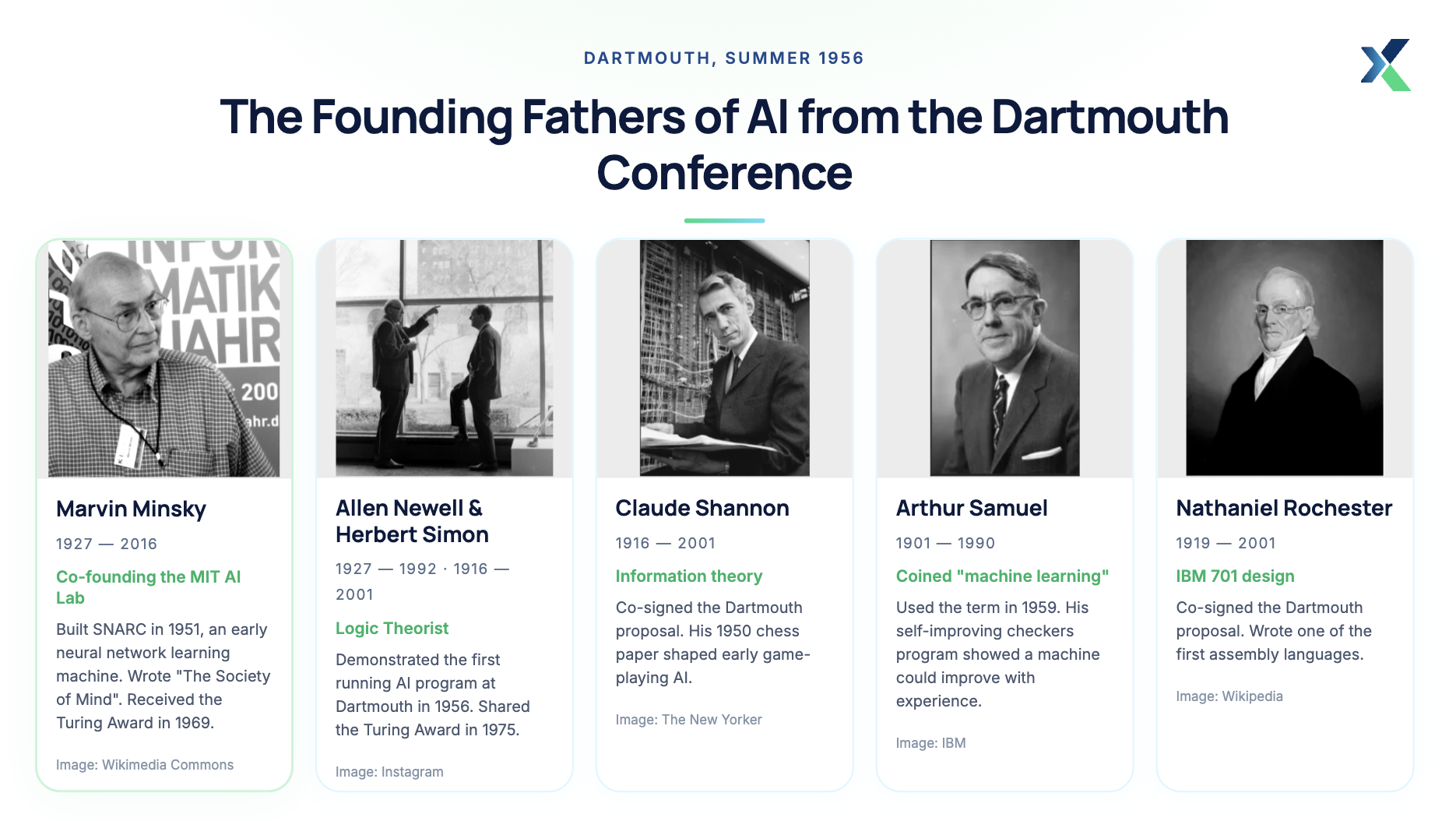
The disagreement that shaped the field most was between McCarthy and the Carnegie Mellon pair. McCarthy wanted intelligence built on formal logic, with knowledge represented as statements a system could reason over. Newell and Simon wanted to build it on the observed behavior of human problem solvers, modeling the search strategies people actually use. That split between logic-based and psychology-based approaches ran through AI for decades and has never entirely closed.
One further name belongs in the account, though not as a founder. Noam Chomsky's work on generative grammar shaped how the field thought about language and cognition, and his long-running objection to purely statistical approaches has become relevant again. The argument he made in the 1950s is close to the one critics now make about large language models: that predicting what comes next is not the same as understanding, however good the predictions become.
This brings the story to the generation that made the statistical approach work anyway.
Who is The Father of Modern Artificial Intelligence?
McCarthy's symbolic tradition hit a wall it never really cleared. Systems built from hand-written rules performed impressively inside narrow domains and failed badly at the edges, because somebody had to anticipate every case in advance. Scaling meant hiring more people to write more rules, and those rules interacted in ways nobody could predict. By the late 1980s, the funding had largely moved elsewhere.
The alternative had existed since the 1950s but did not yet work. Rather than writing the rules, you would show a system examples and let it derive the rules itself. The idea was sound, but the results were poor, mainly because the approach needed three things that didn't exist: large labeled datasets, enough computing power to train on them, and reliable methods for training networks more than a couple of layers deep.
Geoffrey Hinton, a British-Canadian computer scientist, spent most of his career on that third problem, through the decades when very few people thought it worth solving. That persistence is why his name is attached to the modern era.
Hinton, LeCun, and Bengio
Hinton, Yann LeCun, and Yoshua Bengio shared the 2018 ACM Turing Award for the conceptual and engineering work that made deep neural networks central to computing. Hinton's work on backpropagation, LeCun's convolutional networks, and Bengio's work on representation learning supplied the techniques that took over the field once data and hardware caught up around 2012.
Hinton received a second recognition of a different order in 2024, sharing the Nobel Prize in Physics with John Hopfield. The committee cited foundational discoveries that enabled machine learning with artificial neural networks. Press coverage since then has settled on calling him the Godfather of AI.
Why Don't the Two Titles Conflict?
McCarthy founded the field while Hinton built the technique that made it commercially useful. These are separate achievements, and the traditions behind them differ in kind rather than in degree.
Symbolic AI (McCarthy) | Statistical AI (Hinton) | |
|---|---|---|
Core idea | You write the rules. The machine applies logic. | You supply data. The machine derives the rules. |
Peak era | 1956 to roughly 1990 | 2012 to now |
Strength | Explainable, auditable, precise | Handles messy, high-dimensional data |
Weakness | Brittle outside its rule set | Opaque and data-hungry |
Where you meet it today | Tool schemas, guardrails, planning loops | LLMs, vision models, recommendation systems |
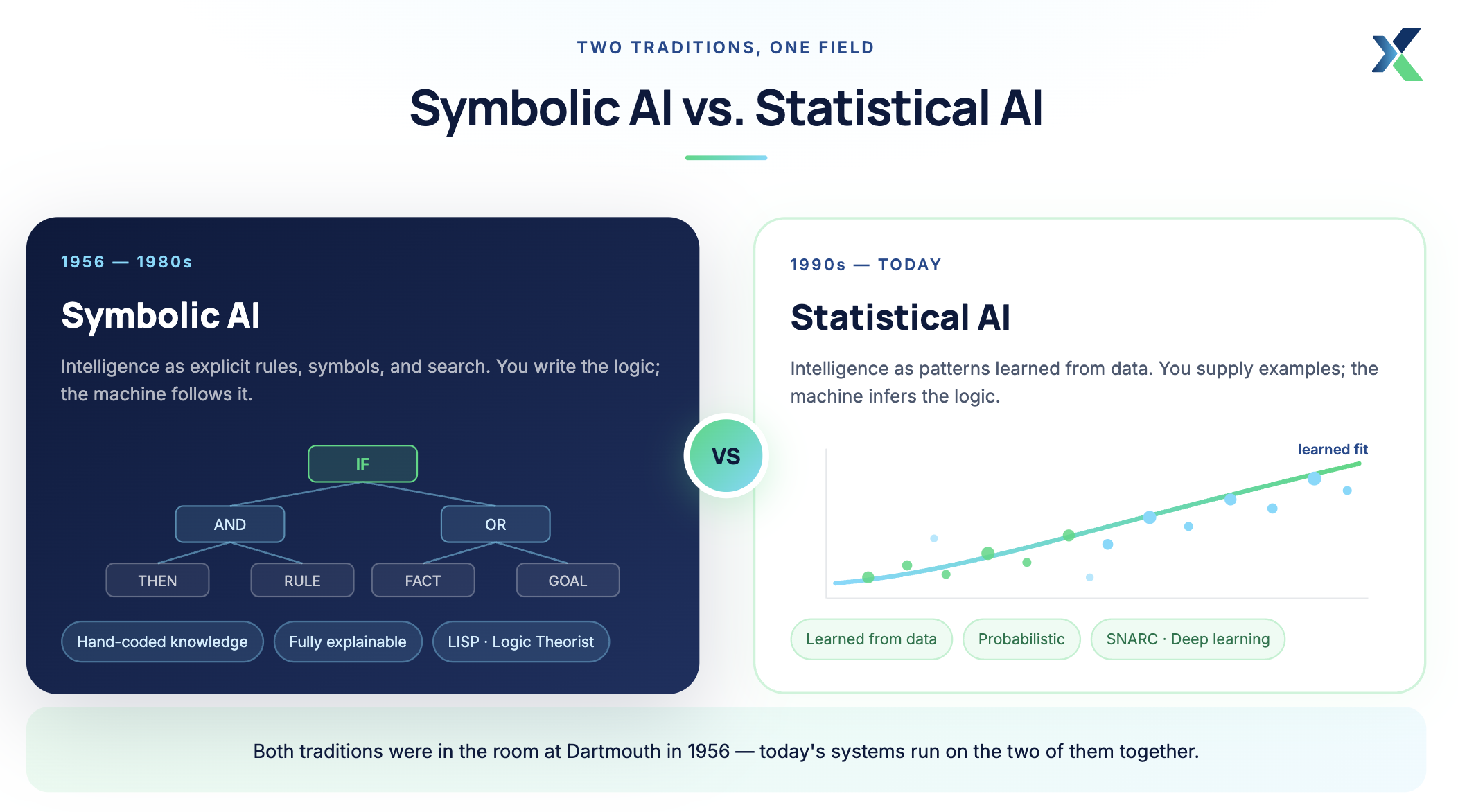
The interesting development is that the split is closing. A language model is a statistical system: it learned its behavior from data, and nobody can point to the rule that produced any particular output. The moment you wrap it in an agent framework, though, you are back in McCarthy's world.
Tool schemas are declarative knowledge, Planning loops are search, and Guardrails are constraints expressed as rules. An agent that revises its plan after a failed call is performing non-monotonic reasoning.
So the practical answer is that both traditions fathered the current generation, and what you are working with is the recombination.
What Changes in the History of How We Learn AI?
This is not only a story about attribution. Three practical consequences follow, and each affects how you should approach the field.
1. The naming game is old, and it still works
McCarthy chose artificial intelligence partly to mark a break from cybernetics, and the choice did its job. It pulled funding, attention, and people toward one way of framing the problem and away from Wiener's. The label performed work that the underlying research could not have performed on its own.
That pattern has not changed. Agentic AI and generative AI describe methods that largely existed before the terms did, and the terms are reshaping budgets and job titles regardless. The useful habit is to ask which technique a label actually points at, because the answer is often something you already know under an older name.
2. Symbolic methods never died
The standard narrative says symbolic AI lost and statistical AI won. Production systems suggest otherwise. Retrieval rules, tool schemas, guardrails, evaluation harnesses, and planning loops are all symbolic structures, and in most deployed systems, they absorb more engineering effort than the model itself.
If your preparation covers only model training, you have learned the half that attracts attention and skipped the half that consumes the working week. What applied AI looks like in practice is mostly the second half.
3. The founders were generalists, and that has returned
McCarthy published in mathematical logic, programming language design, and operating systems, and his reputation rests on contributions in all three. Minsky worked across psychology, optics, and robotics. This was unremarkable at the time, because the field was too young to have produced specialists.
The pattern has quietly come back. Shipping an AI system now means reasoning about model behavior, data pipelines, evaluation, cost, and failure modes at the same time, which is closer to what it takes to become an AI engineer than any single specialization would be.
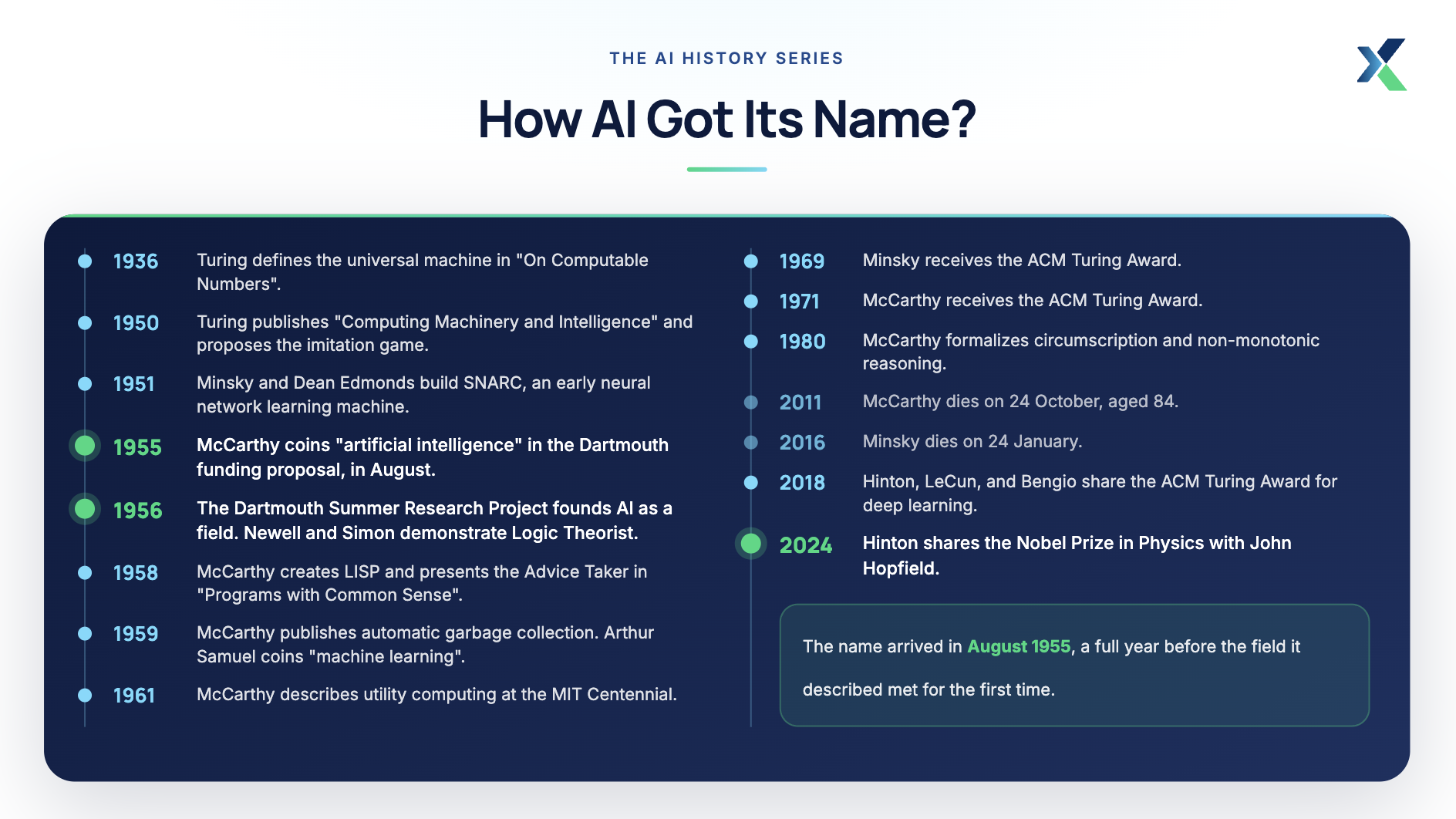
This brings us to the end of the debate over who the father of artificial intelligence is.
Conclusion
So, who is the father of AI? Two answers, both defensible, and you can now see why the disagreement exists rather than simply that it does.
Turing established that the question was worth asking and found a way to test it. McCarthy earned his title by naming the field, convening it, and building the language it worked in for forty years. Hinton supplied the technique that finally made the answers commercially real, which is why the modern label attaches to him rather than to either of the others.
What links them is not a relay of credit but a pattern of recombination. Each generation inherited the previous one's unsolved problems and rebuilt the approach at a scale the earlier one could not reach. McCarthy's declarative knowledge has reappeared inside agent frameworks. Turing's operational test has turned into the evaluation harnesses every serious team now maintains.
You are working inside the same pattern. Learning both traditions, rather than the fashionable one, will let you read where AI goes next before the labels catch up.
FAQs
1. Who is known as the father of AI?
John McCarthy holds that title in almost every academic source. The attribution rests on three things. He named the discipline in 1955 and convened its founding event in 1956. He also built LISP, the language the field ran on for forty years.
2. Who is the father of modern artificial intelligence?
Geoffrey Hinton is usually called the father of modern artificial intelligence. He shared the 2018 ACM Turing Award with Yann LeCun and Yoshua Bengio for deep neural networks. He then shared the 2024 Nobel Prize in Physics with John Hopfield. McCarthy founded the field, while Hinton built the technique that made it commercially useful.
3. Is John McCarthy the father of AI, or was it Alan Turing?
John McCarthy is the father of AI by standard attribution, because he named and organized the discipline. Turing died in 1954, two years before the Dartmouth conference. His 1950 paper asked whether machines could think, which made the field thinkable. Most historians call Turing the father of computer science instead.
4. What did John McCarthy invent?
McCarthy created the LISP programming language in 1958. He invented automatic garbage collection in 1959, which almost every modern language now uses. He pioneered time-sharing, the model behind multi-user servers and cloud computing. He also proposed the Advice Taker in 1958 and formalized circumscription in 1980.
5. Who are the founding fathers of AI?
The founding fathers of AI are the researchers who signed the 1955 Dartmouth proposal and attended the 1956 workshop. That group includes John McCarthy, Marvin Minsky, Nathaniel Rochester, and Claude Shannon. Allen Newell, Herbert Simon, and Arthur Samuel belong in the same generation. Each shaped a different branch of early AI research.
6. Who is the father of artificial intelligence in India?
No single figure holds that title formally. Raj Reddy is the name cited most often. The Indian-born computer scientist shared the 1994 ACM Turing Award with Edward Feigenbaum for work on large-scale AI systems. He founded the Robotics Institute at Carnegie Mellon University in 1979 and helped shape AI research across India.