In April 2026, Gartner placed agentic AI at the peak of inflated expectations on its Hype Cycle for Agentic AI. Not climbing towards it but at the top.
This placement is our hint on how to read every AI trends list published this year, including this one. The peak is where intent runs furthest ahead of delivery, and Gartner's own figures show the distance.
17% of organisations have deployed AI agents. 42% expect to within twelve months, and another 22% the year after. Most of that work targets incremental automation rather than transformation.
What follows a peak is a trough. That is not a prediction of failure; it is the gap between what gets announced and what runs in production that closes slowly and expensively.
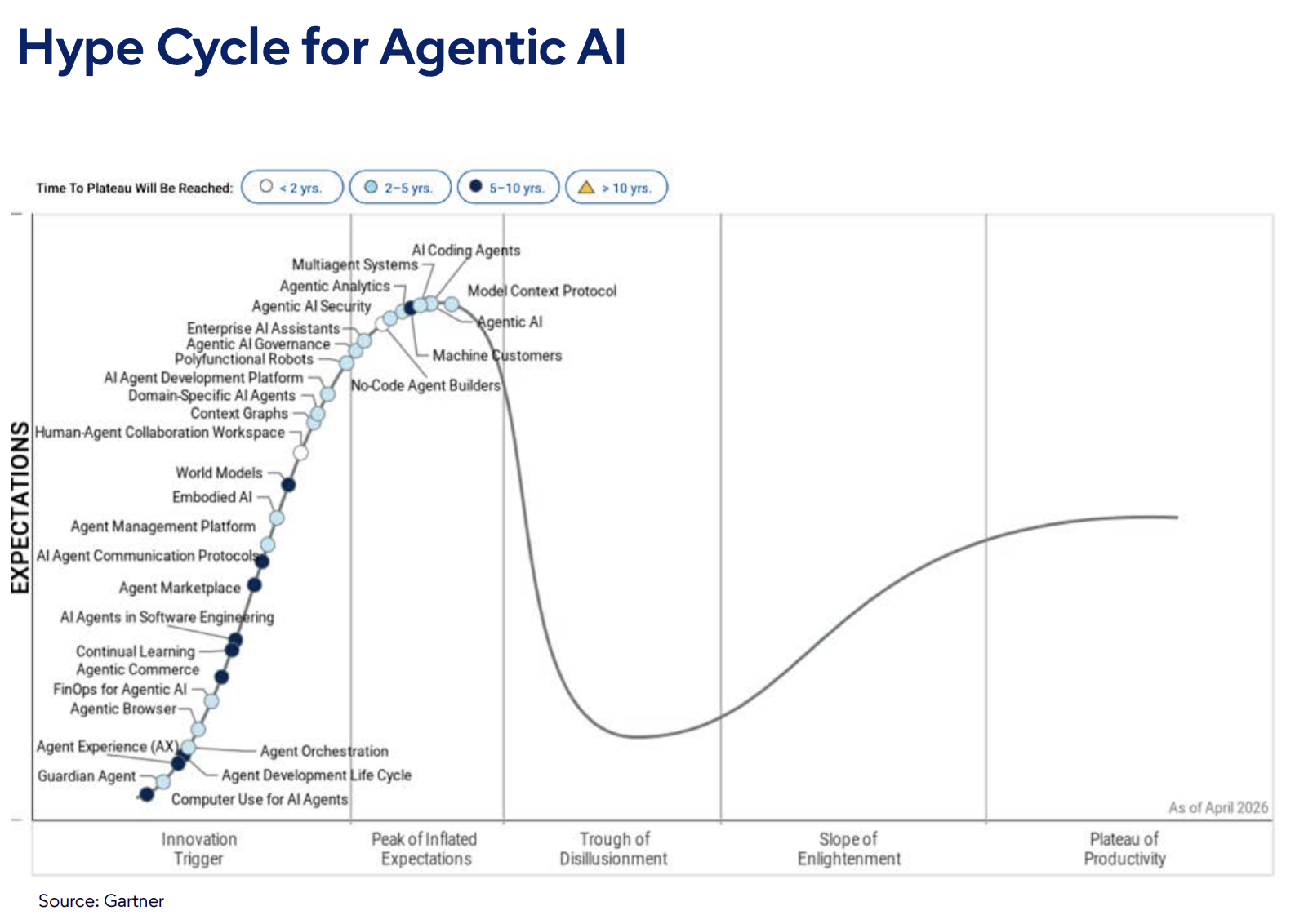
Image Source: Gartner's Agentic AI Hype Cycle Report
Gartner's read on what this does to work is the sharpest framing available. It hints at job chaos rather than a job apocalypse. From 2028 and 2029 onwards, AI is expected to create more jobs than it eliminates, while more than 32 million roles gets significantly transformed every year.
Take note: Transformed, not deleted. This distinction is what the next AI trends are about: 9 shifts across jobs, hiring, projects, careers, learning and industry, each with a named company and a real number.
Why Agentic AI Leads Every List of Current AI Trends?
If you do a simple Google Search on the top AI trends, you will see a long list including quantum computing, smarter automation, multimodal models, sovereign AI, and AI chips. Yes, they are true, but the shift that hardly gets talked about is how AI moved from answering questions to planning and acting on its own. This shift, also called agentic AI, is the trendsetter. The AI agents are all set to take action, sitting at the center of almost every business function you can think of.
According to Gartner, 40% enterprise applications will include task-specifc AI agents by the end of 2026, up by 5% from last year. Safe to say, there is no other AI trend that moved so fast like agentic AI, that too in a single year.
That is why we have put together a list of compelling AI trends that are hard to ignore, because they're shaping how you work and what you do as a human!
Let's get started.
Top 9 Agentic AI Trends Reshaping Your Workspace
It is a very common joke these days that being a human is passé; AI agents are in! While it reads funny, it is almost as good as true. AI agents are the real trendsetters here, redefining how teams are managed, how work gets done, and how much human intervention is required (and when). In Infact, agentic AI job interviews include questions that judge how capable you are of creating, launching, and keeping an AI agent stable when it falters. You, as a human working with AI agents, must know when to intervene and when to get an AI agent to stop.
PS. Read our Agentic AI Interview Guide to know more such questions and how you can handle them on the D-day.
Now that we have cleared the air that AI agents are going to be a regular at our workspace, let's look at the AI trends with the biggest career impacts.
1. AI Agents Will Continue Needing Human Assistance
Picking up from earlier, companies didn't arrive at this point randomly. It happened one agent at a time, and eventually organizations realized they need humans to manage these autonomous agents. Trust me when I say this is now a full-time job.
Yes, AI agents are autonomous. They keep learning over time, but they still need human help setting boundaries, brand guidelines, hard limits, and analyzing whether the outcome is realistically feasible.
At AnalytixLabs, AI agents handle regular, repetitive work for us. When it comes to building strategy or setting brand design guidelines, we still need our human leads to step in. It is more of a coexistence: humans keep adding new prompts so the agent learns the market, hard limits, and business goals.
When Andrej Karpathy reframed the industry's "year of agents" as the "decade of agents" in Dwarkesh Podcast, we paused to listen. Karpathy's case for "the decade of agents" was never a timeline quibble. He argued agents don't work yet because they lack intelligence, multimodality, computer use, and continual learning, and that closing those four gaps is roughly ten years of work, not one.
In short, we agree. We are going there, but it is still time before AI agents do everything independently.
2. Forward Deployed Engineer(FDE) is The Fasted Growing Job Role
In the past year, two job roles saw the fastest growth: AI Engineer, which grew 13x, and Forward Deployed Engineer, which grew 42x.
It is interesting to know what led to this staggering growth for this particular role. In late June 2026, AWS announced a one-billion-dollar investment to build an organization around this role, embedding thousands of FDEs inside customer teams. On July 2, Microsoft launched Microsoft Frontier Company, a 2.5 billion dollar business built around roughly 6,000 embedded experts.
In both cases, the work is specific. FDEs will take a model that performs well in a demo and make it survive a real company's data, systems, and edge cases. It is part engineering, part consulting, and most exposed to whether agentic AI delivers.
As a result, hype and demand for this role have skyrocketed. While this might push you to instantly look for FDE roles, here is a disclaimer:
Roughly a third of live FDE roles are advertized under adjacent titles, so searching with the exact phrase may not land up correct results. Look for Solutions Engineer, Applied AI Engineer and Deployment Engineer as well. Anthropic, for instance, posts the role as Applied AI Engineer.
The same blurring runs the other way. Some employers relabel Solutions Architect roles as FDE to compete for the same candidates, which inflates how much demand looks real. Recruiters hit the mirror image of this problem, which is why many now run AI-powered ATS software that screen on responsibilities and demonstrated skills rather than matching against a job title.
Pro tip: Read the responsibilities, not the title.
3. AI agents will Begin Making Purchases
AI agents are replacing how payments are being made. Most payment infrastructures were designed with the concept that "humans click the buy button". That mindset is shifting as AI agents make purchases. 2026 is expected to be the year the commerce market finally addresses the possibility of agents making purchases and handling payments.
That is exactly why Google announced its Agent Payments Protocol (AP2). This protocol answers three questions: how an agent proves a human authorized the purchase, how a merchant knows the request isn't a hallucination, and who is liable for fraud.
PayPal has already adopted this approach. The use case here is concrete. You tell an agent to buy a black jacket under $ 100 when it restocks, and it monitors and executes. This creates entirely new roles in payments risk and agent trust. It is about seeing how well the market adopts and adjusts to this change. After all, trusting an agent with spending your money is a big leap.
4. Security Teams Will Be the First to Go Agentic
Security has a structural problem that no amount of hiring solves. An attacker needs to be right once. A defender needs to be right every time, across a stream of alerts that grows faster than any team can staff against. Google Cloud found 82% of analysts concerned they are missing real threats simply because of the volume of alerts and data in front of them. This is why security, not marketing or finance, will become the first function to run agents at full autonomy.
For instance, Torq's Socrates platform started using agentic AI to automate security operations. Reportedly, it automated 90% of tier-one analyst tasks, resulting in a 95% drop in manual labor.
Unfortunately, the counterweight arrives in the same breath. Microsoft Security's Vasu Jakkal argued in Microsoft's 2026 trends piece that every agent needs its own identity and access limits. Otherwise, these agents will become a surface for attack rather than defense. The uncomfortable part is symmetry because attackers get the same tools, on the same timeline, but with fewer rules. That is why this AI trend is so essential to watch.
5. Customer Service Moves From Deflection to Concierge
For a decade, service automation was measured by deflection rate, i.e., the share of customers who never reached a human when talking to a bot. Previously, chatbots mostly ran on keyword matching and decision trees and had two hard limits: first, they didn't know who you were, and second, they couldn't change anything. That is why any conversation with a chatbot always began with choosing an order or providing your order number. It eventually closed the loop by offering a help article.
Concierge is not a better bot. It is advanced and reworked. Language models removed the scripted tree, so the agent follows what you mean, not what you typed. Grounding then hands over your enterprise record, so it opens with your last order instead of a form field. Agentic action lets it change something in a live system rather than tell you where to click.
Stack all three and the interaction inverts. For instance, a logistics agent flags a delivery as failed at 3pm. Rather than waiting for an angry call, the concierge agent confirms the van broke down, reschedules for morning, applies a service credit, and texts the customer.
AI voice agents take this beyond text-based support by letting businesses handle conversations, qualify requests, schedule appointments, and complete routine actions through natural voice interactions. Instead of simply answering a customer's question, a voice agent can understand the intent, access relevant information, and take the next step without requiring a human representative for every interaction.
While deflection counts how few people got through, concierge counts how few needed to try.
This inversion is why customer service is the most common agentic use case, with 52% of executives deploying agentic agents. While automating customer support is an ongoing AI trend, Klarna raised caution last year. In 2024, it ran 2.3 million AI service chats, but by 2025 it reinvested in human staff. There was no technical failure, but Klarna understood the fine line between what an agent should own and what it should not. The interesting part is Klarna found this in the production phase rather than planning.
6. AI Joins the Coding and Research Process Itself
The first wave of AI coding tools produced output. You asked, it wrote, and then you reviewed. What it never had was context about why the code looked the way it did, which meant a human still had to hold the architecture in their head. That was tolerable when volume was manageable.
This is exactly why volume is forcing the next step. GitHub's Octoverse report recorded 43 million pull requests merged every month, up 23% year on year, and a billion commits pushed annually, up 25%. However, human review cannot scale at this rate. The answer is what Mario Rodriguez, GitHub's chief product officer, calls repository intelligence. It is AI that reads the relationships and history behind code, not just its syntax.
The same shift is reaching science. Microsoft Research's Peter Lee expects AI to generate hypotheses and operate experimental tools rather than summarize papers, giving every researcher something close to a lab assistant. This raises the question nobody has answered cleanly yet. If AI writes the code and AI reviews the code, the human contribution collapses into deciding what to build and verifying that it was worth building. It might be a smaller job, but it is actually a much harder one.
7. Running AI Gets Cheaper as Models Get Smarter
Most teams assume capability is what gates their AI roadmap, so they wait for a better model. In practice, cost is the binding constraint for most use cases. A project does not get killed because the model cannot do it. It gets killed because doing it at volume costs more than the problem is worth.
If cost is the real gate, the number to watch isn't what models can do, but how much a given level of capability costs to run. Artificial Analysis, which benchmarks models on price, speed and intelligence, publishes that figure over time, and honestly, it keeps falling. The reason is competitive rather than technical: open-weight models keep closing the gap on proprietary ones, and each time they do, the paid tiers have to reprice to stay attractive.
The supply side also pushes in the same direction. Inference cost is dominated by idle capacity, because a chip that sits unused still has to be paid for. So utilization, not chip speed, sets the price floor. For instance, Microsoft's Mark Russinovich describes linked AI superfactories that shuttle workloads between distant datacentres precisely so nothing idles, which lifts utilization and drags unit cost down with it.
That gives project teams one concrete action. Pull up the use cases you rejected in 2024 on cost grounds and re-run the maths with nothing else changed. Some will now clear. The caveat is that agentic workloads consume far more tokens per task than a single prompt, so a falling price per token can still produce a rising invoice.
8. Skills Expire Faster Than Training Can Replace Them
Formal education is built on an assumption that a skill learned at 22 stays useful for a decade or more. Curriculum design, degree length, and corporate training cycles all depend on it. That assumption has quietly stopped holding. Research cited in Google Cloud's report puts the half-life of a professional skill at around four years, and in technology closer to two. A three-year degree now outlasts its own syllabus by roughly twelve months.
When skills decay that fast, continuous training stops being a benefit and becomes an operating cost, and companies have started accounting for it that way. In the same survey, 82% of decision makers said technical learning resources keep their organization ahead in AI, and 71% reported a revenue increase after investing in them. TELUS, which trained staff at scale, found 96% came out more confident using AI tools.
Training is now being measured against revenue rather than attendance.
The sharpest version of the problem is the role nobody can recruit for. Shweta Maniar, who was recently invited to share predictions for a new report on Google Cloud, points out that the expertise to be an agent orchestrator does not yet exist in the market. This is because the job is barely two years old.
That is an opening rather than a warning. When a role cannot be hired, it gets filled by whoever taught themselves first and can prove it, which is why a certificate on its own keeps losing value while a working agent with a test suite keeps gaining it.
9. Indian IT Reprices Delivery Around Agents
The biggest AI trend for Indian professionals isn't a technology at all. It is the price cut, and vendors are advertising it themselves.
Infosys recently told investors it migrated three million lines of Hertz COBOL into a microservices environment using AI foundation models, at 60% lower cost and on a 60% shorter timeline.
Read that as a market signal, not a case study.
Once one major vendor publicly prices a modernization program 60% below the old rate, every buyer expects that number and every competitor must match it. The pyramid model that Indian IT was built on, where large benches of junior engineers bill hours against long timelines, is what breaks first.
If billable hours are the thing being repriced, the only real response is to sell a different unit, and the two largest firms have picked different ones.
Wipro's answer, launched in April 2026, was an AI-Native Business and Platforms Unit built around services-as-software, where the client buys a delivered outcome instead of a staffed team. TCS's answer was scale plus oversight. At its June 2026 annual general meeting, N. Chandrasekaran predicted the firm will soon run as many AI agents as it employs people, with governing those agents becoming a recurring revenue annuity.
Both of these are attempts to find something that compounds the way headcount used to.
Nobody has proven yet whether outcome-based pricing protects margin the way billable hours did. If it doesn't, the repricing isn't a transition; it is a contraction.
What these AI Trends Mean for Your Next 12 Months
Now that we have discussed the most hyped AI trends doing the rounds, let us look at how these AI trends will impact you in the next 12 months.
The funny thing about trends is that they stop being the center once the wave or hype settles down. Only then do we realize whether that trend was worth the time.
Student or fresher
Ship one agent, write its evals, and publish the repository with a note on what broke. AI trends say the market needs people who can show that, not people who can name frameworks. Be one of them.
Working professional
Take the workflow you know best and agentify part of it. Ongoing AI trends make supervision a crucial part of every job description, so arrive with evidence that you can do it.
Career switcher
AI trends suggest roles are being created in payments risk, security operations, and data grounding that screen for domain judgment more than code. If you are transitioning from another domain or industry, this is where your opportunity lies.
Hiring or running L&D
AI trends on skills is your budget line here. Google Cloud's own data ties learning investment to revenue, and the orchestration skill you need cannot be hired in.
The recent AI trends point less towards replacement than towards a reshuffle of who does the verifying.
Agents generate more output than any team can check. Sadly, the scarce skill is no longer producing work. It is deciding whether the work is right, and building the systems that catch it when it is not.
That is a durable position, and a learnable one.
FAQs
What are the latest trends in AI right now?
The dominant trend is agentic AI, meaning systems that complete tasks rather than answer questions. Five others matter for careers. Agent supervision is becoming a job. Hiring is shifting toward deployment skills. Entry-level roles are being redesigned. Upskilling is moving from certificates to shipped work. And Indian IT services is repricing its own delivery model.
Will AI agents replace jobs?
Some, and not evenly. Rule-based repetitive work in business process outsourcing and IT services is being restructured now. Against that, 67% of chief executives in Teneo's survey of 350-plus global public companies expected AI to increase entry-level hiring in 2026, and IBM tripled its entry-level intake. Only 11% of enterprises claiming AI agent adoption actually run agents in production, so near-term displacement is smaller than the announcements suggest. Gartner's framing is the most useful one available: not a jobs apocalypse, but job chaos, with more than 32 million roles transformed significantly each year from 2028 onwards.
Will AI agents replace IT jobs in India?
They will change what IT work is billed for, which matters more than headcount alone. Infosys migrated three million lines of Hertz COBOL at 60% lower cost using AI foundation models, and that pricing becomes the benchmark buyers expect. At the TCS annual general meeting in June 2026, N. Chandrasekaran predicted the firm will soon run as many AI agents as it employs people, with governing those agents becoming a new recurring revenue line. Supervision, governance, and integration roles gain. Volume-based repetitive delivery is the exposed side.
Which AI agent jobs are hiring in India?
AI agent developer, AI engineer, agent architect, automation engineer, agent evaluation and QA engineer, AI product manager and AI implementation consultant. Bengaluru, Pune, Hyderabad, Noida, Gurugram, and Delhi account for most of the volume. NASSCOM projects India will need more than 50,000 specialized agentic AI professionals by 2027. Our guide to AI agent jobs covers roles, salary bands and screening criteria in detail.
What are the AI trends for 2026 specifically?
Three things separate 2026 from 2025. Agentic AI moved from pilots to a measurable production gap, with 79% claiming adoption and 11% shipping. Evaluation and context engineering became named disciplines with their own job postings. And Indian IT services began restructuring commercially rather than just experimenting, through Wipro's AI-native unit and TCS's stated agent-scale ambition.
How do I stay updated with AI trends?
Track primary sources over summaries. Stanford's AI Index and Gartner forecasts point the way. Company investor updates show what is actually funded. Job postings are the leading indicator, because titles change before the commentary does. Our monthly newsletter covers what shifted and what it means for skills.
What are the future trends in AI research?
Continual learning, reliable long-horizon reasoning, and memory architecture are the open problems most likely to change what agents can do. Karpathy's argument for a decade rather than a year of agents rests on exactly these gaps. They sit on a research timeline rather than a hiring one, which is why this article focuses on the shifts already visible in the job market.