When the world's two biggest tech giants commit more than USD 3.5 billion to the same idea, you know it is not a facade. AWS announced a dedicated Forward Deployed Engineering organization backed by a USD 1 billion investment on 30 June 2026. Two days later, Microsoft launched Microsoft Frontier Company at USD 2.5 billion, built around roughly 6,000 embedded industry and engineering experts.
Both companies spent that money on the same kind of person: an engineer who leaves their own office and works inside the customer's, until the AI system actually runs there. They are the Forward Deployed Engineers (FDEs).
FDEs closed the gap that troubled enterprise AI most. When models improved faster than companies were ready for them, capability stopped being the bottleneck. As a result, whether an AI project would pay off depended on whether it could survive a real organization's data, permissions, and users. Forward Deployed Engineers stepped in at this moment to ensure that an AI project succeeds when real data is being used.
The nature of the role itself is a big giveaway that engineers pivot to this role only after gaining at least 2-4 years of industry experience. Sitting in another office and ensuring that an AI project runs and delivers the expected results is not something a college-passout would want to get into. On the other hand, organizations prefer to send an experienced, proven engineer to their client's office to maintain business relationships.
This article gives you a staged roadmap, the two halves of the skill set that get tested, the India hiring and salary picture, and an honest answer on whether a course can help you. If you have been searching for how to become a forward deployed engineer, this is the practical version of that answer.
The forward deployed engineer roadmap in this article is staged, so you can join it at whichever point matches your current experience rather than starting from zero. Let's start with the most essential question: what is a forward deployed engineer?
What Does a Forward Deployed Engineer Do?
A forward deployed engineer builds and ships AI systems inside a customer's own environment rather than inside their employer's product. They work with the customer's data, security constraints, and users, and they stay until the system runs in production. The job is part engineering, part delivery, and it is measured by whether the customer's business outcome moves.
The term Forward Deployed Engineer came from Palantir, which built its early business on sending engineers into client sites instead of shipping software over the wall. For almost a decade, this stayed one company's quirk. Fast-forward to the present day - this is now a standard operating model. Companies like OpenAI and Anthropic each stood up forward deployed engineering groups in May 2026, while consulting firms like McKinsey, QuantumBlack, and BCG have started hiring for the same profile.
Demand and need shape the daily requirements. As an engineer, you spend considerable time on scoping calls, working out what the customer actually needs versus what they asked for. You write integration code against undocumented systems and debug in production environments (which you don't control). This daily reality matters to anyone working out how to become a forward deployed engineer, because the roadmap later in this article is built around these exact demands rather than a syllabus.
If you are an FDE or planning to pivot into one such role, you might have come across this question: how is an FDE different from a software engineer or an AI engineer? Incase you have the same question as well, let's get straight to it.
Forward Deployed Engineer vs. Software Engineer/AI Engineer
Forward deployed engineers share skills with software engineers and AI engineers. The difference between the three is not the technology, but who you are building for, whose systems you are building inside, and what counts as done.
A software engineer ships to their own product; an AI engineer improves a model or pipeline against a benchmark. A forward deployed engineer answers to one named customer whose definition of success was agreed before any code was ever written.
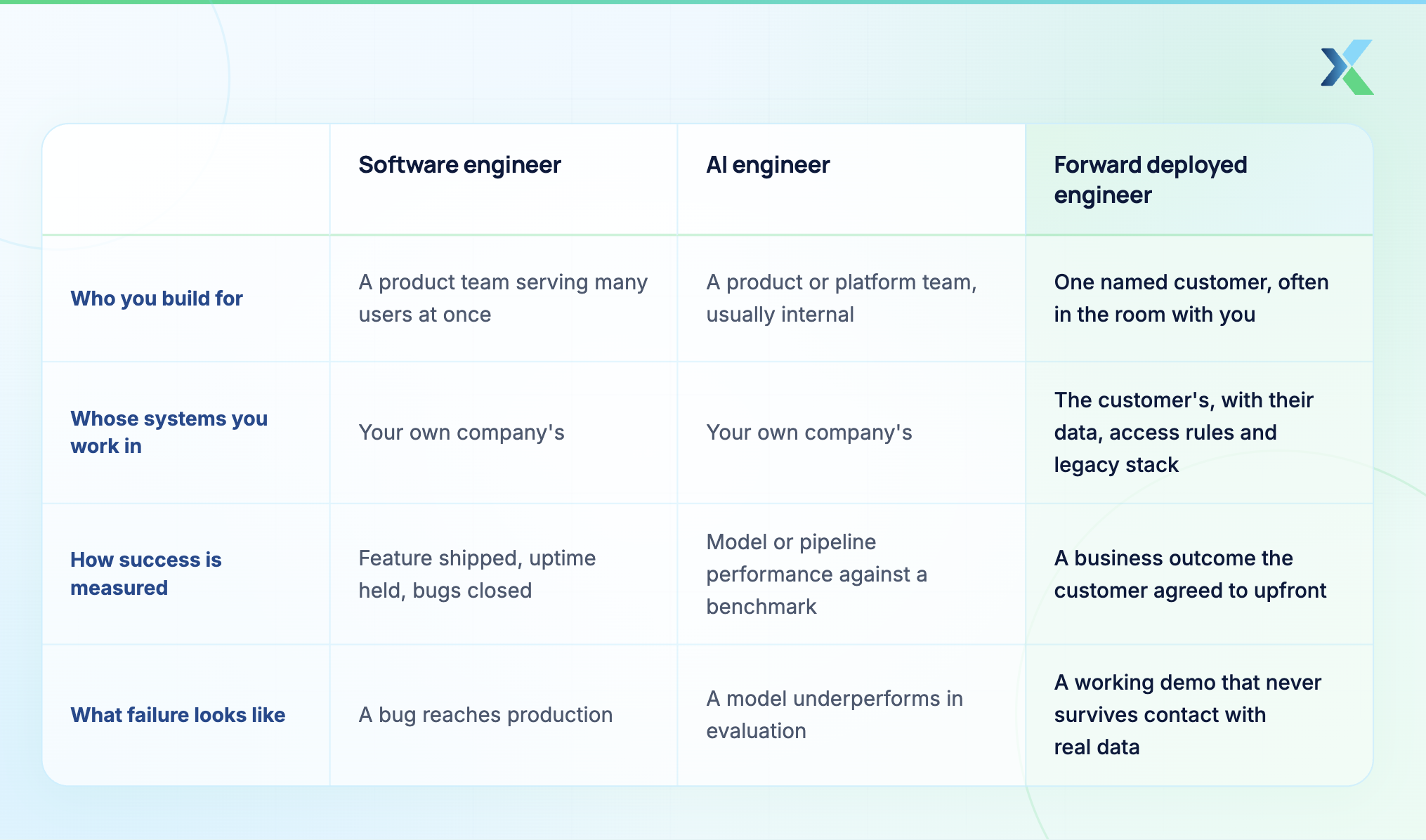
The last row is the one that matters for your career decision. If you enjoy the part where a system meets reality and starts breaking in interesting ways, this role centers on that moment. If you would rather own a clean codebase and a stable spec, it will frustrate you.
Since it is a fairly new role, pivoting without basic research might look risky. You might want to understand the job market before you pivot your career to the FDE path.
Forward Deployed Engineer Jobs in India: What is The Market State?
India has yet to catch the global pace, but reports show about 250-270 active FDE roles across Indian cities at any given time. In fact, Glassdoor shows at least 362 job postings with the exact job title in August 2026 [data as of 20th August 2026].
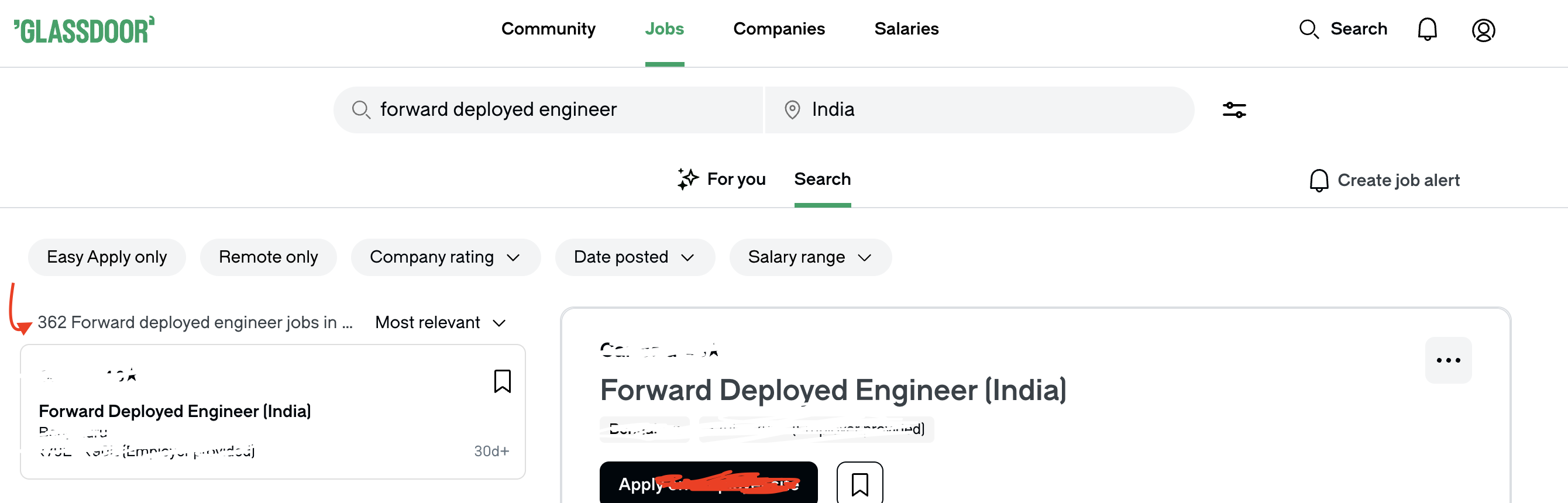
Source: Glassdoor
Why India Hasn't Caught Up (yet) with Global Commitments in FDE?
P.S. This analysis will continue to change as the global and domestic picture for FDE roles evolves.
The AWS and Microsoft announcements are corporate spend commitments rather than extrapolations from job boards, which makes them a far firmer signal. A company can post and unpost roles freely, but it cannot quietly unspend $3.5 billion. When four of the largest players in AI fund the same organizational model within eight weeks of each other, that is a structural bet rather than a hiring cycle.
India today looks smaller than that suggests. TeamLease's estimate of 250 to 270 openings is an early-stage number, not a ceiling, because the title itself is unsettled. Much of this work is advertised as Solutions Engineer, Applied AI Engineer, or Deployment Engineer, so searching the exact phrase hides part of the market from you. Put differently, the forward deployed engineer market in India is larger than the exact-title count suggests, but you have to search for it under three or four names.
As a result, employers fall into four groups rather than a logo wall:
Global AI platforms and cloud providers with India delivery centers, which is where most forward deployed engineer Palantir, Databricks, and Snowflake-style roles sit
Consulting firms building applied AI practices
India-headquartered AI product companies deploying to enterprise customers
Global labs hiring India-based engineers for remote delivery
A small candidate pool with premium pay attached is an argument for moving early rather than waiting for volume to arrive. It also changes how you should search, because with this few postings, referrals and visible work will do more for you than volume applying ever will. In other words, becoming a forward deployed engineer in India is as much a question of search strategy as it is of skill building.
Will India Emerge as a Dominant Market for FDE Roles?
This is our read, not an established fact, and we will show the reasoning so you can weigh it yourself.
For India to become a major market for this role, one condition has to hold: a meaningful share of forward deployed work has to be done without physically sitting in the customer's office. That deserves scrutiny, because proximity is the thing the role is named after.
In practice, the work splits into two halves that behave very differently. Discovery, scoping, executive relationships, and the difficult conversations genuinely depend on being in the room, or at minimum in an overlapping time zone.
The build does not. Integration code, retrieval pipelines, evaluation harnesses, monitoring, and the long tail of iteration after go-live are all remote-capable, and they consume far more engineering hours than the customer-facing half.
This second half is precisely the kind of work India's delivery centers and GCCs have absorbed before, first with application development and later with cloud and data engineering. The capacity to do it again already exists. Tech giants like Databricks, Palantir, Snowflake, Salesforce, IBM, ServiceNow, Qualys, and McKinsey QuantumBlack all run operations in India today. Honestly, embedded engineering at the scale that AWS and Microsoft have funded cannot be staffed from the US headcount alone.
The counterweight is that the co-located half tends to carry the seniority and the money. India may well win the volume before it wins the highest-value scope. Either way, the timing implication is the same. Positioning early in an emerging role is worth more than waiting for the volume to confirm it.
Forward Deployed Engineer Salary in India: What the Data Actually Shows
The Forward Deployed Engineer is a considerably new role. That newness is exactly why you should read any forward deployed engineer salary figure alongside its sample size, not on its own. Add to that, the Indian job market often uses Software Engineer, Applied AI Engineer, or Deployment Engineer to refer to the same role.
Salary data for this title is wide, and the spread says something. A job title only two years old produces small, self-reported samples, so the numbers disagree. We put that disagreement on the page rather than averaging it away, because an average across incompatible samples is less honest than the range.
Figure | Sample basis | Date |
|---|---|---|
₹18 to ₹28 LPA, 0 to 2 years experience | Normalized from self-reported inputs | 2026 |
₹28 to ₹55 LPA, 3 to 6 years experience | Normalized from self-reported inputs | 2026 |
₹55 to ₹90 LPA and above | Senior and global-remote, small population | 2026 |
Around ₹17 LPA average, range ₹11 to ₹36 LPA | Nine data points | July 2026 |
Around ₹13.2 LPA average | Self-reported | 2026 |
Around ₹40 LPA for experienced FDEs | Practitioner estimate | 2026 |
The realistic target for a strong engineer with three to six years and a genuine deployment portfolio is the 28 to 55 LPA band. The 55 to 90 LPA figures are real, but they describe a small group with senior scope or a global-remote arrangement, so treating them as a default will distort your planning. Even the middle band sits at a clear premium to a comparable backend role at the same experience level, which happens when demand concentrates and supply stays thin.
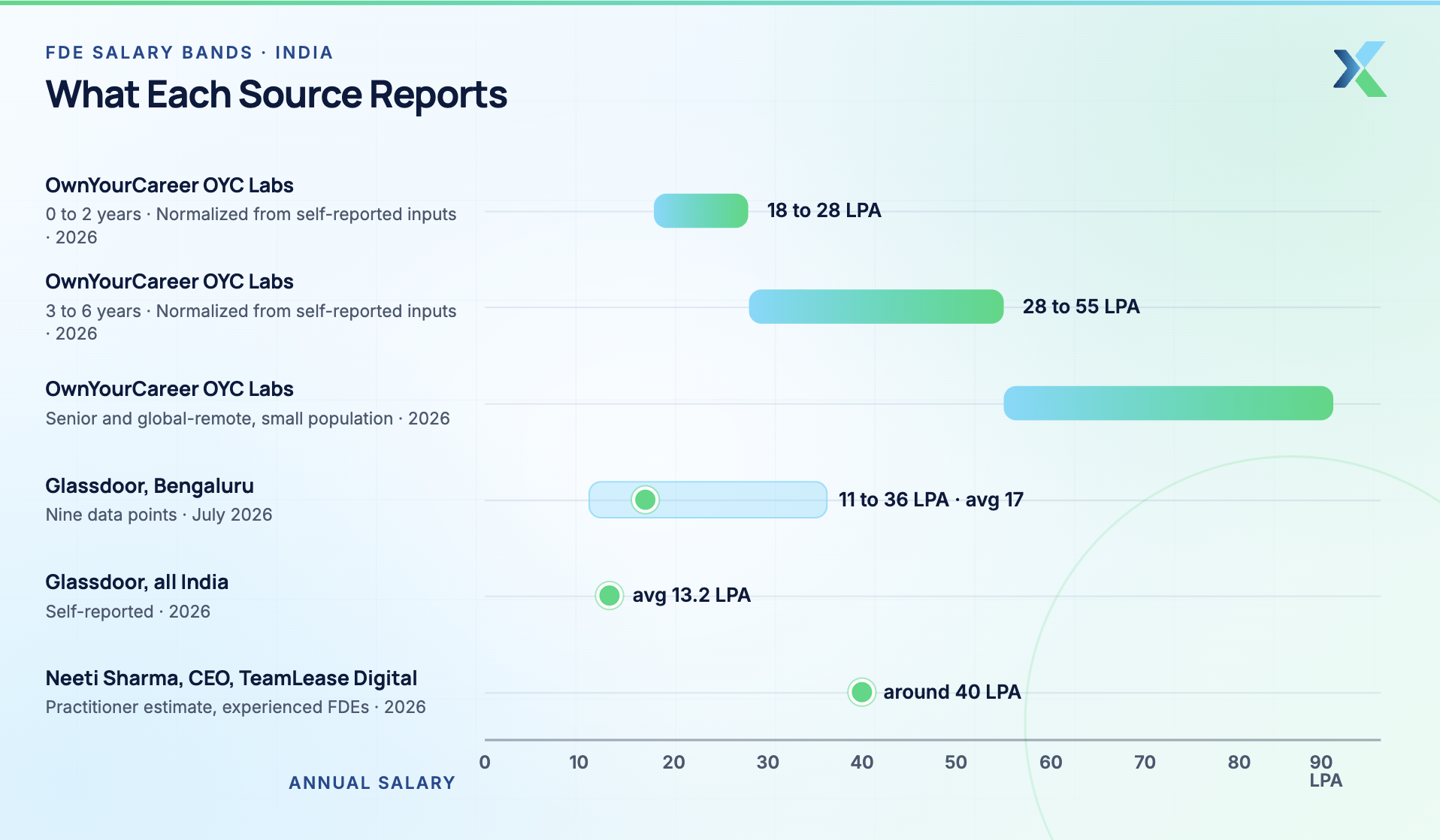
An FDE's salary bracket is usually influenced by factors like experience level, technical specialization, customer exposure and travel requirements, deployment complexity, and the type of organization (clients).
India is well positioned for salary growth. Companies in India need engineers who can deploy AI and automation in messy, real environments. FDEs can reduce time-to-value and de-risk deployments. This is exactly what most businesses want to prioritize. In addition, the shortage of skilled hybrid engineers who can merge systems engineering with customer problem-solving is driving up salaries, especially in the experienced bands.
Forward Deployed Engineer Skills: The Two Halves Employers Screen For
Salary largely depends on the skills you have as an engineer. Infact, skills are the driving force behind how you perform in such roles. They are also the most common starting point for anyone asking how to become a forward deployed engineer, though the technical list is only half of what employers screen for.
A forward deployed engineer who handles complex deployments, i.e., industries where stakes are higher, has higher pay. This includes defense, AI infrastructure, and finance. Similarly, the more frontline exposure you get as an FDE, the better the pay scale. Technical specialization matters most in firms related to AI/ML deployment, data engineering, cybersecurity, LLMOps, and retrieval systems.
While experience is a strong force in deciding your paycheck, a lot of it also depends on the skills you bring to the table. Employers rely heavily (and pay more) on engineers who can work across cloud infrastructure, customer deployments, and AI systems. Core skills of an FDE usually include:
AWS, Azure, or Google Cloud
Python
LLMs
Distributed systems
Retrieval-augmented Generation
Model Context Protocol
API development and integrations
Data engineering
AI agents and agentic AI
Enterprise SaaS deployment
System design
On the non-technical side, skills also include communication, customer handling, travel, and integrated coding.
Also read:
When you look at live job descriptions rather than a curriculum wish list, the two (JD and curriculum) diverge sharply in the second column. Employers describe this role in two halves, and they screen for both. Read any forward deployed engineer job description closely, and you will find both columns represented, usually with the delivery side buried in the responsibilities rather than the requirements. The forward deployed engineer skills below are grouped the same way employers assess them.
Engineering side | Delivery side |
|---|---|
Production Python, not notebook Python | Scoping an ambiguous problem into something buildable |
API design and systems integration | Running a customer call without an engineer translating for you |
Cloud deployment and containerization | Stakeholder management across technical and business contacts |
CI/CD and version control discipline | Working without a complete specification |
Retrieval pipelines and grounding | Written and spoken English suited to client work |
Agent frameworks and multi-agent orchestration | Saying no to a requirement that will not survive production |
Evaluation, monitoring and observability | Escalating a problem without damaging the relationship |
Here is the part most guides skip.
Indian engineers rarely lose forward deployed engineer offers on the left column. They lose them on the right one, because the left column is what our education and hiring systems already train and test for, and the right column is treated as something you pick up eventually. In this role, we test it in the first interview.
If the agent and multi-agent side of the left column is where your gap sits, our agentic AI course covers orchestration and multi-agent system design in depth.
How to Become a Forward Deployed Engineer: 3-Stage FDE Roadmap
Before we begin, here is a disclaimer: This stage-wise guide assumes that you have at least 4-5 years of backend, full-stack, or data engineering experience. Any guide pretending otherwise is selling you something!
Each stage below names concrete tools and ends in one defensible artifact, because artifacts are what this role screens on. If you want one compact answer for how to become a forward deployed engineer, it is this: work through these three stages in order, and finish each one with something you can show a hiring manager.
Treat this forward deployed engineer roadmap as sequential rather than pick-and-choose, because each stage assumes the artifact produced by the one before it. Let's start with the steps.
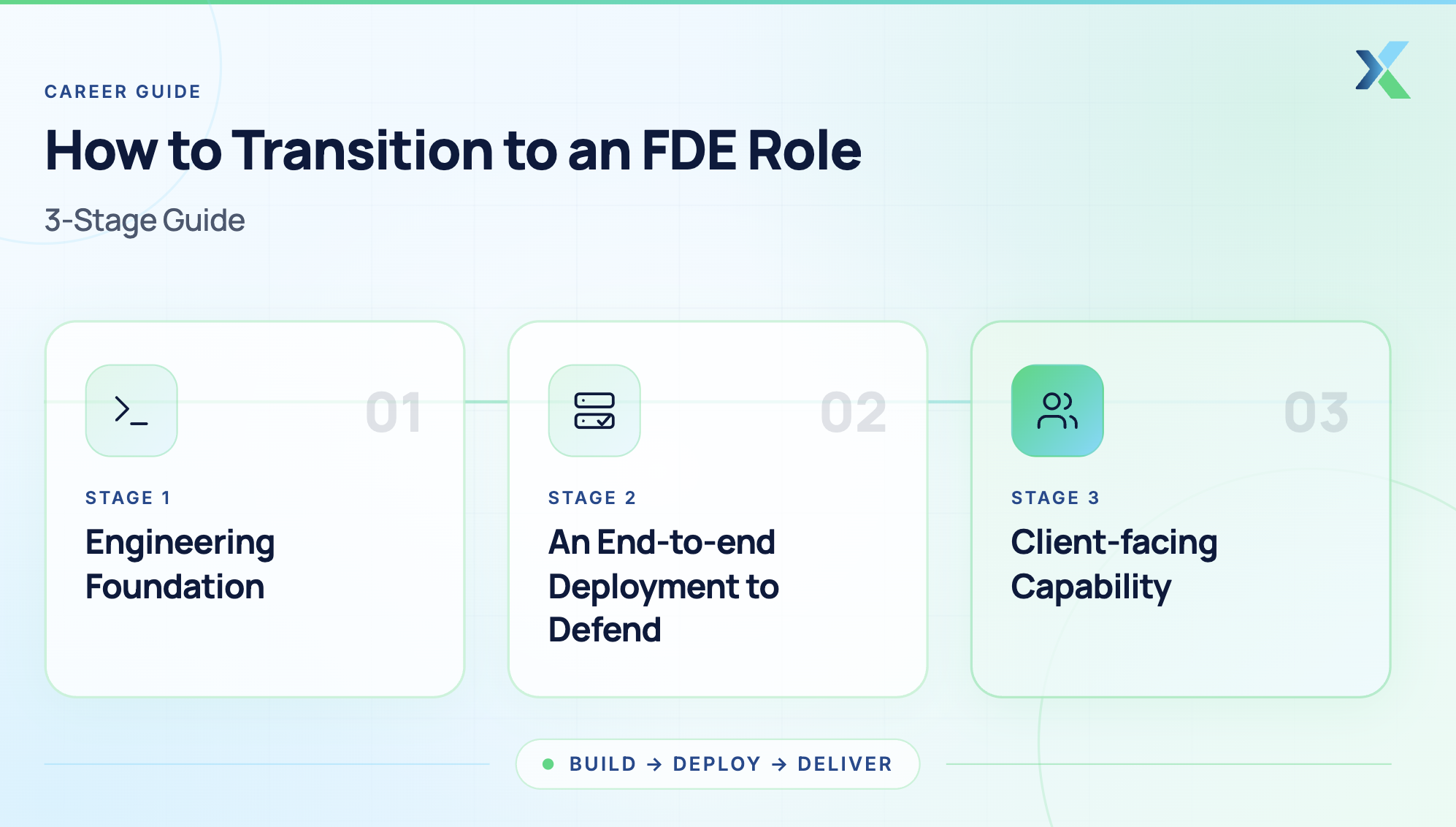
Stage 1: Engineering Foundation
Treat this stage as an audit you can run against yourself in two minutes. You need production Python with typing, testing, and packaging, API design in a framework such as FastAPI or Flask, working SQL, Git with a branching model you actually follow, containerization with Docker, one cloud provider across compute, storage, identity, and networking, and CI/CD basics through GitHub Actions or an equivalent. Close whatever is missing before moving on, because every later stage will assume you have it.
Artifact for this stage: A deployed service with logging, monitoring, and a health check that someone other than you can run. A notebook does not count. If you want this foundation structured rather than self-assembled, our FullStack Applied AI course covers the deployment stack end to end.
Stage 2: An End-to-end Deployment to Defend
This is the decisive interview asset - one strong project beats five shallow ones. Focus on building a single system that contains retrieval over a real document or data set, generation grounded in that retrieval, an evaluation layer with defined metrics, a serving interface, and a monitoring surface that shows you what is happening in production.
What makes it defensible is not the architecture but the context around it: a real user or stakeholder who wanted the thing, a success metric you stated before building, and at least one documented failure you found and fixed. Interviewers spend most of their time on that last item, because it is the only part nobody can copy from a tutorial.
Artifact for this stage: The deployed system plus a short written record covering what you measured, what broke, and what you changed. This record is worth more in an interview than any certificate, and the job descriptions themselves say so when they ask for production deployment experience rather than credentials.
Stage 3: Client-facing Capability
This is the least-taught part of the role and the most common reason a technically strong candidate does not convert. It is learnable, provided you treat it as a set of practices rather than a personality trait.
Four practices are worth building deliberately.
Write a one-page scoping note stating the problem, the constraint, the success metric, and what you are explicitly not doing.
Run a discovery call where you ask more than you explain.
Say no to a requirement that will not survive production, and offer an alternative in the same breath.
Escalate a slipping timeline in writing before anyone asks.
Artifact for this stage: An anonymized scoping document you can show and talk through. This closes out the forward deployed engineer roadmap, and the three artifacts together are what an interviewer will actually ask you to walk through. If you are moving into AI delivery from a non-engineering background, our Generative AI course is a more appropriate entry point, since it builds AI workflow capability without assuming a production engineering base.
This brings us to the next important section. An forward deployed engineer is mostly asked to demonstrate their skills in real time. More than theoretical know-how, it is the experience of handling an AI project end-to-end and managing the client expectations simultaneously that counts.
Forward Deployed Engineer Interview Questions: What the Loop Actually Tests
Interviews for this role are structured around four categories rather than a fixed question bank, and knowing the categories is more useful than memorizing questions.
Most people researching how to become a forward deployed engineer prepare heavily for the first two categories and barely at all for the last two, which is precisely where the loop tends to catch them. Each category tests a different failure mode.
Production coding under ambiguity
You get an underspecified problem and are watched to see whether you ask before you build. Example: Here is a client data feed with inconsistent schemas across sources; make it usable.
System design with integration constraints
Not greenfield architecture, but design inside somebody else's limitations. Example: the customer will not let data leave their VPC; design the retrieval layer.
Customer scenario handling
A judgment test, usually a roleplay. Example: the client asks for a feature you know will fail in production, and their sponsor is on the call.
Portfolio defense
A deep interrogation of your stage-two project, focused on tradeoffs and failures rather than features.
Now that you know what this role demands and what kind of skills are required, the natural next question is whether you should enroll yourself in a dedicated forward-deployed engineer course. The answer isn't a simple yes or no.
Is Forward Deployed Engineer Course Worth It?
The honest answer depends on which half of the role you are missing, so start there rather than with the course catalog.
If you already have the engineering foundation from stage one and you have access to a real stakeholder with a real problem, build the portfolio yourself. Nothing in a classroom substitutes for a deployment somebody actually depended on. Infact, you will learn more from one difficult stakeholder than from a module on stakeholder management.
Structured training earns its place in three situations.
When delivery is your gap, because that half is hard to self-teach without context that forces you to practice it.
When you have no access to a real deployment environment, which is common in internal tooling roles or services work with limited client exposure.
When you need a credential to clear a screening filter that would otherwise reject you before a human reads your profile.
One caution applies to our own category as much as anyone's. A standalone forward deployed engineer certificate with no deployment portfolio behind it carries limited weight. This is because the employers hiring for this role screen on evidence of shipped systems.
We recommend judging any training by whether it produces that evidence, and bringing that question into any conversation about a forward deployed engineering course certification. Ultimately, the answer to how to become a forward deployed engineer comes down to evidence rather than enrollment: employers want to see a system you deployed, not a certificate you collected. A course earns its fee only if it moves you along the forward deployed engineer roadmap faster than you would move on your own.
FAQs
Is forward deployed engineer a good career in India?
It is a strong option for the right profile and a poor fit for most others. Pay sits at a premium, with a realistic band of ₹28-55 LPA in mid-senior years, and the candidate pool is small. Against that, India carries roughly 250 to 270 openings at any given time, so volume is limited. Expect a targeted search rather than a broad one.
Will forward deployed engineer hiring grow in India?
Our read is yes, with the reasoning shown rather than a projected number. Every major hirer for the role already runs India delivery or GCC operations, and the embedded headcount committed by AWS and Microsoft in mid-2026 cannot be staffed from US teams alone. The counterweight is that customer proximity and time zone overlap keep some of this work close to the customer, so not all global demand will route to India.
Can a fresher become a forward deployed engineer?
Not directly, in almost all cases. The forward deployed engineer roadmap requires production engineering judgment and customer-facing capability at the same time, which is why job descriptions typically ask for two to five years of experience. A realistic fresher path is to spend two to three years in backend, full-stack, or data engineering while building deployment experience, then pivot.
Forward deployed engineer Palantir roles: does Palantir hire in India?
Palantir originated the title and hires for it globally. The company has an India presence, but whether it is actively recruiting for the role in India changes frequently, so check its careers page directly rather than relying on aggregator listings. The broader point is that several employers hiring for this work in India advertise it as Solutions Engineer or Applied AI Engineer instead.
What should a forward deployed engineer resume show?
Lead with one deployed system rather than a list of technologies. State what the system did, who used it, what metric it moved, and what you fixed when it broke. Include customer-facing responsibility explicitly, such as running scoping calls or owning a client relationship, because reviewers look for it and most engineering resumes omit it entirely.
What is the forward deployed engineer career path after this role?
The role combines production engineering and customer ownership, so it opens more than one direction. Common next steps include leading a deployment or delivery team, moving into solutions architecture, joining an applied AI company as a founding or early engineer, or shifting into product with unusually direct knowledge of what customers struggle to adopt.
How to become a forward deployed engineer without prior AI experience?
Start from the engineering half rather than the AI half, because that is the faster route for most people. Solid backend or data engineering plus cloud deployment gets you most of the way, and the AI layer you actually need for this role is applied rather than research-level: retrieval, grounding, evaluation, and monitoring. Build one deployed system that uses those four things on a real dataset, document what broke and how you fixed it, and you will have a stronger case than a candidate with AI coursework and no production exposure.
How long does the forward deployed engineer roadmap take?
Plan for nine to eighteen months alongside a full-time job, though the honest answer depends on where you start. If stage one is already covered by your current role, stage two is realistically a two- to four-month project done properly, and stage three builds on whatever client or stakeholder exposure you can engineer for yourself at work. Engineers with no production deployment experience should expect the longer end, because you can't rush stage one without weakening everything built on top of it.
What forward deployed engineer interview questions should you prepare for?
Prepare across the four categories rather than memorizing a list, because the loop tests different failure modes. Expect an underspecified coding problem where asking before building is the point, a system design question constrained by someone else’s security or infrastructure rules, a customer roleplay where the right answer involves saying no well, and a long interrogation of a project you actually shipped. The last two are where most technically strong candidates lose the offer.