SQL i.e. Structured Query Language, is one of the most used query languages. Mastering SQL for Data Science is not a quick process. To completely comprehend the depth and breadth of this potent tool, an organized learning method combined with consistency and professional supervision is necessary. We will discuss the principles of SQL, its importance in data processing, various important topics, and some steps to master it in this article. Let’s start with the basics.
What is SQL?
Structured Query Language (SQL) is a special-purpose programming language containing a set of statements that enable communication with the relational database. The data access procedures in SQL work by firing queries and statements to store, manipulate, retrieve, and delete data. The query language provides user privileges and creates, modifies, and deletes database objects like tables, columns, and users. The major categories of SQL are:
- Data Definition Language (DDL) including CREATE, ALTER, and DROP.
- Data manipulation Language (DML) including SELECT, UPDATE, INSERT, and DELETE.
- Data Control Language (DCL) including REVOKE, GRANT.
- Transaction Control Language (TCL), including BEGIN, COMMIT, and ROLLBACK.
Importance of SQL
In the readily evolving technological world, can you think of something working as well as it worked around five decades ago? Structured Query Language (SQL) is one of the oldest and most used programming languages. It was made commercially available in 1979 by developers from Relational Software (now Oracle).
SQL is still the most used language for defining, accessing, retrieving, and maintaining data from datasets .
Businesses need a skilled workforce to drill the data and communicate with databases effectively when talking about big data. The data-driven businesses generate the need for SQL as a prerequisite in the candidates’ resumes.
Proving its excellence for ages, SQL exploits the data in a useful manner by evoking the required essentials from the massive data bags. Industries in almost every sector develop and use queries to create datasets.
Various applications use these datasets, including crafting interactive reports and applying machine learning algorithms. SQL also develops review strategies and techniques for designing analytical datasets, facilitating knowledge building.
Before peeking into the use of SQL, having a glance at the reasons to learn the language will prove its industrial magnificence.
SQL for Data Pre-Processing
During data pre-processing, we recognize SQL as a very important tool. SQL offers a vast range of capabilities and functionalities, enabling effective and efficient data preparation prior to any analysis. SQL is used for data pre-processing in various ways: 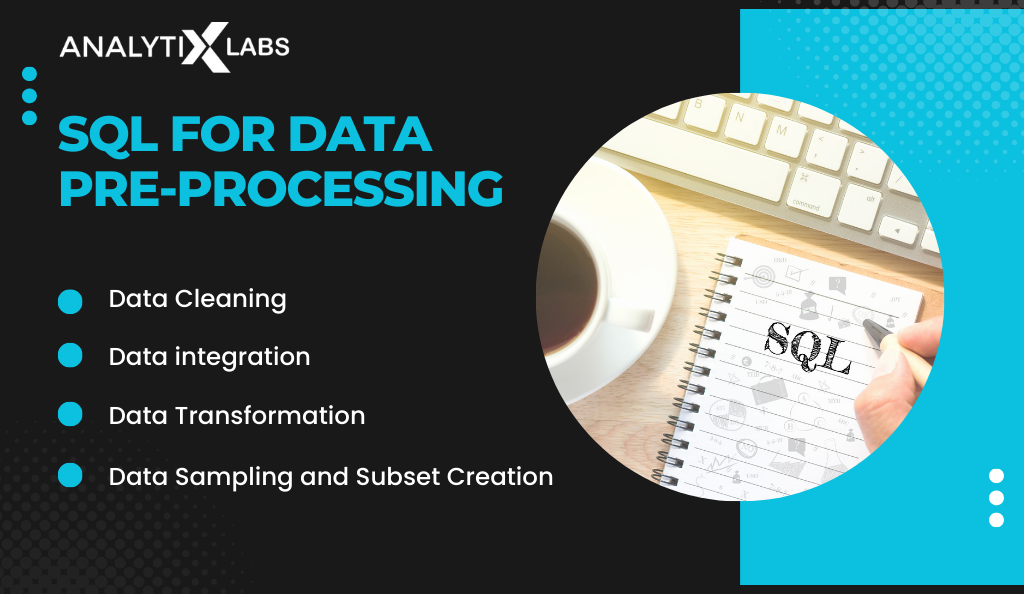
- Data Cleaning: SQL allows you to carry out data cleaning operations like eliminating duplicates, dealing with missing values, and standardizing mismatched data types. You can further clean the data by leveraging SQL’s grouping, filtering, and transformation capabilities.
- Data Integration: Using SQL, you can merge data from various sources into a single, coherent dataset. With the use of joins, unions, and subqueries, you can combine and merge data from many tables or databases, ensuring that all the necessary data is present for analysis.
- Data Transformation: SQL offers robust operators and functions for data transformation. Using SQL queries, you can alter data structures, carry out computations, conduct mathematical operations, construct derived columns, and more. By doing so, you can restructure and get the data ready in a way that will work for further analysis.
- Data Sampling and Subset Creation: With SQL, you can build subsets of your data based on particular criteria or extract random samples from your data. Utilizing SQL’s sampling and filtering features allows you to work with smaller data samples for exploratory research or model creation, lowering computational costs and processing time.
5 Reasons to Learn SQL
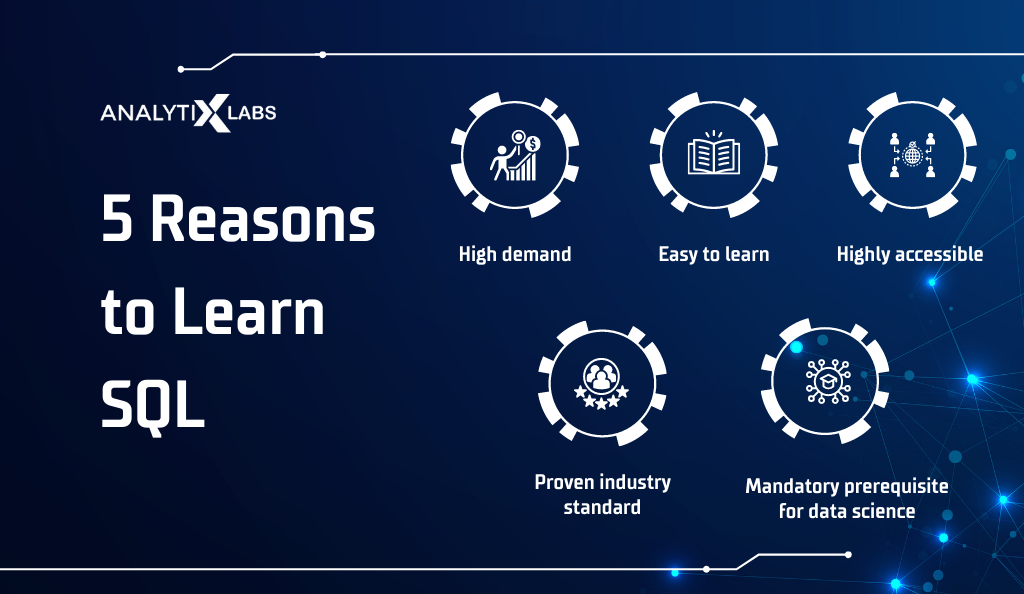
1) High demand
You may be one of those aspirants willing to enter the data science field for job roles like data analyst or data engineer. The job roles of the niche industry demand its professionals be acquainted with SQL Skills. Despite the popularity of languages like Python, R, and Scala, old-age SQL is still incredibly important for relational database communication.
2) Easy to learn and use
SQL uses declarative statements that are easy to use as compared to other programming languages following typical syntaxes. Unlike complex programming languages like Java, which follow a restricted series of steps to complete a given task, SQL utilizes simple English words as queries to manipulate data and derive insights from it.
With the use of SQL, it is easy to view and modify data in the databases. With fewer queries, one can update and control the schema and transactions in the large database. The highly reliable language works well with complex queries and delivers character results.
3) Highly accessible
SQL is widely used due to its compatibility and quicker access to information. Queries, along with the joins, expressions, clauses, and predicates, help access even the hidden information from the databases with high reliability and exception handling.
The language is popular for its compatibility with most databases like Microsoft Access, Oracle, MySQL, etc. SQL can be applied over servers, laptops, and mobile devices to ensure ease of access to the data.
4) A proven industry standard
SQL has the capability to handle huge data sets with higher processing speed and efficiency. Restricted access to the data ensures data protection and security. These features make SQL an old and experienced database language.
5) A prerequisite for a data science job
One must be skilled in understanding databases for jobs in the data science industry. SQL helps in developing thorough insights into the data by using queries. You can play and explore your data set by using SQL by filtering, slicing, sorting, and aggregating. Hands-on experience in SQL skills can make you eligible for various data science jobs like data engineer, data analyst, and data scientist.
Where is SQL used?
The fundamental use of SQL lies in maintaining and communicating in relational Database management systems. The major uses of SQL include defining the schema architecture, manipulating the data, controlling the user permissions, and allowing database transaction control SQL. SQL rests as a base for various applications listed below.
-
SQL for Websites
Websites contain a backend database that stores a large amount of data related to users and products. The developers retrieve this data using SQL query language. E-commerce websites like Flipkart and Amazon use MySQL for data management and communication. Additionally, movie booking applications and accommodation websites use SQL to perform operations to undergo the booking procedures.
-
SQL for Finance Industries
Financial industries store and operate robust data about users and their financial transactions. SQL queries can retrieve This data using higher efficiency, reliability, and added security.
In addition to this, financial analysts can make their own databases containing the financial data for analysis. This specialized database can be used to monitor the cash flow and predict the health of the financial institutions.
-
SQL for Social Media Platforms
People nowadays spend their maximum time posting and surfing social media platforms like Facebook, Snapchat, and Instagram. SQL is used by the apps to monitor the user’s profile and update the database whenever any content is posted.
The database stores every modification made to the profile, enabling the profile user to access shared photos and sent/received messages at any given time. These superficially simple and user-friendly procedures have complex SQL queries to store and update the data on the database.
-
SQL for Machine Learning
Machine learning procedures involve continuous training of the data. They learn by examples that are fed into the system for better learning. To handle these large datasets, SQL plays an inevitable role. SQL finds its place in the next-generation cloud storage technologies.
They ensure scalable infrastructures and real-time data transfer for heavy machine-learning applications. Moreover, SQL can be integrated with scripting languages like Python and R to use the databases implemented in these languages effectively.
This helps data scientists and ML engineers to work over large datasets more easily. The latest example of SQL for Machine Learning is Google’s cloud platform BigQuery.
-
SQL for Data Analysis
The process of data analysis requires effective communication with data. SQL allows the analysts to question the data using simple queries to get quick and perfect responses from the database. Cloud data is highly granular and dynamic.
The analysts need to work to predict user behavior for business proliferation. SQL helps eradicate the noise and understand the data to build insights for the business.
-
SQL for Marketing
For effective marketing, it is requisite to understand the customer demographics, buying behavior, predict sales and identify potential customers. Marketers use query languages like SQL to filter the data to generate the necessary insights for higher sales.
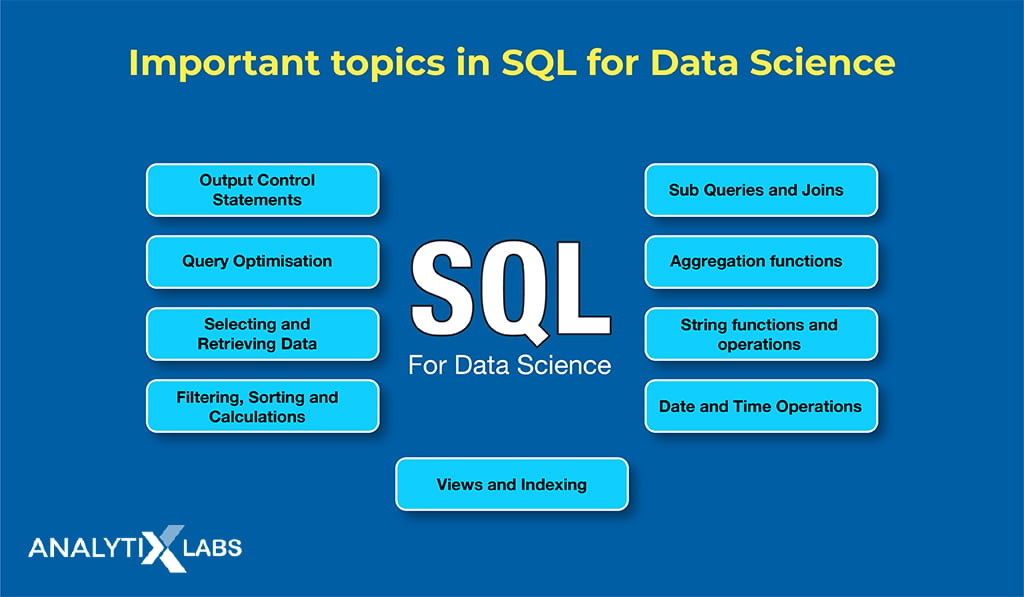
Important Topics of SQL
There are multiple learning sources available to learn SQL. Choosing the correct platform depends upon your learning preferences, time availability, and budget.
Enrolling in integrated courses that offer theoretical knowledge and practical applications can help you land suitable job designations. Some important SQL topics are mentioned in the section below.
Data Types in SQL
Data Type is a guideline for SQL workbench that dictates what type of data is to be expected in a particular column. Each column in a table is required to have a proper name and a data type, where the user has to decide what data type is to be given to a particular column. There are some data types in MySQL, for example:
-
String
-
CHAR
-
VARCHAR
-
BINARY
-
VARBINARY
-
TEXT
-
Numeric
-
INT
-
FLOAT
-
DOUBLE
-
Date and Time
-
DATE
-
DATETIME
-
TIMESTAMP
-
YEAR
This data standardization makes it extremely handy when performing data science as we often need to have the data and its columns to have proper data types. This helps in the easy implementation of functions and performing other operations.
- Selecting and Retrieving Data with SQL
Data Science often requires a specific dataset for analysis or creating a model. Therefore, selecting and retrieving the dataset from the database commands such as SELECT of SQL is useful.
For example, if we have a table in our current database with the name – Employee.
| Employee ID | Employee F. Name | Employee L.Name | Salary |
|---|---|---|---|
| 1 | Aron | Mathew | 20000 |
| 2 | Deb | Woods | 40000 |
| 3 | John | Adams | 60000 |
And if we want to retrieve the whole data, then we use the SELECT command:
SELECT * from employee;
Here * is used to retrieve the whole data, so we get the output as a full table.
- Filtering, Sorting, and Calculating
Often Instead of simply retrieving the whole data, we need to retrieve the data based on some conditions. Here commands such as the WHERE clause help for filtering out data from a table.
Suppose we want to retrieve the data based on conditions, e.g., want the employee id whose salary is more than 60000, then we write the query like:
Select employee id from employee
Where salary >60000;
| Employee ID | Salary |
|---|---|
| 3 | 60000 |
This is the output we get by running the above query. If you want to sort the data, then the ORDER BY clause is used for sorting any column.
-
Aggregation Functions
The next advantage of SQL is that it can quickly provide us with descriptive statistics to summarize the data. An Aggregate function performs the calculation on a set of values, returns a single value, and ignores the null values (except count(*)).
Some of the common aggregation functions in SQL include:
- Min
- Max
- Avg
- Count
- Sum
Let’s look at some queries related to the above aggregate functions:
-
String Functions and Operations
A string function is a function that takes a string value as an input regardless of the data type of the returned value. In data science, where Natural Language Processing is often a common theme and the user needs to perform operations on text-based data, these string functions help the user clean the data. Common string functions in SQL are:
1. ASCII
American Standard Code for Information Interchange. This ASCII query returns the output as: