

Full Stack AI Course
Applied AI Mastery: GenAI, Computer Vison & Deep Learning
317+ Hours
5
Months
*TIH Partnerships via Edzor CAITE
15 Mar
Interactive Live Online
29 Mar
Gurgaon
04 Oct
Interactive Live Online
29 Mar
Gurgaon

08 Nov
Noida
08 Nov
Gurgaon
28 Sept
Noida
Learning Modes

Classroom Sessions
INR 86,440/-*
(Pay in Easy Installments)

Interactive Live Online
INR 77,000/-*
(Pay in Easy Installments)

Blended eLearning
INR 71,100/-*
(Pay in Easy Installments)



Applied AI Course Overview
Artificial Intelligence Engineering
₹ 20000/-
Artificial Intelligence Engineering
₹ 20000/-
Artificial Intelligence Engineering
₹ 20000/-
₹ 65000/-
₹ 48000*/-
Optional Course
Data Science using R
₹ 20,000
₹ 4000/-
Applied AI Course Overview
Program Fees
(Program fees starts from)
INR 70,800/-*
(Program fees starts from)
INR 53,100/-*
Learning Modes
Interactive Live Online
INR 80,240/-*
(Pay in Easy Installments)
INR 68,440/-*
(Pay in Easy Installments)
Blended eLearning
INR 70,800/-*
(Pay in Easy Installments)
INR 53,100/-*
(Pay in Easy Installments)
Full Stack Applied AI Course Overview

105 Hours Live Training
+ 35 Hours e-learning

Self Study & Practice
Projects & Assignments

Assessments & Projects
19 Hours
Employers need professionals who can build systems as AI moves from pilot projects to production systems. The demand is high but there is a shortage of skilled professionals. This FullStack Applied AI course bridges this gap and takes you from AI foundations to deployed, agentic AI applications in just about 4 months.
This is not a theory-first course. You start with generative AI and no-code agentic workflows, move into building LLM-powered applications in Python, and finish with advanced computer vision and reinforcement learning. Along the way you work with the tools teams actually use in production: LangChain, LangGraph, CrewAI, RAG pipelines, Hugging Face, and deployment stacks like FastAPI and Streamlit.
The program runs across 105+ hours of live training and 35 hours of e-learning, with a project-and-assessment track built around real business problems rather than toy datasets. It carries a dual certification from TIH at IIT Patna and FutureSkills Prime Nasscom with guest lectures from TIH-associated experts layered on top of the core curriculum.
AI Certification Course Curriculum
The curriculum runs in four connected stages.
- You first build your foundation in generative AI, prompt engineering, large language models, and no-code agentic automation using tools like Zapier, n8n, and Make.
- Then you move into applied agentic AI with Python: fine-tuning, multimodal LLMs, vector databases and RAG, autonomous multi-agent systems, and the Model Context Protocol.
You then learn how to take AI applications from development to production, covering deployment, evaluation, monitoring, and performance optimization. You also build an understanding of LLM security, MLOps, and LLMOps practices needed to build and maintain reliable AI systems.
Last is a self-paced advanced module covering computer vision and reinforcement learning.
By the end, you will have built and deployed AI agents, LLM applications, and computer vision models, with a portfolio of capstone projects to take into interviews.
Generative AI & Nocode Agentic AI
AI Foundations
- AI vs. Automation vs. Analytics
- AI, Machine Learning (ML), Deep Learning (DL) – differences & connections
- Narrow AI vs. General AI vs. Super AI
- Core AI applications (NLP, CV, Robotics, Predictive Analytics)
Generative AI Basics
- Traditional AI vs. Gen AI
- Every day, GenAI applications
- How does GenAI work?
- Key models (GPT, Claude, Gemini, LLaMA)
- Text generation & completion techniques
- Prompt Engineering basics: role, task, context
- Core Prompting Tasks (Text generation & completion, Summarization (short & detailed), Rewriting in different tones/styles)
- Prompt Structures (instructional, role-based)
- Prompting Techniques (Zero-shot prompting, Few-shot prompting, Chain of Thought (CoT) prompting
- Role Prompting, Multi-turn interactions (context retention), etc..
- Limitations of prompting
- Evaluating GenAI output quality
Large Language Models (LLMs): How They Work
- Introduction to transformers
- LLMs vs. SLMs
- Popular LLMs (GPT, Claude, Gemini, LLaMA) – Overview – Strengths & Limitations
- Introduction to Embeddings
Introduction to Agentic AI
- No-code AI overview
- Intro to workflow automation tools
- Introduction to Zapier basics (triggers & actions), n8n workflow design, Make.com integrations
- AI-powered productivity with Notion AI for task automation & summarization, Airtable for data storage & automation, Glide for mobile app prototyping, etc.
- Design & Storytelling Tools
- Integrating AI into everyday workflows – Linking AI workflows with business processes
- Prototyping with no-code/low-code tools
What is an AI Agent? How it differs from chatbots
- Agentic AI vs. AI Agents
- Key components of Agentic AI: memory, planning, tool use, autonomy
- AI Orchestration with no-code tools
- Agent frameworks (LangChain, AutoGen, CrewAI – overview)
AI challenges: Bias, hallucination, privacy & security issues
- Responsible AI principles: Fairness, Accountability, Transparency, Explainability
- Global AI Ethics Frameworks
- Safe & Responsible usage
- Responsible AI: Guardrails
Applied Agentic AI (Agentic AI Systems using Python)
Setting up the development environment
- Installing and configuring tools like VS CODE, JUPYTER LAB, GitHub
- Best practice for managing dependencies and optimizing the workspace
- Numpy & Pandas for AI workflows
- Functions & Classes in Python
- Working with APIs (REST APIs, JSON handling, requests library)
Transformers & Fine-Tuning
- Transformers Architecture Basics(Introduction, attention, multihead attention, encoder-decoder with context)
- The Main Idea behind the Transformer
- Coding self-attention in Pytorch
- Self-attention and Masked Self-attention
- Hugging Face Transformers basics
- Pre-trained vs fine-tuned models
- Fine-tuning pre-trained models (BERT, GPT-style)
- Parameter-efficient fine-tuning (PEFT, LoRA, adapters)
GPT from Scratch
- Language modeling concepts
- Tokenization & embeddings
- Implementing a simple GPT model step by step
- Training with a toy dataset
- Training loop & loss function
Multi-Modal LLMs
- Text-to-Image models (Stable Diffusion, DALL·E)
- Image-to-text models (BLIP, CLIP, Flamingo)
- Text-to-Speech and
- Speech-to-Text APIs
- Speech-to-text (Whisper)
- Combining modalities (vision + text)
- Multi-modal pipelines (text+image, text+audio)
LLM Prompting & LangChain Basics
- LLM Wrappers & APIs
- Prompt engineering strategies
- LangChain components: Memory, Tools, Chains, Agents
- LangChain wrappers and memory
- Orchestrating LLM workflows
- Building basic agents
Vector Databases & RAG (Retrieval-Augmented Generation)
- Introduction to embeddings (SBERT, OpenAI, Cohere)
- Vector embeddings and similarity search
- FAISS & Pinecone, Weaviate for vector search
- Chunking & indexing documents
- Building RAG(Retrieval-Augmented Generation) pipelines
- Integrating Fusion & Re-ranking (Practical Sketch)
Autonomous Agents (Agentic AI)
- Introduction to LLM Agent Systems
- CrewAI & AutoGen frameworks
- Multi-agent coordination
- Task decomposition & delegation
- Building workflow-driven AI agents
- Tools, memory, reasoning
- Deployment & Use Cases
LangGraph & Model Context Protocols (MCP)
- LangGraph introduction
- Designing agent workflows with graphs
- State management in multi-agent systems
- MCP for standardized context sharing
- Future of agentic AI ecosystems
- Agent to Agent Protocols (A2A)
Testing & Evaluating LLM Apps/outputs (metrics, hallucination checks & frameworks)
- Monitoring & debugging with LangSmith
- App deployment with Streamlit, Gradio
- API deployment with FastAPI
Production Deployment, Evaluation, LLM Security, MLOps & LLMOps Basics
Packaging & Containerizing an AI Service
- Why deployment is different for AI systems: batch vs. real-time inference, self-hosted vs. managed serving and how to choose
- Packaging an LLM or agent pipeline behind a clean, versioned API contract
- Environment reproducibility: pinning dependencies and avoiding works-on-my-machine failures in an AI stack
- Docker fundamentals for AI workloads: base images, layer caching, handling large model weights and dependencies
- Writing a production-sane Dockerfile using multi-stage builds and slim images
- Local testing of a containerised service before it reaches a cluster
Kubernetes & Cloud AI Platforms
- Kubernetes core concepts for AI workloads: Deployments, Services, Ingress
- Autoscaling for variable, bursty AI traffic, and resource requests and limits for GPU or CPU-heavy workloads
- AWS Bedrock, Azure OpenAI and GCP Vertex AI: what a managed platform buys you against a direct provider
- API call
- Cost and latency trade-offs across deployment options
- A decision framework for choosing a deployment target given real project constraints
Evaluation Foundations: Why Metrics Fail & Golden Datasets
- Why accuracy, BLEU and ROUGE do not capture generative AI quality
- Failure-mode taxonomy: hallucination, drift and silent degradation, and why AI systems fail quietly instead of
- crashing
- Evaluation as a required production artefact, not an academic afterthought
- Building a golden dataset: ground-truth curation, sampling strategy, edge-case coverage
- Core metrics: task success rate, faithfulness and groundedness, relevance, toxicity and bias, cost per quality
LLM-as-Judge & Automated Evaluation Harnesses
- Building a rubric-based LLM judge and sanity-checking it against human-labelled examples
- Harness architecture: dataset, scorer, report. Batch testing and result aggregation
- Before and after comparison reporting to prove a change actually improved quality
- Regression testing basics: gating a release on evaluation scores so quality cannot silently slip backward
- Building a lightweight evaluation summary a non-technical stakeholder will actually read
MLOps, LLMOps & Observability
- MLOps fundamentals recap, and where LLMOps departs from it
- Prompt and pipeline versioning: treating prompts, chains and RAG configurations as versioned artefacts
- Why the model in an LLM system is really model plus prompt plus retrieval config plus tools, and why all four
- need version control
- What to log and trace beyond standard application logs: prompts, retrieved context, tool calls, token usage
- Tracing tools and reading a trace to understand why an agent did what it did
Monitoring, Drift & Security Basics
- Defining SLOs and SLIs for an AI feature that go beyond uptime: quality, hallucination rate, latency
- Alerting on drift: model drift and data drift basics, and simple detection approaches suitable for a small team
- Turning a production trace into a new evaluation test case
- OWASP Top 10 for LLM applications: prompt injection, insecure output handling, excessive agency
- PII detection and redaction basics, and an audit-trail and logging checklist for compliance-sensitive deployments
Product Design for AI, Without Writing Frontend Code
- UI and UX principles for AI-powered interfaces: managing latency, uncertainty and streaming output
- Translating a workflow into a usable, efficient product design, and heuristics for good against confusing AI-
- product UX
- Rapid, code-free prototyping using AI prototyping tools
- When to hand a UI need to a design or frontend specialist, and when a lightweight engineer-built mock-up is
- enough
- Feedback loops: what to instrument so you learn what users actually do with an AI feature
- Product thinking: a build, configure or escalate decision framework
Runbooks & Internal Tooling
- Recognising when a project-specific fix should become a reusable pattern
- Writing runbooks and deployment playbooks another engineer can follow without you in the room
- Documentation standards that scale a solution across projects
- Building small internal tools, CLI scripts and lightweight dashboards that speed up the next project
- Contributing a pattern back to a shared internal library, and what makes a pattern genuinely reusable
- Balancing delivery speed against the discipline of writing things down
Advanced AI (Optional Self-Paced Learning)
Advanced AI, Computer Vision & Reinforcement Learning
- Introduction to AI & Deep Learning (AI)
- Artificial Neural Network
- Introduction to Cloud Keras, Pytorch
- Computer Vision & Applications
- Convolution Neural Nets – Architecture – Implémentation
- Popular ImageNet models & Transfer Learning
- E2E Custom Data training framework in Pytorch
- Computer Vision – Object Detection, Encoders
- Reinforcement Learning
Request a Call back
*The programme also includes additional modules designed to enhance your learning experience.
Download the brochure to view the complete course curriculum and module details.
How This AI Course Fits With Our Other Programs?
The Full Stack Applied AI Course is the most extensive of our AI training courses. If your goal is narrower, or you are earlier in your journey, one of these may fit better:
- Generative AI course for a focused track on LLMs, prompting, and generative applications. This is a no-code/low-code learning track that is ideal as a starting point.
- Agentic AI course to focus specifically on building autonomous AI agents. This track helps in advancing your AI skills to building and deploying agentic AI systems.
Ideally, our recommended learning track is: Generative AI → Agentic AI → FullStack Applied AI for a complete end-to-end AI learning.
Each program has a distinct goal, though the curriculums intersect at points. Explore the individual curriculums to see which one maps to your career target.
Why Learn AI with AnalytixLabs?
AnalytixLabs has trained data, analytics, and AI professionals since 2011, and that experience shapes how this course is built. It is designed to be accessible whether you are a fresher, a working professional, or a career-switcher, starting from core concepts and building toward production-grade skills. We have constantly revised and upgraded our curriculums to address employer-to-professional skills gaps head-on, and train professionals to stay relevant, irrespective of the timelines.
This, like all our other courses, is crafted by practitioners putting the emphasis on application: you learn each tool in the context of the problem it solves, then apply it to business scenarios. Two objectives run through the program.
- To give you genuine command of the AI toolchain, progressing in a sequence that lets each concept settle before the next.
- To take you to a level where you can design, build, and deploy AI systems that help organizations make confident, data-driven decisions.
Who Should Do The AI Course?
This program is built for four kinds of learners:
- AI and Deep Learning career aspirants: If you are a fresher or switching into AI, you build a complete, job-ready skill set spanning generative AI, agentic AI systems, computer vision, and reinforcement learning, and you leave with multiple capstone projects to show in interviews and on your portfolio.
- Working professionals and data practitioners: Move from theory to production through hands-on Python projects covering LLM development and fine-tuning, agentic application development with LangChain, LangGraph, and CrewAI, RAG pipelines, and real-world deployment on FastAPI, Streamlit, and cloud platforms.
- Researchers and enthusiasts: Go deep on current agentic AI, including multi-agent orchestration with CrewAI, the Model Context Protocol (MCP), multimodal LLMs, transformer architectures built from scratch, and reinforcement learning techniques such as DQN, DDPG, and DPO.
- SMBs and tech innovators: Automate real business workflows with no-code and low-code tools like Zapier and n8n, then scale into custom Python-based AI systems as you outgrow no-code limits, without heavy upfront R&D investment.
Key Skills
- Understand the foundations of AI and Generative AI
- Master prompt engineering and prompting frameworks for real-world scenarios
- Automate workflows with no-code/low-code AI tools
- Design and deploy AI Agents for business and personal productivity
- Understand core AI & GenAI fundamentals
- Build LLM-powered apps with LangChain & Vector DBs
- Design & deploy AI agents using Python frameworks
- Work with practical enterprise use cases in automation
- Apply AI responsibly with awareness of ethical, bias, and governance considerations
- Computer Vision Applications
- Reinforcement Learning
Learning Outcomes
Graduates of the program will be able to:
- Communicate AI concepts to both technical and business audiences.
- Design prompts and no-code workflows for productivity and automation.
- Build and deploy LLM-based apps with LangChain, RAG, and multi-agent systems.
- Implement computer vision models for tasks like image classification, surveillance, or defect detection.
- Apply reinforcement learning for decision-making, optimization, and autonomous systems.
- Develop advanced AI prototypes — from chatbots to CV-enabled drones.
- Integrate AI safely and ethically into real-world workflows.
- Showcase an AI portfolio with capstone projects across Generative, Agentic, and Advanced AI.
Projects
- Objective: Build an AI assistant that helps with productivity using GenAI + No-Code Automation using tools like zappier, make or n8n etc..
- Problem Identification: Choose a real productivity pain point (e.g., too many emails, meeting overload, research notes etc..)
- Workflow Design: Build automation using Zapier/n8n to connect AI with apps (Notion, Google Docs, Slack).
- Chatbot Assistant: Use ChatGPT/Notion AI for contextual Question & answers.
- Interface Prototype: Build front-end in Glide/Tome AI.
- Final Presentation & Demo: Live demo + explanation of workflow + reflection on ethics
- Should automate at least 3 tasks (e.g., meeting notes → task assignment → daily summary email)
- End-to-end AI Agentic Workflow integrating multiple modules.
Assignments
- Add extra features: e.g., voice input, task prioritization, or reminders.
- Explore alternative integrations (Slack, WhatsApp bots).
- Document your workflow and share video demo
Job Roles to Explore
- AI Engineer
- Data Scientist
- Machine Learning Engineer
- AI-ML Specialist
- Robotics Specialist
- Data Science Consultant
- Computer Vision Engineer
- Analytics Consultant
Key Skills You Will Learn
This artificial intelligence certification course includes a comprehensive range of skills, including but not limited to the following.
- Large-Scale Analytics on Cloud
- Deep Learning Modelling for AI Applications
- Predictive Modelling using Neural Network
- Data Science Methods
- Image Processing Using Deep Learning Techniques
- Supervised Learning Models
- Natural Language Processing & Generation (Chatbots)
- Unsupervised Learning Models
- Check your eligibility
AI engineering Capstone Projects
Our artificial intelligence courses in India include multiple case studies and assignments for self-study and hands-on skills, in addition to multiple case studies.
Assignments
- 10 short exercises on NumPy & Pandas
- 4 case studies on Pandas for data munging, descriptive & visual analysis
- 3 Basic exercises (Excel, SQL & Tableau)
- 1 Assignment on basic Python
- 2 exercises for statistical analysis
Projects
- Image classification for inventory management (AI DL)
- Machine Language Translation (French to English & Hindi to English)
- Stock price forecasting (Deep Learning)
- Image classification project (AI DL)
- Credit Card fraud detection (Deep Learning)
- Automated image captioning (AI DL)
- Age detection using images (AI DL)
- Toxic comments classification (Deep Learning)
- Image classification & localization (Using YOLO)
- Network intrusion detection (Supervised machine learning)
- Online job posting analysis (Text mining & NLP)
- Banking customer cluster (Unsupervised machine learning)
- Retail chain sales forecasting (multivariate time series)
- Predicting credit card spend (regression methods)
- E-commerce recommendation engine (MBA)
- Chatbot creation (Seq2seq Deep Learning)
- Bank reviews analysis (Text mining & NLP)
Programming Tools and Languages






Artificial Intelligence Course Fees
Interactive Live Online
Blend classroom dynamics with engaging, real-time interactive Online sessions tailored to busy schedules. This innovative approach combines traditional and digital learning, ensuring effective knowledge retention. Experience deeper understanding through flexible, responsive instruction designed for modern learners.
Blended eLearning
Fuse the rich atmosphere of classroom instruction with the flexibility and accessibility of eLearning modules, meticulously integrated to accommodate learning preferences. This unique blend ensures an optimal learning experience, empowering participants to delve into subjects deeply.
Flexible Payment Options Across All Plans
Pay in up to 3 instalments · 0% Interest EMI via education financing partners · High-ROI programmes designed to deliver measurable career outcomes
Artificial Intelligence Course Fees

Interactive Live Online with Blended eLearning
₹ 58,000 + taxes
Blend the dynamic experience of traditional classroom with engaging, real-time interactive sessions, carefully tailored to meet the demand of busy schedules. This innovative approach ensures effective learning, fostering a deeper understanding and retention of knowledge.
- Fees payable in installments
- 0% Interest EMI – Pay in Easy Installments (though education financing partners)
- Cost-effective courses with high ROI, making it worth every penny you invest.
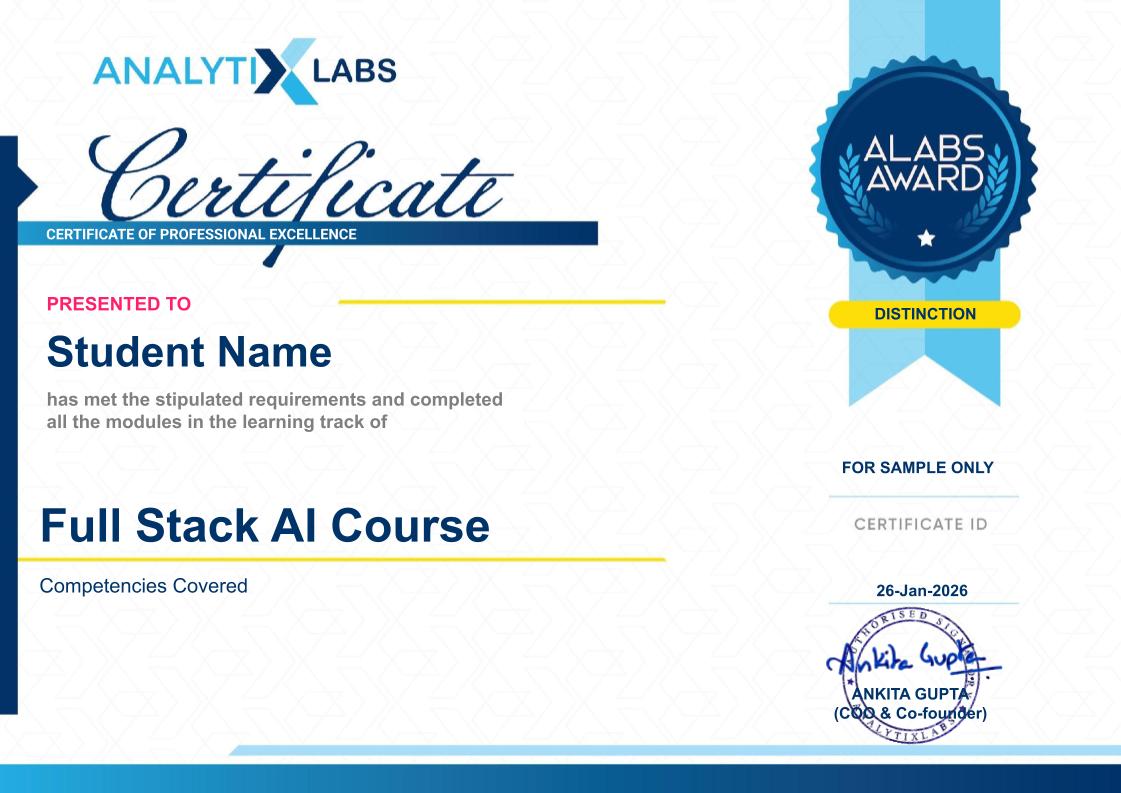
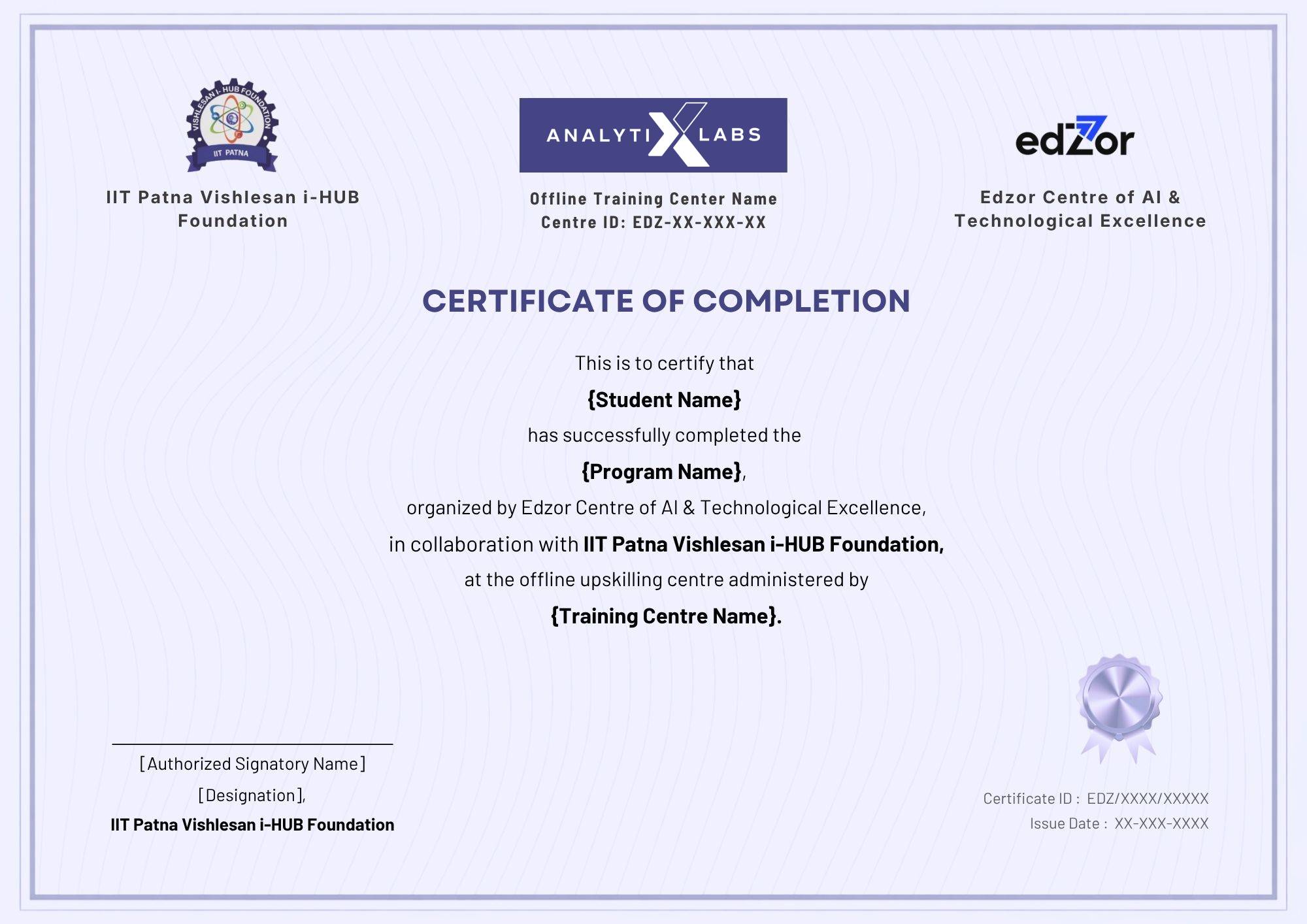
AI Course Certification Details
AnalytixLabs certifications are highly valued across the industry, backed by a rigorous assessment process including case studies, MCQs, and viva evaluations. Certification is awarded on successful completion of all requirements within the defined timelines. Candidates get two attempts per assessment, and certification must be completed within one year of enrolment.
You also earn credentials from our esteemed academic and industry partner:
- TIH Knowledge Partner Certification: TIH at IIT Patna
Certification under the IIT Patna Vishlesan I-HUB Foundation knowledge partner programme. This includes virtual guest lecture sessions by TIH-associated experts, supplementary to the regular curriculum.

AI Course with Placement Support
At AnalytixLabs, we’re committed to helping you build successful careers in AI, Data Science, and Analytics. With comprehensive placement assistance integrated into our certification programs, our dedicated team of industry professionals offers personalized support based on your educational background and work experience. The placement process is designed to equip you with both opportunity and readiness—helping you transition seamlessly into the data-driven workforce.
Accelerate your career with our Job Guarantee Program: https://www.

Placement Readiness Program
The Placement Readiness Program is a 6–8 week, industry-aligned module designed to give you a competitive edge after certification.
It goes beyond technical skills, offering expert guidance on resume building, interview coaching, and real-world simulations. With strong industry referrals, strategic job search planning, and personalized feedback, the program ensures you're not just prepared for the job market—you’re ready to stand out in it.

Diverse Job Opportunities
• Access to job opportunities through direct collaborations with organizations, reputed recruiters, and the extensive AnalytixLabs Alumni network.
• Many students receive multiple interview calls and see a significant boost in career prospects.
• Success, however, depends on a combination of the candidate’s dedication and the institute’s support. Active participation and timely course completion are essential for maximizing placement outcomes.

Continuous Career Support
Your journey with AnalytixLabs doesn’t end after completing the Placement Readiness Program. We offer ongoing placement support to ensure you stay on track until you achieve your career goals.
Our dedicated team continues to assist with job opportunities, interview preparation, and personalized guidance as long as you need it. Many of our students benefit from multiple interview calls and long-term career growth, thanks to the strong foundation and in-demand skills built during the course.
How To Apply
select your course, complete the registration form, and make payment.

Submit your application
Submit your application by filling out the form, providing necessary details, and clicking submit to complete the process.

Give a selection test
Take the selection test to demonstrate your skills and knowledge. This will help us assess your readiness for the course.

Reserve your seat
Reserve your seat today to secure your spot in the course. Act fast, as spaces are limited and fill quickly!

Payment
Complete your payment to finalize your enrollment in the course. Choose your preferred payment method and follow the prompts to proceed.
What Students Say About Us?
True Stories, Transformative Career Experience
Piyush Ganar, Class of 2012 IIM Ahmedabad
(Director of Operations, Kenty.AI)
The course material is very easy to understand and the case studies were based on real time business problems. What I love the most about Sumeet and his team is that they never operated the institute like a typical commercial enterprise but more like a temple for learning. The gates of Alabs are always open for students for any kind of help and guidance. I would recommend ALabs to all.
Raajeev Kumar Sahu
(Senior Manager – Data Science, FinTech Startup)
I am from Advance Big Data Science course of Nov 2016 batch. The course was very structured and got real world problems to practice during the final case studies. It has also boosted my skills to start participating in the hackathons. Chandra sir was really helped me in preparing my resume right from very beginning of the course. Also, the placement team was very well organized and connected to industry leaders so that people get the right opportunity right after completing the course. I really recommend this institute, who are interested to transition into analytics field.
Sumit Asthana
(Assistant Manager, Senior Data Scientist)
The rapid pace at which the institutes are mushrooming all over India and Facebook newsfeed being inundated with thousands of options for analytics training, there are only handful of training institutes or rather say only couple of places where they prepare you to foray into rapidly growing analytics vertical. I have been working into legacy systems for past 5 years and was quite apprehensive if I will ever break into data science successfully.
Surbhi Sultania
(Analytics Manager, Mastercard Data & Services)
I took three months Big Data training from Analytix labs. Before joining this course, I had so many questions and doubts that will this course be worthy enough but later I found myself lucky to join this program. All trainers are amazing and always ready to help. Live examples and Case Studies are given which helps in understanding the concept and hands on practice.Not only they help in quality in depth knowledge transfer but also tend to give right direction to your career.
Vibhu Gautam
(Professor of Practice – Computer Science, UPES)
I had been associated with AnalytixLabs since 2012. This has been possible because of the mentor ship and support you get from faculty there specially from Sumeet and Chandra.I did a Business Analytic course with a focus on Marketing Analytic. The course deliver had been great and most importantly you never feel like you are part of formal classroom teaching. You are mentored there at every step, from Code Errors to Understanding Statistics behind it.
Demo & Brochure
Benefits of Demo Account
- Get access to trial sessions to choose the most suitable course.
- SAVE UP TO 40% on specialization learning tracks.
- JOB ORIENTED COURSES crafter and delivered by industry experts.
- INDUSTRY RELEVANT programs with latest curriculum.
Want to see how it works?
Frequently Asked Questions
Does this AI course require coding?
No prior coding experience is required to start. The course opens with generative AI and no-code tools like Zapier and n8n, so you build working AI workflows before writing a line of Python. From there, Python is introduced progressively, taking you to LLM development, agent building, and deployment. You finish comfortably coding AI applications, even if you started with none.
Do you provide guaranteed placement?
We offer both Placement Guarantee and Placement Assistance programs, depending on the course. Guarantee programs include a job assurance, a minimum package assurance, and a 50% fee refund if you do not secure a qualifying role within six months of certification, subject to eligibility.
Assistance programs include a two-month Placement Readiness Program covering interview preparation, mock interviews, case studies, and simulated recruitment drives. Check current terms at our placements page.
What is the difference between traditional AI, Machine Learning, and Generative AI?
Artificial intelligence is the broad field of building machines that perform tasks associated with human intelligence, such as learning, reasoning, and perception. Machine learning is a subset of AI focused on algorithms that learn patterns from data to make predictions without being explicitly programmed. Generative AI and agentic AI, both central to this course, sit within this landscape: generative AI creates new content, while agentic AI uses LLMs to plan and act autonomously. In short, AI is the goal, ML is one method, and generative and agentic AI are the current frontier.
What academic background do I need?
The course suits learners from technical or quantitative backgrounds such as engineering, mathematics, statistics, or business management, as well as motivated beginners willing to build a foundation. Logical aptitude and genuine interest in AI matter more than a specific degree. The early modules establish the groundwork, so you are not expected to arrive with advanced programming or math.
What jobs can I get after this AI course?
The program prepares you for applied AI roles, including:
- AI Engineer
- Machine Learning Engineer
- Data Scientist
- Computer Vision Engineer
- AI-ML Specialist
- Robotics Specialist
- Data Science Consultant
- Analytics Consultant
Demand for these roles continues to grow as organizations move AI from experimentation into production.
Is this an online or classroom course?
We offer three formats: classroom sessions, interactive live online, and blended eLearning. You choose the mode that fits your schedule and location, with the same curriculum across all three.
How do I know if this course is right for me?
If you want to build and deploy real AI systems, not just understand them in theory, this course is designed for you. It works whether you are starting fresh, upskilling from a data role, or switching careers into AI. Review the curriculum, projects, and learning modes above, or speak to a counselor to map it against your goals.
When will I get access to learning materials?
You get one year of access to the LMS and course materials, and you can retake classes within that period, subject to batch-change policies. Access to co-branded certification materials is typically six months. Recording access can be extended in genuine cases. Because the curriculum is updated regularly to keep pace with the field, we do not offer lifetime access.
Is there a free version of this course?
There is no free version, but we run regular webinars on current AI developments that are open to learners. You can also explore a large library of AI and data content on the AnalytixLabs blog and our Medium channel.
Is this course for graduates or experienced professionals?
Both. The program is built for college students, recent graduates, and working professionals alike. It suits those with a technical or quantitative foundation especially well, but the structure supports anyone serious about moving into AI, whether to deepen current skills or transition into a new role.
Excited?
Talk to Expert
Counselor
to gain insights into your profile and
strategize your next career move!
