If you want to know what forward deployed engineer jobs in India actually look like, you'll probably have very little to work with. Every published estimate of demand traces back to a single source that never stated a method. Two growth figures circulating across job portals claim 700% and 800% in a year, with no sample, no base year, and no agreement with each other.
So we counted instead. Our Q3 2026 market study is a hand-coded census of every forward deployed engineer role we could find live in India on 27 August 2026. We found 289 postings attributable to a named company. Another 27 came through recruitment firms that withheld the client, bringing the total to 316. TeamLease Digital independently estimated 250 to 270 using a completely different approach, which is a useful corroboration rather than a competing claim.
Here is what those 289 postings tell you about who hires, what they pay, and which skills they actually want.
Also read our detailed guide, "How to Become a Forward Deployed Engineer," to learn what an FDE is.

The Money Arrived Before the Job Descriptions Did
We started with the timeline, because the sequence explains the hiring.
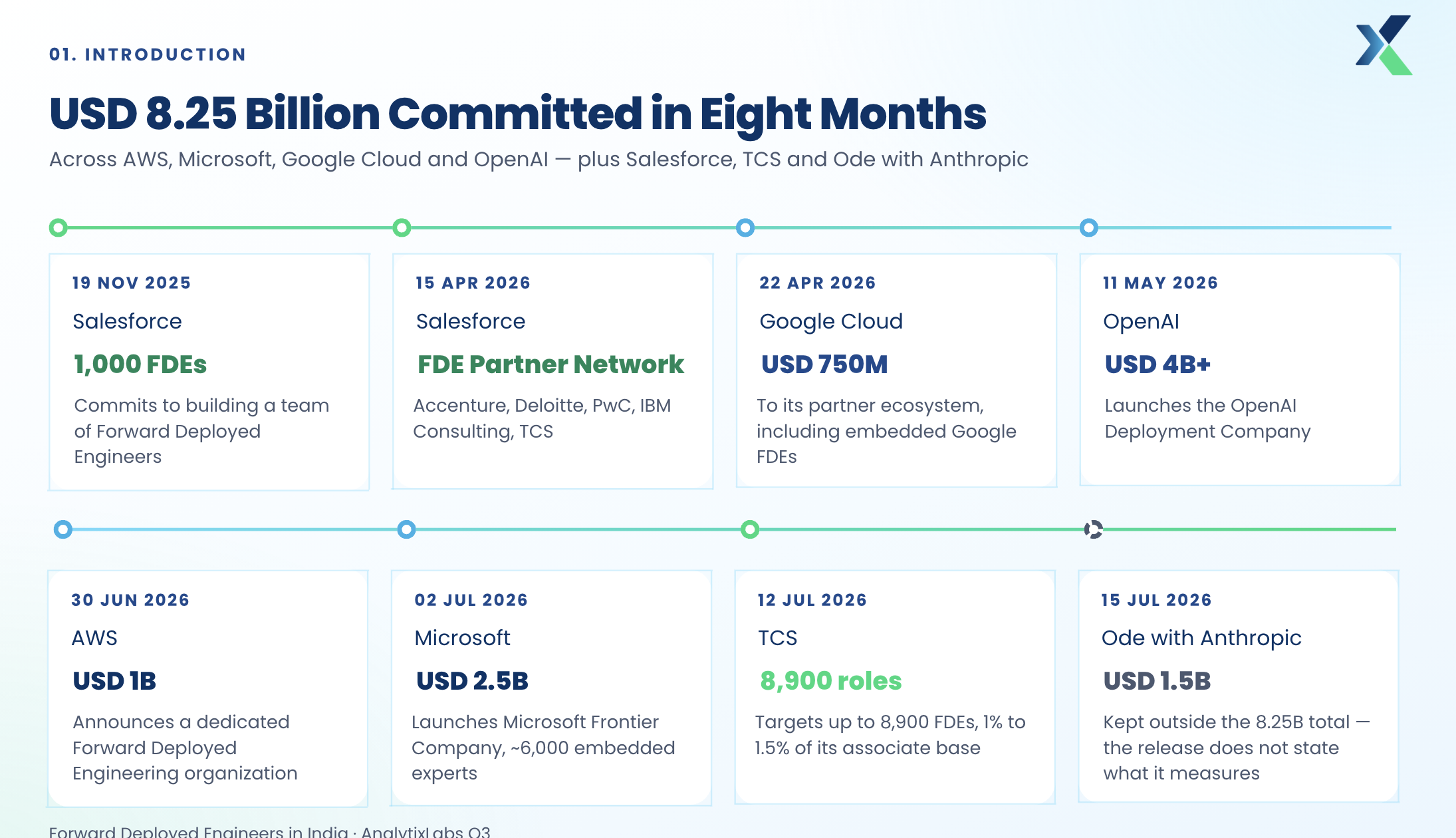
Salesforce committed to building a team of 1,000 forward deployed engineers in November 2025. Everyone else followed between April and July 2026. Google Cloud backed its partner ecosystem with USD 750 million. OpenAI launched a deployment company with an initial investment of more than USD 4 billion. AWS and Microsoft announced dedicated organizations two days apart, worth USD 1 billion and USD 2.5 billion. Around USD 8.25 billion is now committed across those four companies, with Ode with Anthropic reported separately at USD 1.5 billion. Tata Consultancy Services said it wants up to 8,900 of these engineers, 1% to 1.5% of its associate base.
Our census found four live TCS postings for the role on 27 August 2026. That gap between four and 8,900 suggested that most of those people will come from re-training rather than new hiring, which matters a great deal if you are planning your own move into this work.
Why This Role Exists at All
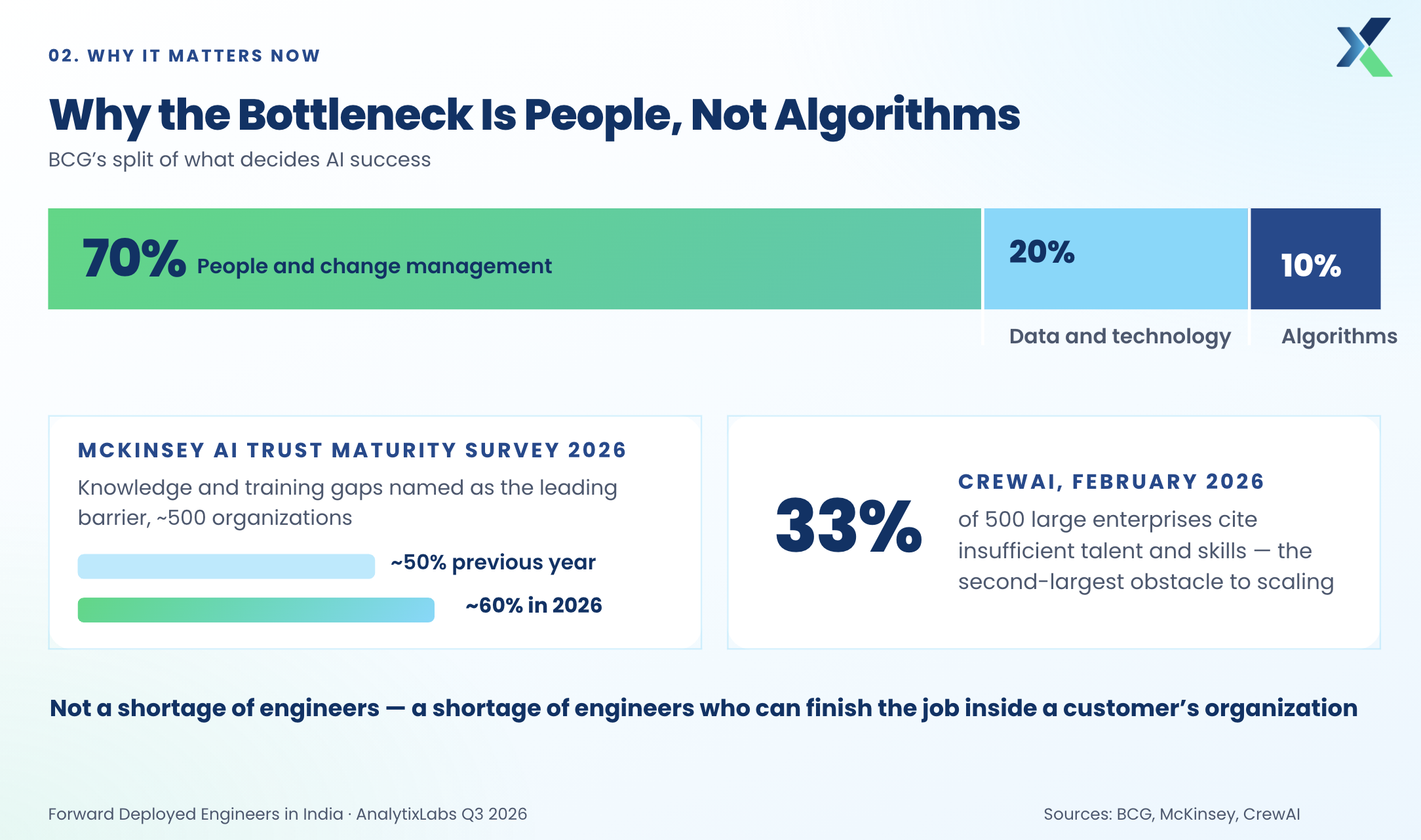
Enterprises aren't short on AI software. They lack people who can make it work within one specific business, using that business’s data, systems, and rules.
All the research houses describe the same gap from different angles. Boston Consulting Group found that only 5% of companies are genuinely agent-first, with the other 95% sitting below 30% adoption even for basic tools. Forrester found that three-quarters of enterprise leaders say they are adopting agentic AI, while only a small minority have it running in meaningful production. BCG splits what decides success into 70% people and change management, 20% data and technology, and 10% algorithms.
Put those together, and you get a specific shortage. Not a shortage of engineers, but a shortage of engineers who can work inside a customer’s organization and finish the job there. Every company sitting between buying AI and deploying it is a potential employer.
What the Job Actually Involves: Four Layers
A forward deployed engineer does four things in sequence, and this is the single most useful frame in the study.
You build multi-step behavior, planning, and tool use that completes a real task rather than answering a question.
You wire it into systems you did not design, including authentication, rate limits, and legacy warehouses.
You make it behave predictably when nobody is watching, through evaluation suites, monitoring, and error handling.
Then you constrain what it can do with permissions, audit trails, and an explicit answer about what the system is not allowed to do.
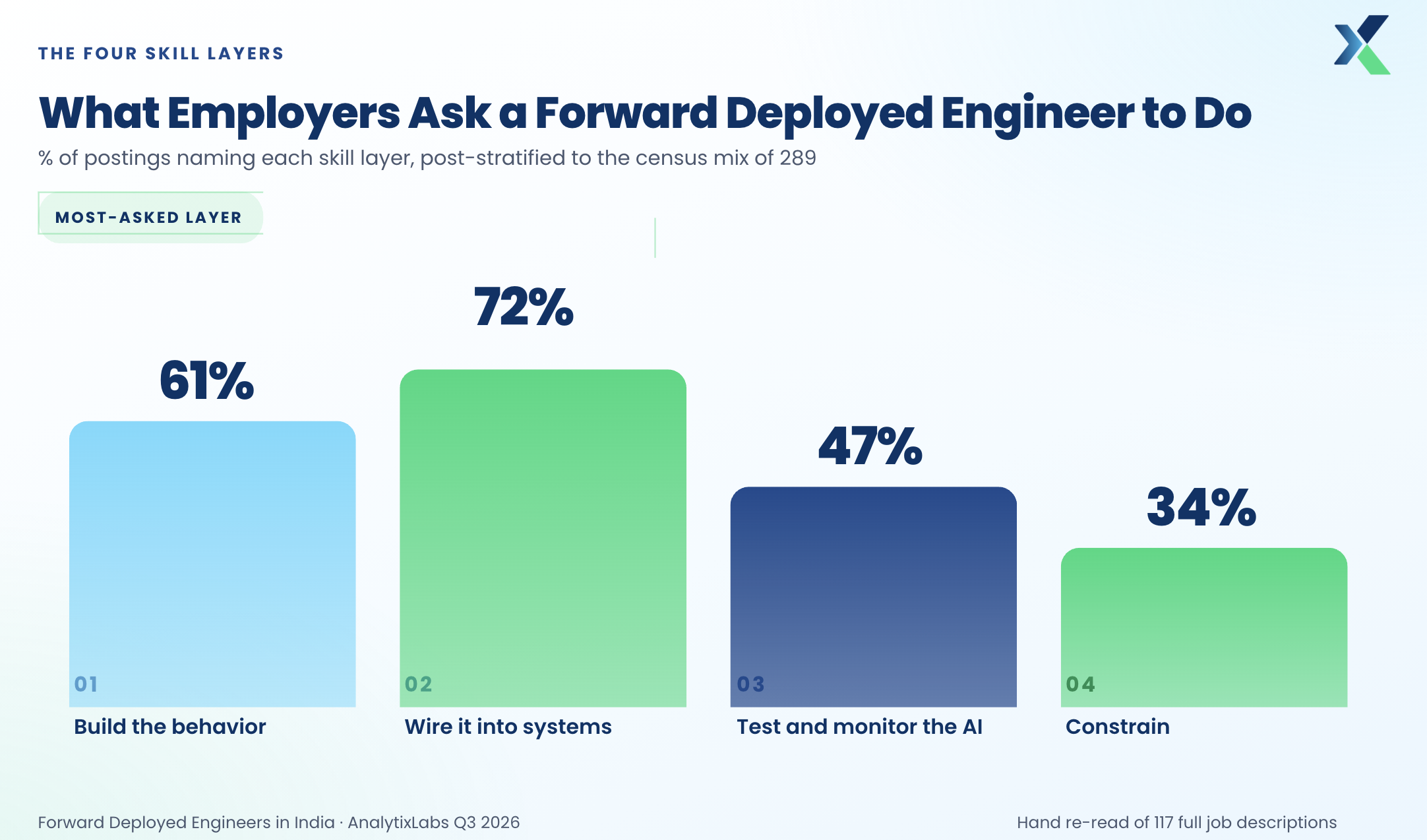
We read all 117 postings that carried full job descriptions and coded each layer by hand against a written rubric. About six in ten mention building. About two in three mention wiring. Fewer than half mention testing or monitoring. Only about three in ten mention limits on what the system may do.
That gap is the finding the whole study is built on. Employers are hiring people to build and connect agents faster than they are hiring people to keep them running safely.
Who Is Actually Hiring
We expected one of two outcomes before running the census. Either cloud providers and product companies would lead, following the United States pattern, or IT services firms and consultancies would lead, following every previous Indian technology wave.
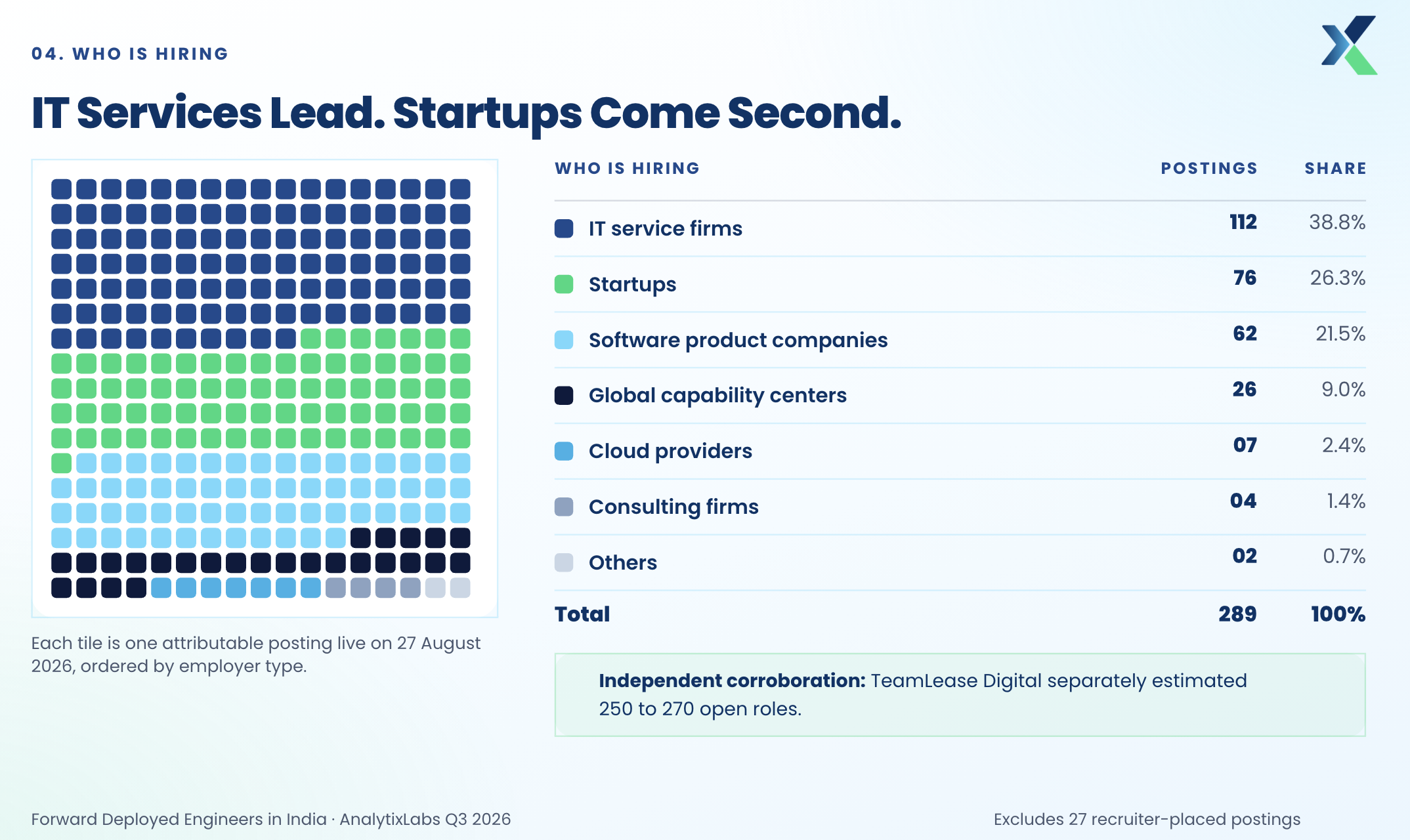
Neither happened cleanly. IT services firms do lead at 38.8% of postings. But startups came second at 26.3%, ahead of software product companies, global capability centers, and consulting firms. That one contradicted our own plan for this study.
Startups usually do not hire for roles that require sitting inside a large customer’s organization, because they rarely have large customers. Their presence here suggests something specific. Indian AI startups sell to enterprises, and they have found that sales don't close unless an engineer goes with the software.
The opposite surprise is just as telling. Consulting firms, whose entire business model is placing people inside client organizations, account for four postings in the whole census.
Geography concentrates hard. Bengaluru holds roughly 31% of postings, Delhi NCR about 14%, and Hyderabad about 13%. One in ten roles are advertised across more than one city.
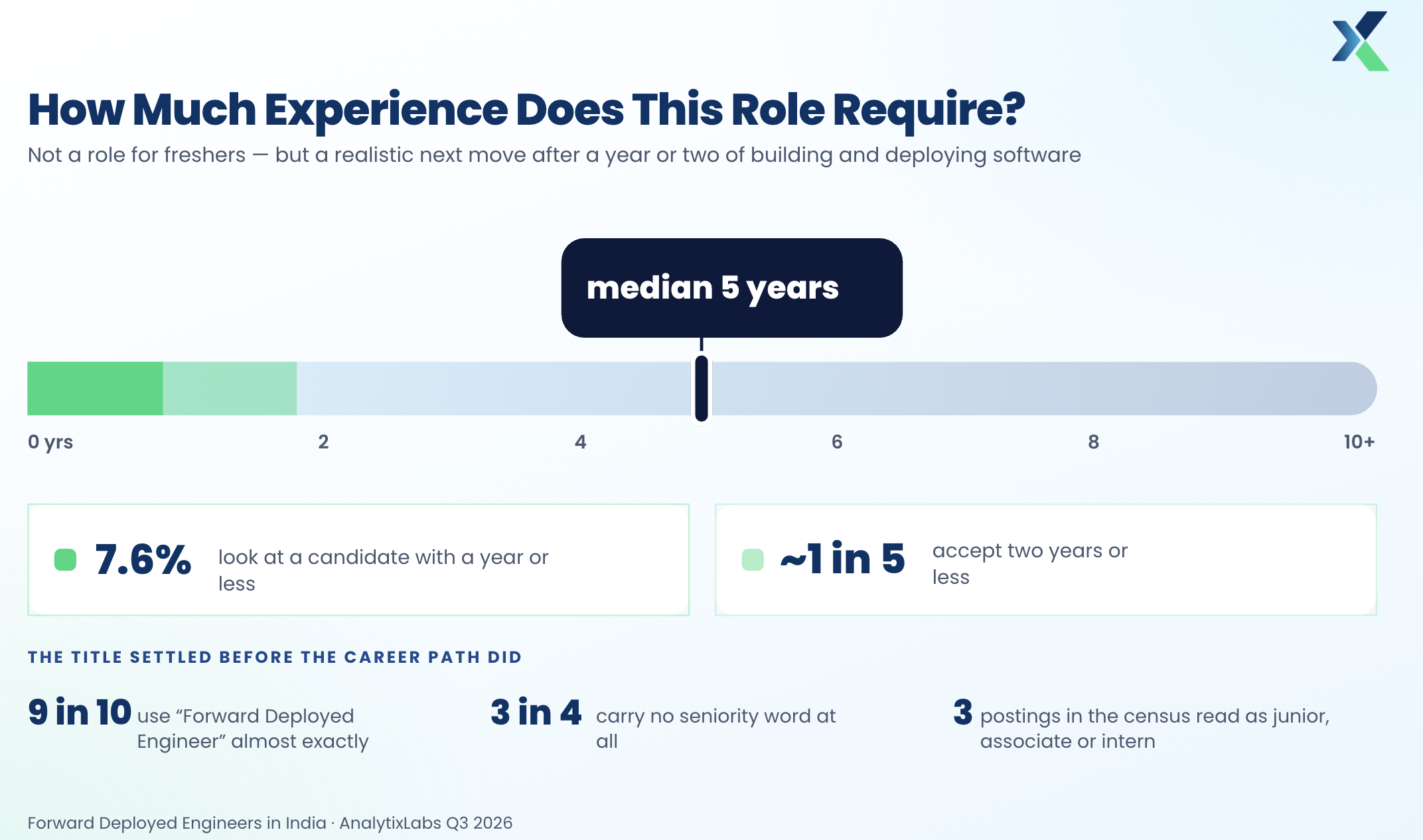
If you are wondering whether forward deployed engineer jobs are open to newer engineers, the honest answer is mostly no. The median posting asks for five years. About one in five will consider someone with two years or less, and fewer than one in ten (7.6%) will consider a candidate with a year or less. Treat this as a career switch you make from an engineering background you already have.
What the Job Pays, and Why the Numbers Disagree
This is where the market shows how young it is.
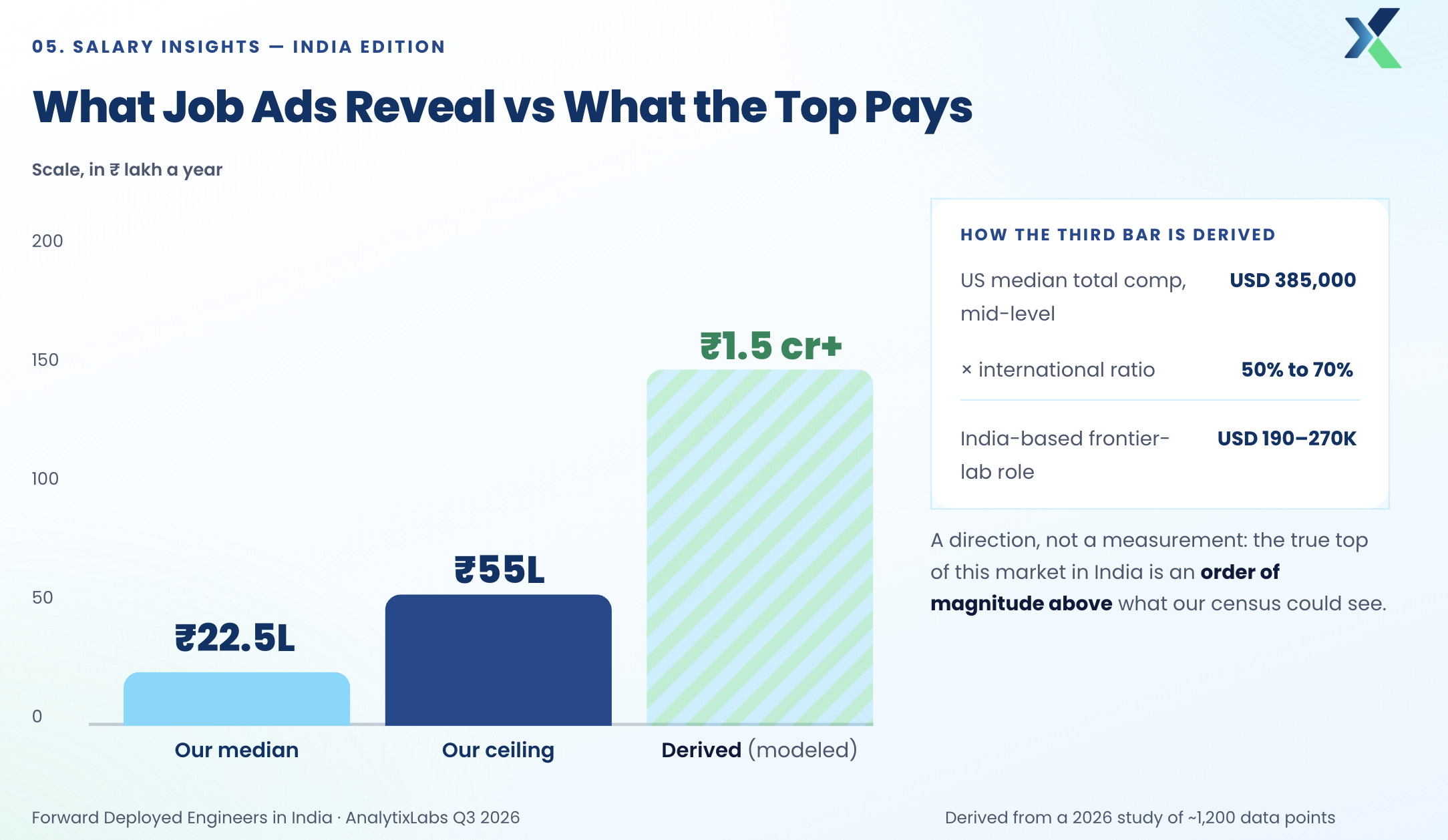
Of 289 attributable postings, only 18 disclosed pay at all, and only 16 gave a band we could use. Those 16 run from ₹5 lakh a year to ₹55 lakh a year. That is eleven times the money for the same job title, and the median midpoint sits at ₹22.5 lakh.
The ₹5 lakh floor is not an error. It comes from training providers and IT services companies advertising FDE-titled roles at ordinary services rates. When a job title becomes desirable, employers attach it to work that doesn't deserve it, and the bottom of this range shows title inflation in rupees.
The ceiling is not real either, for the opposite reason. The companies paying the most for this work in India publish no pay and don't use this job title. We kept four sources deliberately separate rather than averaging them: Glassdoor India at about ₹13 lakh, SalaryExpert at ₹27.9 lakh, TeamLease Digital’s named figure of around ₹40 lakh, and a derived international ceiling that implies well above ₹1.5 crore for an India-based frontier-lab role. These measure different populations, so averaging them would produce a number that describes nobody.
What this means practically is that evidence moves your offer more than experience does. In a market that has not agreed on price, the scarce layers are your leverage.
How the Role Reached India: Three Routes
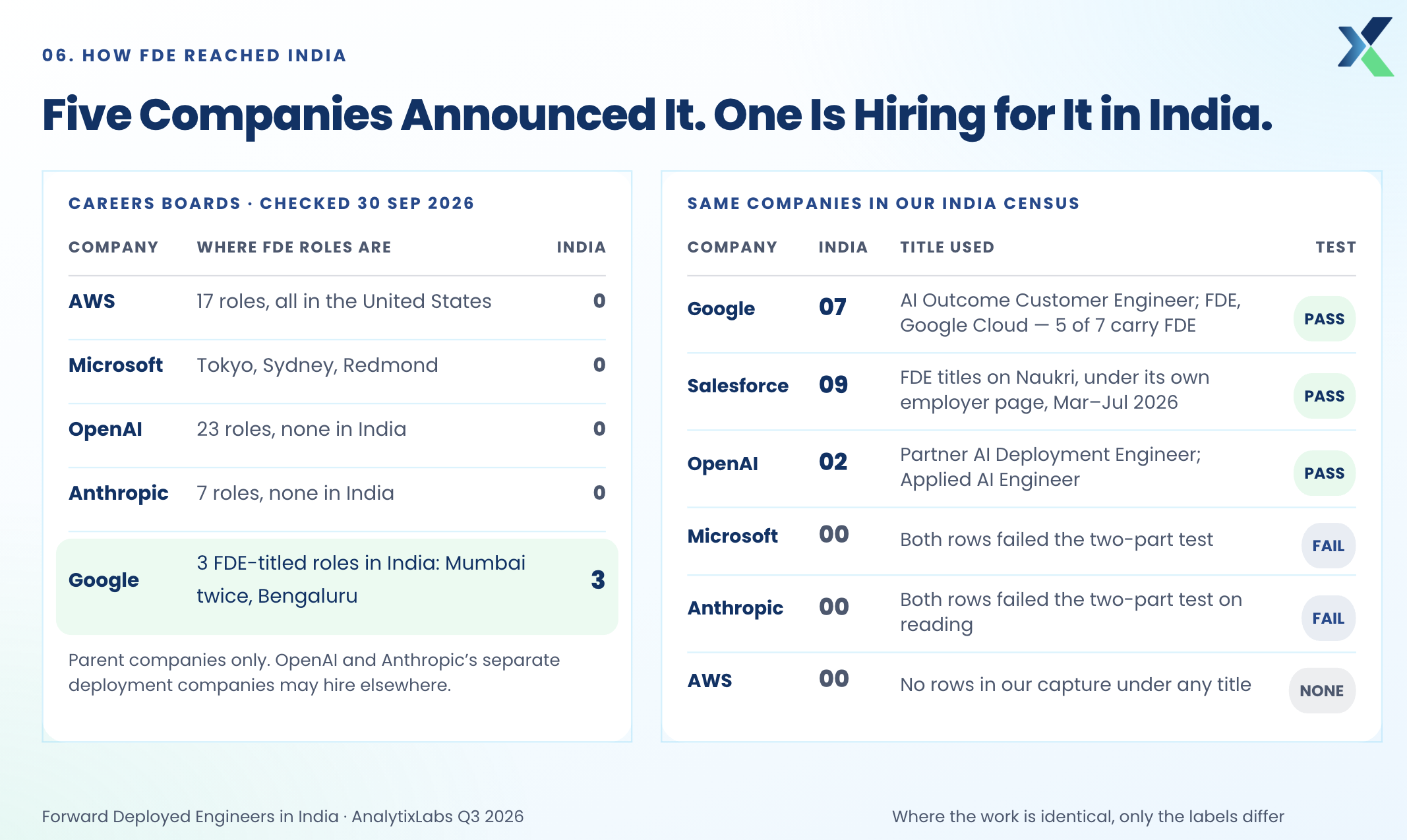
Five companies defined this category and committed billions to it. As of 30 September 2026, only one of them had postings in India under that name.
The direct route is barely open. AWS had 17 roles, all in the United States. Microsoft had roles in Tokyo, Sydney, and Redmond. OpenAI had 23, and Anthropic had 7, none in India. Google had three FDE-titled roles in India. Cloud providers account for seven postings in our census, all of them Google.
The absorption route is dominant. Indian IT services and consulting firms take on the work as part of ordinary project delivery, where engineers do the job but the job title never appears. Reported build-outs give a sense of pace, with Coforge described as scaling from roughly 20 to 100 forward deployed engineers and EPAM from roughly 50 to 100.
The startup route is the one nobody was tracking, and it accounts for more than a quarter of everything we coded.
There is a twist worth noting. The title did cross the border, but through the companies that never announced a program. Google carries it quietly, and Salesforce listed nine FDE-titled roles for India between March and July 2026.
Our own model projects this role growing from roughly double to six or seven times its current count by 2030, depending on which route wins. We state the assumptions openly so you can disagree with them, and we label the model as modeled rather than measured. The more useful conclusion is that the scarce skills are identical in all three scenarios.
How to Build Toward These Roles
Build in the order employers hire, not the order that looks impressive.
Learn the foundations first, covering statistics, Python, data handling, and applied machine learning if you come from software engineering. Then start building multi-step agent behavior, which is necessary but will not differentiate you, because six in ten postings already ask for it. Then learn wiring, which is the most-asked layer at about two in three postings and the hardest to learn from tutorials, because real enterprise estates are messy in ways sample projects are not.
Then prepare for the real scenarios. Testing, monitoring, error handling, and limits on what the system can do appear in the fewest postings, and we see no path to increase their supply. That's why it sits last rather than being optional.
Your portfolio should mirror those four layers. Build a working multi-step system that completes a real task, not a chatbot. Build an integration nobody handed you, with real authentication and a real rate limit, and document what broke. Build an evaluation suite and show what you tested, what failed, and what you changed. Build a permissions and audit layer that shows what your system is not allowed to do, which is the rarest artifact in this market.
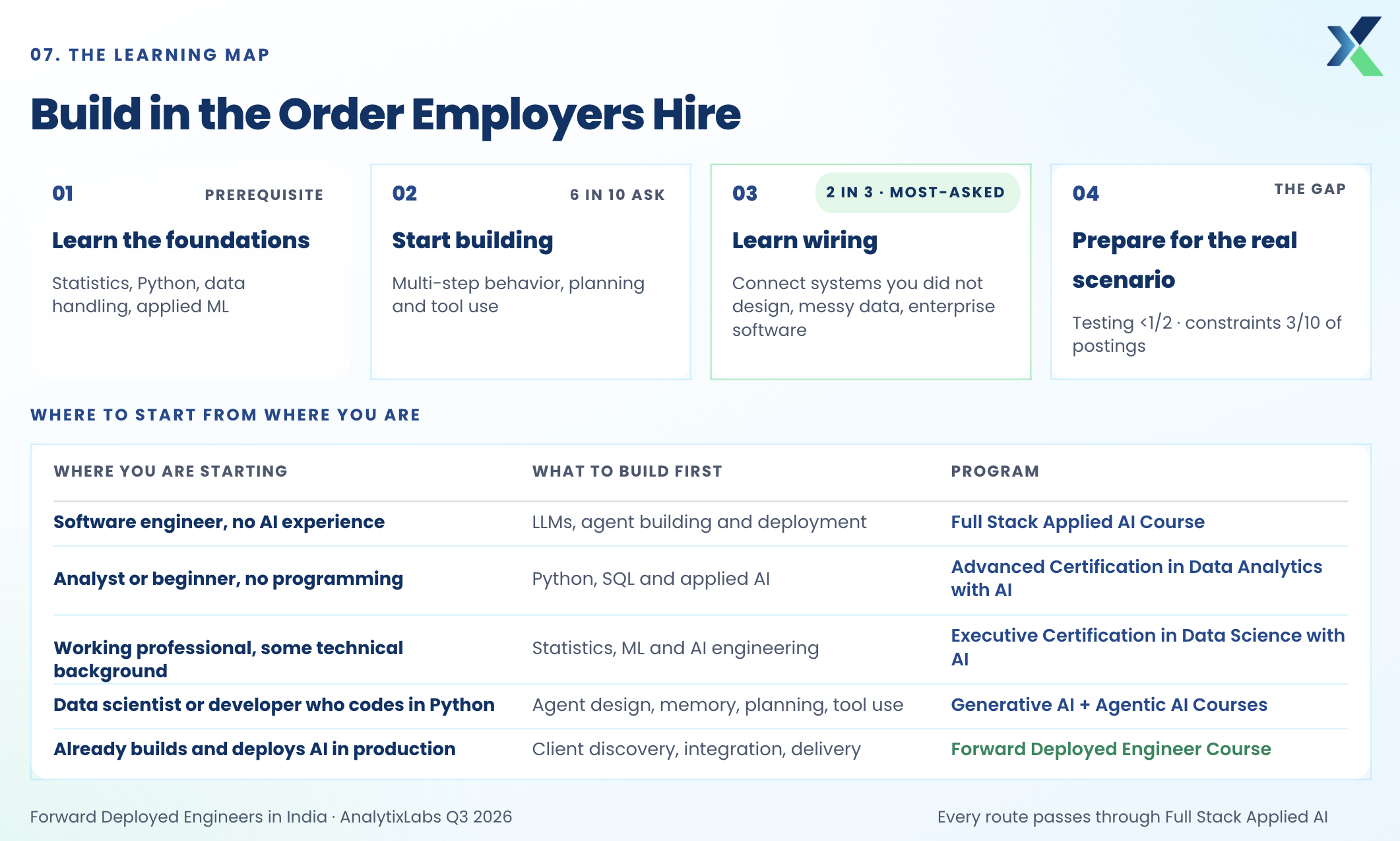
At AnalytixLabs, we have launched a dedicated Forward Deployed Engineer course as a specialization alongside our Full Stack Applied AI course. The specialization sits on top rather than alongside, so every route runs through that prerequisite. If your gap is the customer’s data estate rather than the AI layer, the Certified Big Data Engineering course closes the integration half first.
One thing we will say plainly. Constraining what a deployed system can do is currently learned on the job, and we won't claim a course fills a gap it doesn't.
What to Take Away
Employers have agreed what to call this role and almost nothing else about it. They have not agreed on seniority, with three-quarters of postings carrying no seniority word at all. They have not agreed on price, with sixteen usable bands spanning eleven times the money. They have not agreed on what the role is responsible for, since almost half the descriptions we read name one layer or none.
If you are learning, the crowded route is getting good at building agents. The uncrowded one is getting good at making them behave. The second is harder, less taught, and worth more.
If you are hiring, count how many of the four layers your own job description names. If you need someone who can keep a deployed system running, say so, or you will interview for one job and hire for another.
We are treating this census as a starting line rather than a growth claim. The Q4 2026 edition repeats the same search with the same rules and the same coding sheet, and that pair produces the first growth rate for this role in India that a reader can actually verify.
Download the full Q3 2026 market study for the entire research, including the method appendix, the full reference list, and both the unweighted and post-stratified skill-layer tables.
FAQs
What is a forward deployed engineer?
A forward deployed engineer builds software while sitting inside the customer’s organization. They are not consultants who advise or support engineers who fix. They ship working systems in someone else’s building, against someone else’s constraints, which is why the role demands both engineering depth and customer-facing judgment.
How many forward deployed engineer jobs are there in India?
Our hand-coded census found 289 postings attributable to a named company, live on 27 August 2026. Another 27 came through recruitment firms that withheld the client, taking the total to 316. TeamLease Digital independently estimated 250 to 270 using a different method.
What salary do forward deployed engineer jobs pay in India?
Only 18 of 289 postings disclosed pay, and 16 gave a usable band. Those run from ₹5 lakh to ₹55 lakh a year, with a median midpoint of ₹22.5 lakh. Employer-survey data sits higher, with SalaryExpert at ₹27.9 lakh and TeamLease citing around ₹40 lakh for experienced engineers.
Can freshers apply for forward deployed engineer jobs?
Mostly no. The median posting asks for five years of experience, and fewer than one in ten will consider a candidate with a year or less. Treat this as a career switch from an existing engineering background. For recent graduates, it becomes realistic after a year or so of building and deploying software.
Which companies hire forward deployed software engineers in India?
IT services firms lead at 38.8% of postings, followed by startups at 26.3% and software product companies at 21.5%. Among the global names, Google carries the title into India most visibly, and Salesforce listed nine FDE-titled India roles between March and July 2026.
Which skills matter most for a forward deployed engineer career?
Wiring systems together is the most-requested layer at about two in three postings, followed by building agent behavior at six in ten. Testing, monitoring, and constraining deployed systems appear in the fewest postings, which makes them the scarcest and strongest evidence you can bring to a negotiation.