The first roadblock is always "where do I start?". You keep searching for that right learning path and end up finding ten conflicting opinions. While one tells you to master statistics before writing a single line of code, the other says to build projects from day one. A third insists you cannot touch AI without a computer science degree. Sadly, none of these give you a sequence that makes structural sense.
This is exactly what this article does. It gives you a layered, logic-driven roadmap for building expertise in data science and AI. From the foundational concepts that make everything else possible to the advanced skills that employers in India are actively looking for in 2026 - this article cover everything to the T.
Before we dive into the career roadmaps and tools, it is important to understand why data science and AI are converging, and what it means for learners like you.
What is Data Science and AI?
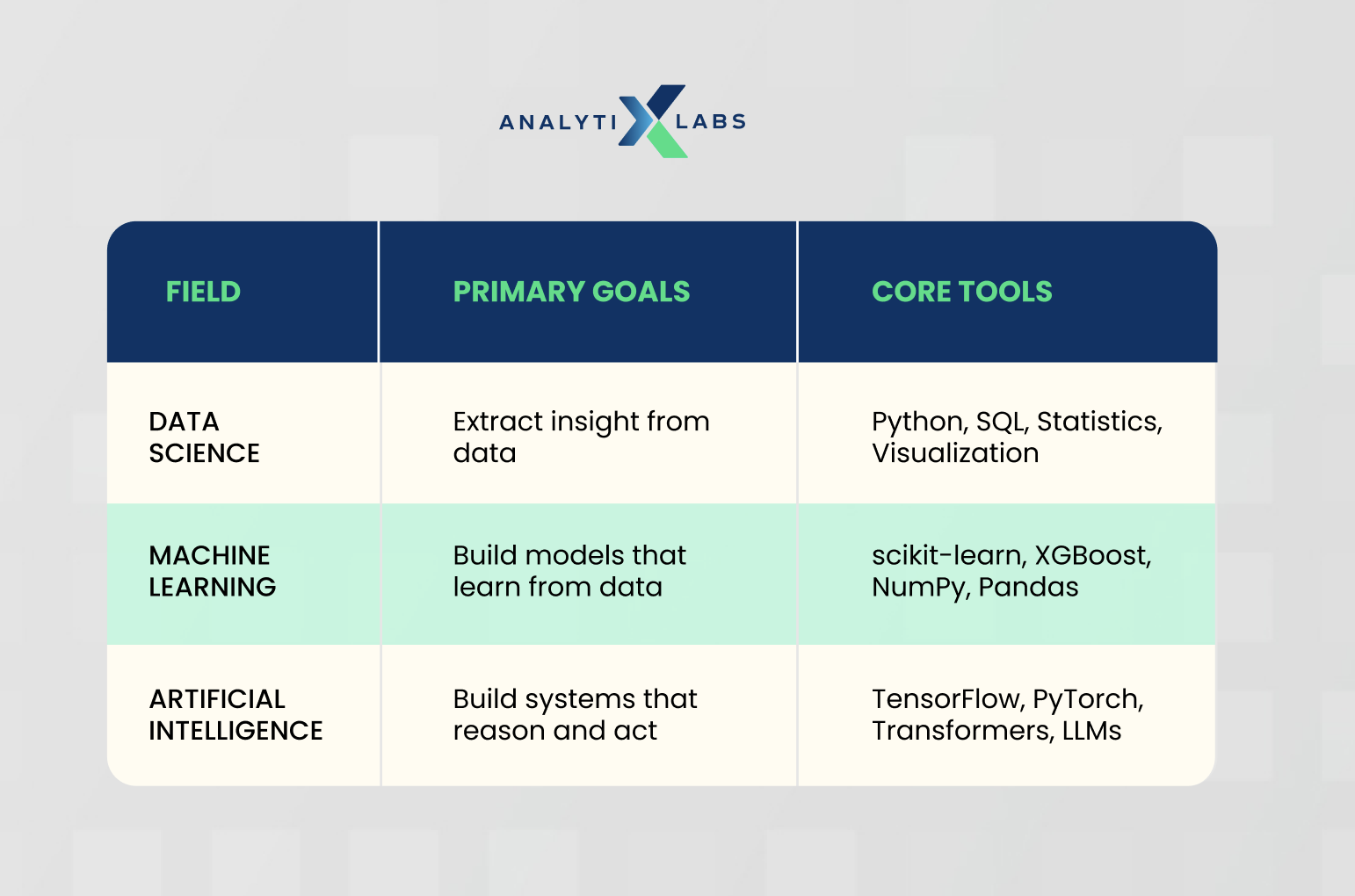
If talking about these separately, data science is the discipline of extracting knowledge from data. You collect raw data, clean it, analyze it, and build models that reveal patterns or make predictions. As a result, the output is insight or a trained model. On the other hand, AI is about building systems that perform tasks that typically require human intelligence. Its scope includes reasoning, language understanding, image recognition, and decision-making. As a result, the output is a system that acts on the world.
Why Both Fields Are Converging?
Five years ago, a data scientist and an AI engineer had clear separate job descriptions. Today, the lines have started to vanish. The arrival of large language models (LLMs), generative AI, and agentic systems has blurred every boundary.
To build or deploy an LLM-powered application today, you need to understand feature engineering, model evaluation, prompt design, and retrieval-augmented generation (all at once!). These are data science and AI skills combined, not one or the other.
According to LinkedIn India's 2025 Jobs on the Rise report, roles with both "data science" and "AI" in the description has grown by 47% year-on-year. Employers are no longer hiring for half the stack. They want professionals who can handle data, models, and deployment as a single integrated discipline. That is precisely what this roadmap prepares you for.
Let's start with addressing how data science is different from machine learning (and AI).
Data Science vs. Machine Learning vs. Artificial Intelligence
Often, machine learning overlaps with data science, and AI overlaps with machine learning. The fun fact is, these three are distinctly different from each other. (Yes, we do agree they merge at some poing given how complex AI agents are stepping into the workforce).
Machine learning sits at the intersection of data science and AI. You use data science methods to prepare your data, and you apply machine learning to build the models that power AI systems. Remove either side and the pipeline breaks.
Data Science and AI Learning Roadmap
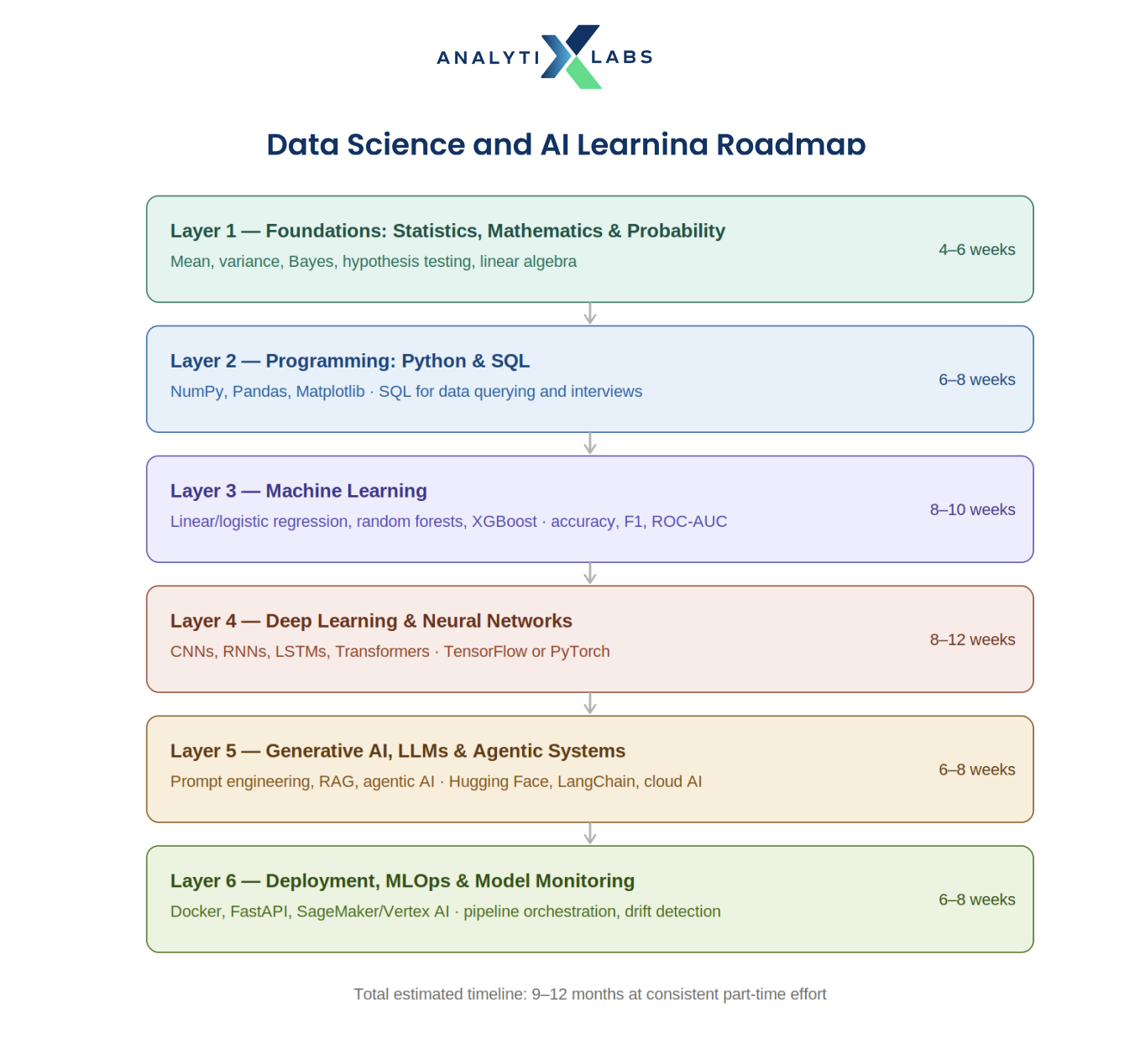
The data science and AI roadmap has six layers. Each layer is a prerequisite for the next. You cannot skip Layer 2 and expect Layer 4 to make sense, just as you cannot understand backpropagation before you understand derivatives.
We recommend walking through the layers in sequence. The time estimates below assume a working professional studying 10 to 15 hours per week. For fresh graduates, the time might vary.
Layer 1: Foundations - Statistics, Mathematics, & Probability
Statistics and mathematics is core to learning data science and AI. Here's why: every prediction a machine makes is a probabilistic statement, and every model you evaluate produces a number you must interpret. Without a working knowledge of statistics and mathematics, you are operating machinery you cannot understand.
You need to build fluency in descriptive statistics (mean, median, variance, standard deviation), probability theory (conditional probability, Bayes' theorem), inferential statistics (hypothesis testing, confidence intervals, p-values), and the basics of linear algebra (vectors, matrices, dot products).
Realistic timeline: 4 to 6 weeks at the pace described above.
Layer 2: Programming - Python and SQL
Python is always the winner in any data science debate. It has the most extensive library ecosystem, an active community, and the lowest barrier to entry for non-programmers. That is wht you learn Python first.
Meanwhile, SQL is non-negotiable and is consistently underestimated by new learners. Every data role, from junior analyst to senior ML engineer, touches a database which means you will write SQL in your first week on the job. We recommend that you learn it alongside Python, not after.
Start your Python learning with three libraries:
NumPy for numerical computation
Pandas for data manipulation
Matplotlib for visualization
These three unlock 80% of the data work you will do in your first year.
Learners who skip SQL consistently struggle in interviews. Every data science hiring test involves at least one SQL problem. Make sure to build it early, not as an afterthought.
Realistic timeline: 6 to 8 weeks for Python fundamentals and working SQL fluency.
Layer 3: Machine Learning
Machine learning is where data becomes a predictive power. You build models that learn patterns from historical data and apply those patterns to new inputs.
Start with supervised learning: linear regression for continuous outputs, logistic regression for classification, decision trees and random forests for non-linear problems, and gradient boosting (XGBoost, LightGBM) for competitive performance on tabular data. Then move into unsupervised learning: k-means clustering, hierarchical clustering, and dimensionality reduction with PCA.
Model evaluation is as important as model building. You must understand accuracy, precision, recall, F1 score, and ROC-AUC and know when to use each one because a model with 95% accuracy on a fraud detection task is often useless if 95% of transactions are legitimate.
Realistic timeline: 8 to 10 weeks.
Layer 4: Deep Learning and Neural Networks
Classical machine learning performs very well on structured, tabular data but not on images, audio, or free-form text. Deep learning fills that gap.
Start with the mechanics of neural networks: perceptrons, activation functions, forward and backward propagation, loss functions, and optimization using gradient descent. Then move into architectures built for specific data types.
Learn TensorFlow or PyTorch. Pick one and go deep rather than learning both superficially. Most Indian industry roles accept either, but PyTorch has become the research standard and TensorFlow the production standard.
Layer 5: GenAI, LLMs, and Agentic Systems
The Transformer architecture, introduced in the 2017 paper "Attention Is All You Need", changed the trajectory of AI. You need to learn the architecture and concepts of Large Language Models (LLMs) like GPT, Gemini, and Claude that are built on the 2017 paper.
At this layer, you learn how LLMs are pre-trained, fine-tuned, and deployed. You work with prompt engineering and retrieval-augmented generation (RAG), a technique that connects LLMs to external knowledge bases for more accurate and current outputs. You also encounter agentic AI: systems that decompose complex goals into sub-tasks and execute them using tools, APIs, and other models.
Also read: Types of AI Agents
This layer is genuinely a new territory. The frameworks and best practices are still evolving. Hugging Face, LangChain, and cloud AI services from AWS, GCP, and Azure are few of the primary platforms to learn.
Layer 5 only makes sense if you have worked through Layers 3 and 4. Learners who skip to generative AI without understanding model training and evaluation cannot debug when things go wrong. And trust us when we say - things will go wrong!
Realistic timeline: 6 to 8 weeks for functional proficiency with LLMs and agentic frameworks.
Layer 6:Deployment, MLOps, and Model Monitoring
Getting a model into production, and keeping it accurate once it is there, is the sixth layer. For instance, a model that only runs in a Jupyter Notebook is not a product; it is an experiment.
You need to understand containerization (Docker), model serving APIs (FastAPI or Flask), cloud deployment on AWS SageMaker, GCP Vertex AI, or Azure ML, and the principles of MLOps: version control for models, pipeline orchestration, and drift detection. Drift occurs when the real-world data distribution shifts from the training distribution, quietly degrading your model's performance without raising an error.
This is where data science becomes engineering. Employers in 2026 are not looking for model builders alone. They want professionals who can ship, monitor, and maintain AI systems in production.
Realistic timeline: 6 to 8 weeks.
Tools You Need at Each Stage of the Roadmap
The list of data science and AI tools is long and grows every year. The table below maps the tools you actually need to the layer where you need them. Learn the tool when the layer demands it, not before.
| Layer | Primary Tools | Where Used in Industry |
|---|---|---|
| Layer 1 | Excel, Khan Academy Stats, SciPy | Statistical analysis, A/B testing, experiment design |
| Layer 2 | Python (NumPy, Pandas, Matplotlib), SQL, Jupyter | Data cleaning, EDA, database querying, reporting |
| Layer 3 | scikit-learn, XGBoost, LightGBM, Seaborn | Predictive modeling, fraud detection, churn analysis, recommendation systems |
| Layer 4 | TensorFlow, PyTorch, Keras, OpenCV, NLTK | Image classification, object detection, NLP, sentiment analysis |
| Layer 5 | Hugging Face, LangChain, OpenAI API, AWS Bedrock, Vertex AI | GenAI apps, RAG pipelines, conversational AI, AI agent development |
| Layer 6 | Docker, FastAPI, Flask, MLflow, Airflow, AWS SageMaker, GCP Vertex AI | Model deployment, pipeline automation, drift monitoring, cloud serving |
Data Science and AI Career Paths in India: Roles, Salaries, and Progression
The Indian data science and AI job market in 2026 is rewarding knowledge depth. Employers are not looking for professionals who have heard of every tool. They are looking for professionals who can solve specific problems with specific skills.
The table below maps the six roadmap layers to real job titles, the layer depth you need for each, and current salary ranges in India.
(Salary figures are based on data from NASSCOM, LinkedIn India, and AIM Research reports published in 2025.)
| Role | Experience | Layers Needed | Salary Range (India, PA) |
|---|---|---|---|
| Data Analyst | 0-2 years | Layers 1-2 | ₹4L - ₹8L |
| Junior Data Scientist | 0-2 years | Layers 1-3 | ₹5L - ₹10L |
| Data Scientist | 2-5 years | Layers 1-4 | ₹10L - ₹22L |
| ML Engineer | 2-5 years | Layers 1-4 + Layer 6 | ₹12L - ₹25L |
| NLP / CV Engineer | 2-5 years | Layers 1-4 (specialized) | ₹14L - ₹28L |
| AI Engineer | 3-6 years | Layers 1-5 + Layer 6 | ₹18L - ₹35L |
| Senior Data Scientist | 5+ years | All 6 layers | ₹22L - ₹40L |
| Head of Data / AI Lead | 8+ years | All layers + leadership | ₹35L - ₹55L+ |
Top Industries Hiring in India for Data and AI Roles
Leading by volume is the BFSI industry. Banks, insurance companies, and fintech firms need data scientists for credit risk scoring, fraud detection, customer lifetime value modeling, and regulatory compliance automation. This is where the highest volume of entry-level and mid-level roles currently sits.
eCommerce and retail follows closely, being the second most largest hiring sector. Recommendation engines, demand forecasting, dynamic pricing, and supply chain optimization all require ML engineers and data scientists. Firms like Meesho, Flipkart, Zepto, and Swiggy run large data science functions.
Healthcare tech, SaaS, and manufacturing are growing fast. Diagnostic imaging AI, predictive maintenance in factories, and churn prediction in SaaS businesses are all active hiring areas. Professionals with domain expertise plus data science skills hold a distinct advantage here.
✦Next Steps for You
Great progress on data science! Based on your reading, what would you like to do next?
How to Choose Your Learning Path Based on Your Background?
Not everyone starts at Layer 1. Your starting point depends on what you already know. Here is how to identify your entry point and plan your timeline honestly.
Fresh Graduate
Start at Layer 1 and move through all six layers in sequence. Your advantage is time and flexibility. Your focus in the first six months should be building technical depth. In months seven to twelve, shift toward building a project portfolio that demonstrates applied skill.
Three well-documented, problem-solving projects on GitHub will matter more in most interviews than a list of completed courses. Choose projects that touch real datasets from Indian industries like credit scoring, food delivery optimization, medical image classification, so that interviewers see domain relevance alongside technical competence.
Realistic timeline to job-readiness: 9 to 12 months at 10 to 15 hours per week.
Switching Careers from Non-tech Domain
Your domain expertise is a competitive advantage, not a gap. A data scientist with five years of experience in BFSI, healthcare, or manufacturing understands the business problem better than a fresh graduate with better Python skills. Employers know this.
Start at Layer 1 but apply every example and every project to your industry. Build a credit risk model if you came from banking. Build a patient outcome classifier if you came from pharma. Your domain context makes your technical work more credible.
Realistic timeline: 10 to 14 months, accounting for the additional effort of building programming fluency from scratch.
Working Professional Looking to Upskill
You likely already have SQL fluency, some Python exposure, and a clear sense of the business problems data science solves. Audit your skills against the six layers and find your gap. Most working professionals entering this path in 2026 are strong through Layer 2 and need to build from Layer 3 onward.
Prioritize Layers 4 and 5 if your organization is moving toward AI integration. Prioritize Layer 6 if your current data science work sits only in notebooks and needs to become production-grade.
Realistic timeline: 6 to 9 months at a weekend-study pace.
Mistakes to Avoid in Data Science and AI Career
These are not warnings. They are patterns observed across thousands of learners who have moved through this field. Recognizing them early saves months of wasted effort.
Skipping the mathematics and jumping straight to tools. Tools change with every product release. The mathematical reasoning behind gradient descent, probability, and linear algebra does not. A learner who understands the concept can adapt to any framework. A learner who only knows the API cannot.
Learning everything and specializing in nothing. The job market rewards depth over breadth at the entry and mid levels. You get hired for being genuinely strong in one area, not superficially familiar with ten. Pick a specialization like NLP, computer vision, tabular ML, or MLOps, and go deep once you clear Layer 3.
Not Building a Portfolia. A certification tells an employer you completed a course but a project tells them what you can actually build. Employers reviewing data science profiles want to see notebooks, GitHub repositories, and documented problem-solving, not just course completion badges.
Ignoring deployment. A model that only runs in a local notebook has no production value. Companies hire for impact and impact requires deployment. Learning FastAPI, Docker, and cloud serving, even at a basic level, separates candidates who can ship from candidates who can only experiment.
Not following India-specific market signals. Global AI trends and Indian hiring patterns are not always aligned. In India, BFSI dominates data science hiring by volume, and SQL-heavy analytical roles outnumber pure research positions. Build your skills around where the actual jobs are, not where the Twitter conversation is loudest.
Conclusion
The data science and AI landscape in India in 2026 is not short of opportunity. It is short of professionals who have built genuine skill depth across the right layers.
The roadmap in this article gives you a clear sequence: start with statistical foundations, build Python and SQL fluency, progress through machine learning and deep learning, develop working knowledge of generative AI and agentic systems, and close the loop with deployment and MLOps. Each layer earns the next. Each skill compounds.
Your background, whether you are a fresh graduate, a career switcher, or a working professional, determines your entry point, not your potential. The question is not whether data science and AI is the right field but if you are ready to build your path through it with the right structure.
Frequently Asked Questions
Is data science and AI a good career in India in 2026?
Yes, and the demand is growing. NASSCOM's 2025 Tech Sector Report projects over 1.4 million AI and data science job openings in India through 2027. The BFSI, e-commerce, and healthcare tech sectors are the highest-volume employers right now. Entry-level salaries start between ₹4L and ₹8L per annum, and experienced professionals with AI specialization earn upward of ₹30L.
How long does it take to learn data science and AI from scratch?
At 10 to 15 hours per week, a fresh graduate working through all six layers should expect 9 to 12 months to reach job-readiness. A career switcher should plan for 10 to 14 months, accounting for programming fluency. A working professional upskilling from Layer 3 onward can reach their target in 6 to 9 months. These are realistic estimates, not marketing timelines.
What is the difference between a data scientist and an AI engineer?
A data scientist focuses on extracting insight and building predictive models from data. An AI engineer focuses on building, deploying, and maintaining AI system, including LLMs, computer vision pipelines, and agentic applications. In 2026, the roles increasingly overlap. Most AI engineer roles expect data science foundations, and most data scientist roles now expect some deployment capability.
Do I need a mathematics degree to learn data science and AI?
No. You need working fluency in specific mathematical concepts: probability, statistics, linear algebra, and calculus at an applied level. A mathematics degree is not required. Many of the most effective practitioners in Indian industry came from engineering, commerce, and even humanities backgrounds. What matters is methodical learning of the foundational concepts in Layer 1 before progressing.
Which programming language should I learn first for data science and AI?
Python. It is the industry standard for data science, machine learning, and AI across India and globally. It has the widest library support, the largest community, and the lowest barrier to entry for non-programmers. Learn SQL simultaneously, not after. You will need both from your first month in any data role.
What is the starting salary for data science and AI jobs in India for freshers?
Freshers entering data analyst roles typically earn between ₹4L and ₹8L per annum, depending on the organization and city. Freshers entering junior data scientist roles with stronger ML foundations and a project portfolio can target ₹6L to ₹10L. Bangalore, Hyderabad, and Pune typically offer the highest starting packages in this domain.