Data analyst or business analyst? Which one is worth pursuing? If this question has been on your mind for some time, you’ve come to the right place. In 2026, it’s a far more interesting question than it used to be five years back. Artificial intelligence has quietly rewritten what both of these roles look like day to day, so the choice you make now is really a choice about how you want to work alongside AI for the next decade.
Facts show that data analytics has always been a part of our workforce, consistently analyzing data and facts for companies. What has now changed is that AI sits right next to the analyst, drafting queries, summarizing reports, and surfacing patterns that once took hours of manual effort.
This hasn’t made analysts redundant. If anything, it has made the human judgment behind the analysis more valuable than ever, because someone still has to ask the right questions and make sense of what the machine produces.
In smaller organizations, the job titles of data analyst and business analyst are often used interchangeably, mainly because both roles handle data from a broader perspective. In larger and more mature organizations, however, these roles are treated very differently.
At times the line between a data analyst and a business analyst may seem blurred, but in the end, the job environment and what each professional does with the data is what sets them apart.
Thanks to big data and now generative AI, data professionals across the globe have moved firmly into the limelight. Their involvement with data within a company runs long and deep, which makes them a core resource for any organization that wants to stay competitive.
Why Companies Value Data (and Data Analysts)
The fact that companies are thriving on data is directly proportional to the high demand for the data analyst role. Now let’s talk specifically about companies of enterprise stature.
These companies handle huge sets of data, both structured and unstructured, and they need proper structuring and analytical brains to make sense of it all. A data analyst studies this data and creates measurable insights that are significant for any business hoping to grow and thrive in such a competitive world.
This is why companies value professionals who handle data directly. These are the professionals who handle sensitive information, maintain privacy, and still manage to draw meaningful business insights out of enormous data sets.
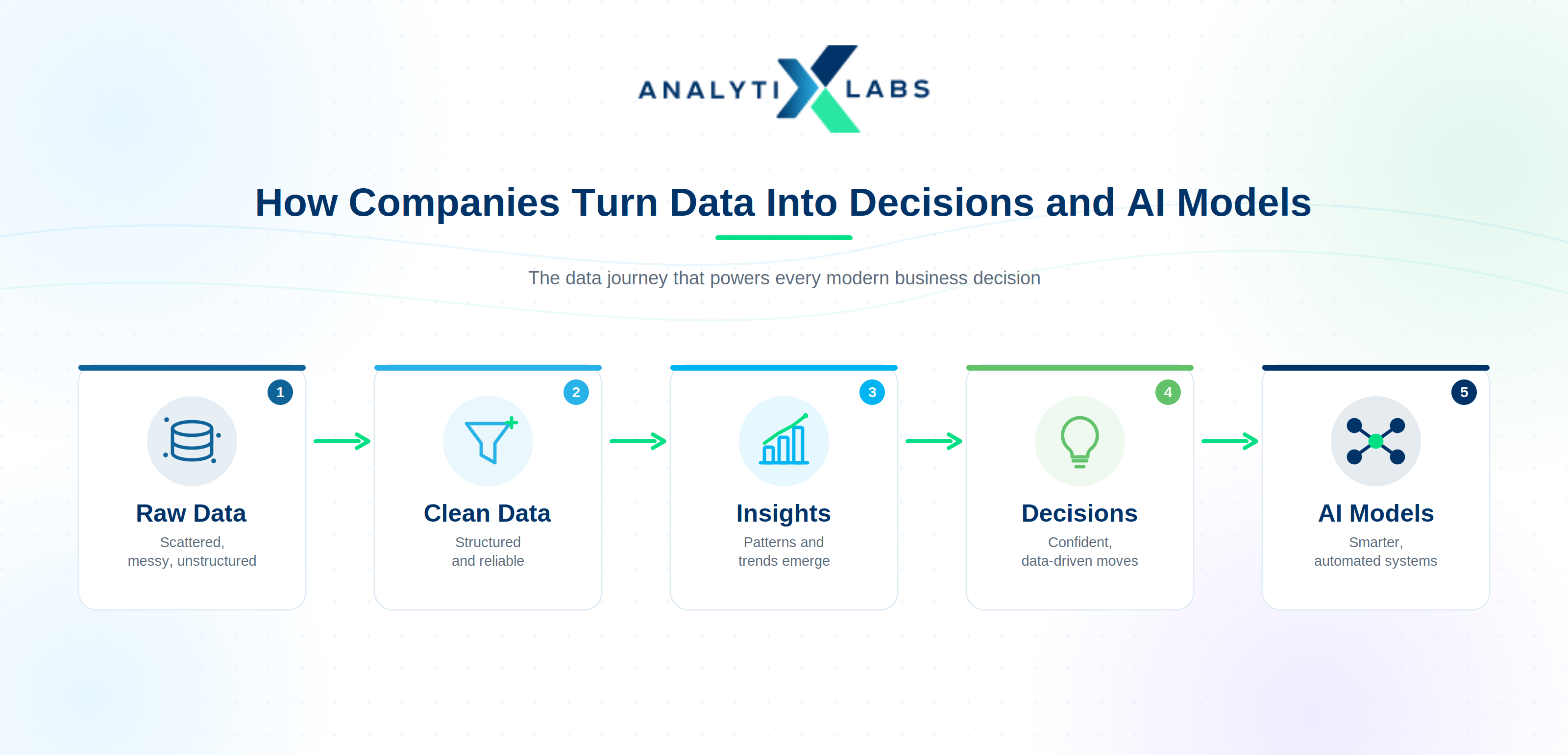
There is also a newer reason worth understanding. The same clean, well-structured data that analysts produce is exactly what AI and generative AI systems feed on. A model is only ever as good as the data behind it. Hence, an analyst who can prepare and interpret that data has quietly become one of the most important people in the room.
This brings us to the next pertinent question: should you opt for a business analyst or a data analyst profile? As I mentioned at the beginning, the difference between the two lies largely in the area of work.
In both profiles you will be dealing with data and trying to make sense of it, but your target and purpose will change with each role.
To understand the similarities and differences clearly, you first need to understand what each profile is really about. When you pick one as your career, you must understand where it will place you in the long run, and whether you are ready for it. Let’s dig in!
Business Analyst vs Data Analyst: An Overview
A business analyst will always oversee the business implications of data on a larger scale. They predict long-term actions based on their research like developing a new product line or prioritizing one business activity over another. This role requires a careful amalgamation of applications, skill sets, and tools that help a business measure its achievements and improve the effectiveness of core functions like marketing, sales, or IT.
Data analyst (a data-scientist adjuscent role), on the other hand, is responsible for determining patterns and trends by analyzing huge data sets. A data analyst predicts trends, tests several hypotheses, and enables a business to make data-driven decisions. And when I say ‘hypotheses,’ I don’t mean any random theory.
When a business appoints a data analyst, that analyst creates several hypotheses like predicting certain business-driven outcomes while considering all the available resources and tentative goals. They then analyze the data, draw conclusions, and pit those conclusions against the original hypotheses to see whether they can be implemented in practice. If they can, the analyst pulls out a data-driven roadmap to achieve them.
In layman’s terms, a data analyst can answer questions like the geographical impact of a mobile company, or which customers are likely to purchase in the next 30 days. This role requires a solid grasp of statistical and machine learning techniques, which is also why it overlaps in places with the roles of a data scientist, data modeling engineer, and data mining specialist.
Summing it up, the roles of business analyst and data analyst can be broken down into three sections: goals, data, and approach.
Goals
Business analyst: To identify trends in an organization and arrive at one version of the truth that can be optimized to improve business performance.
Data analyst: To recognize patterns in data and make accurate predictions, considering events of the past, present, and probable future.
Data
Business analyst: Works with predefined data sources based on project goals.
Data analyst: Works ad hoc, adding new data sources over time as correlations are discovered.
Approach
Business analyst: Defines goals and requisites for programs or projects.
Data analyst: Takes a predictive and prescriptive approach.
This gives us a broader perspective on how business and data analysts function within an organization. Now let’s see what it actually takes to build a career in each.
Choosing Your Career Path: Business Analyst vs Data Analyst
1) Educational Background
Blake Angove of LaSalle Network, a director of technology services, believes that business analysts and data analysts tend to come from different backgrounds, both academically and professionally.
A business analyst usually have an undergraduate degree in a business-focused major. This kind of qualification is considered ideal, because a business analyst takes business requirements and works with the technical team to shape a feature or package.
A data analyst, on the other hand, works with large data sets to predict business outcomes, and so these professionals often come from STEM majors with strong exposure to mathematics, science, programming, databases, and predictive analytics.
One thing has changed over the years is that a formal degree is no longer the only way in. Employers today happily consider strong certifications, bootcamps, and a solid portfolio of projects, which has opened the doors to plenty of career switchers.
2) Your Interests
This point (and the next one) matters enormously when you’re trying to etch out a career path for yourself.
Whatever role you pick should align with your interests. Imagine a professional who loves creating graphics for marketing but spends the day buried in data; that’s a classic example of wasted talent.
If you find numbers and statistics genuinely interesting, you’re more inclined to make a great data analyst. If your inclination is towards solving core business problems using data, then the business analyst role is the one for you.
A business analyst enjoys the corporate world and tends to solve business challenges on a larger scale. They are involved in researching, organizing, and looking into the implementation of new workflows. On top of that, these professionals usually have excellent written and verbal skills and are fantastic communicators, simply because business analysts are responsible for explaining their concepts to technical teams and stakeholders before anything is implemented in practice.
A data analyst, by contrast, is driven by numbers. They excel at mathematics and statistics, and they have a knack for extracting meaningful insights from disparate sources and complex data points.
3) Your Personal Choice
Your choice is the most crucial factor in deciding which role you take. You might be great at communication, and yet your heart may lie in the visual extraction of data. Try to understand where you actually want to be, and where you see yourself five years after starting with either role.
Your decision will also depend on a couple of practical things like salary insights and the subjects you enjoy. Both roles pay well, and sometimes the numbers are similar, but their long-term career paths will always differ.
Just know that you can pick either of the two, though it’s always wiser to choose the one whose skills you can realistically acquire. If you are confused, you can look at the course materials on AnalytixLabs for each of these subject matters to get a better sense of the fit.
Data Analyst vs. Business Analyst Salary in India
It will be a lie to say salary isn’t important. It is very much important, though of course, never at the cost of exploiting your own talents. Both business analysts and data analysts can make a real fortune with the right skills and the determination to make it big.
Recent trends show that companies increasingly see the benefit of having strong analysts in-house, and that demand has only grown as data and AI have become central to decision-making. Here is how the numbers look across India in 2025 and 2026.
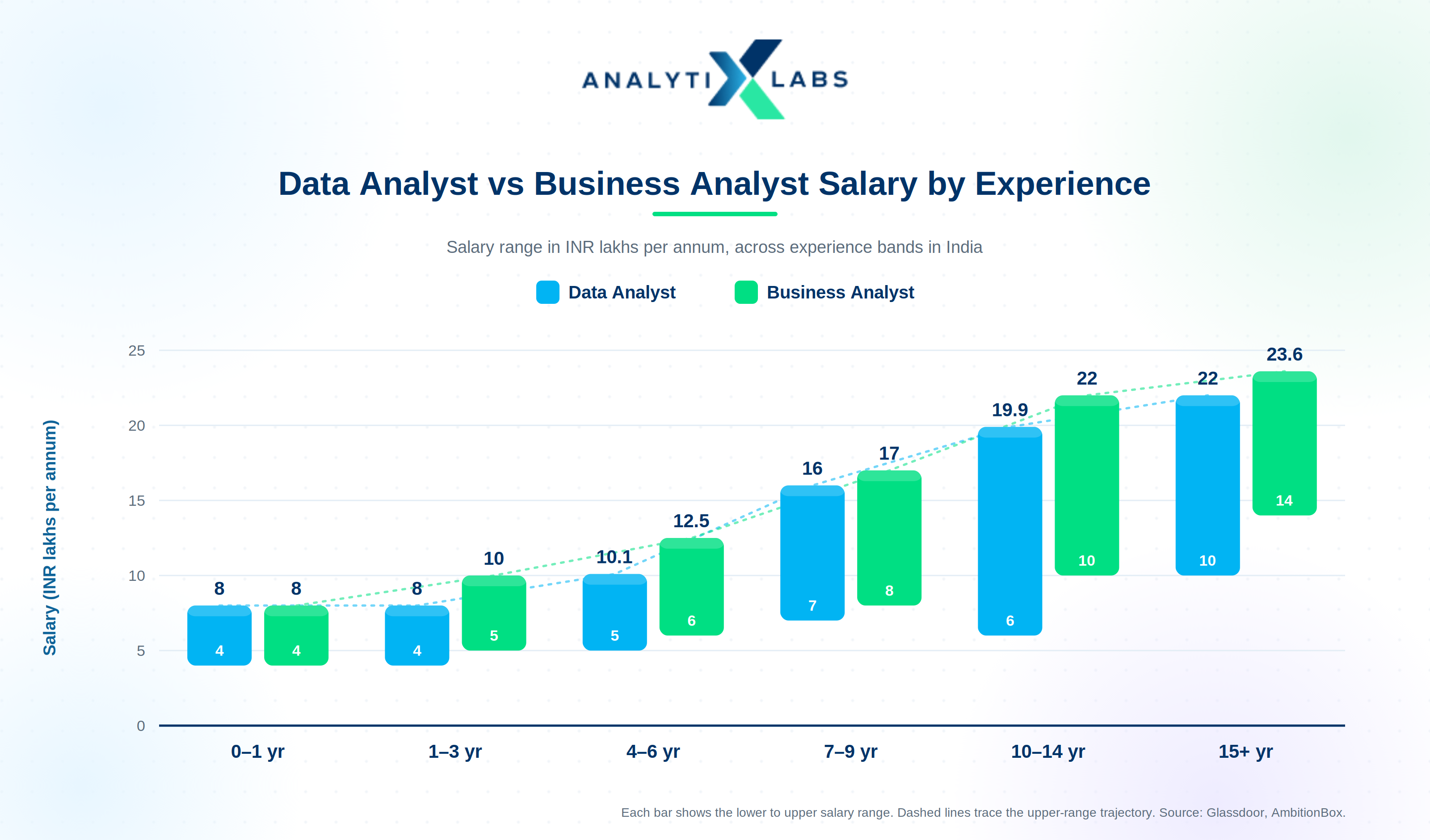
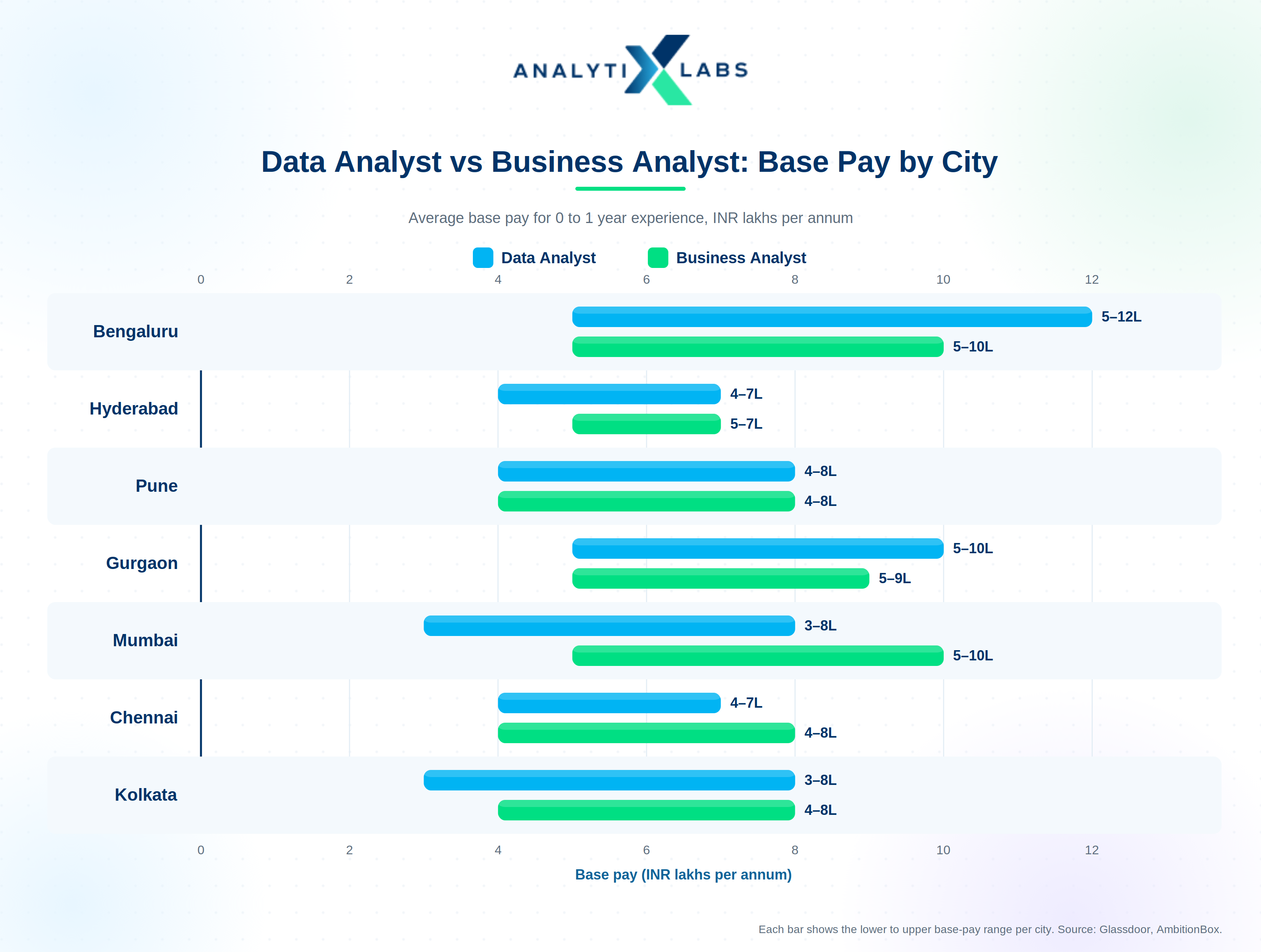
These ranges reflect aggregated estimates from sources like Glassdoor and AmbitionBox, and pay tends to climb sharply once you can demonstrate real proficiency in SQL, Python, and modern visualization tools. Location matters too. Cities like Bangalore, Hyderabad, Pune, Gurugram, and Mumbai sit at the top of the pay scale for both roles.
How the Roles Compare Globally
The global picture is just as encouraging. The U.S. Bureau of Labor Statistics projects that employment of operations research analysts, a close cousin of the business analyst, will grow by 21 percent between 2024 and 2034, much faster than the average for all occupations.
Data-focused roles are growing even faster: the BLS expects data scientist roles to grow by 34 percent over the same decade. To put rupees and dollars side by side, the 2024 median wage for data scientists in the United States was around 112,590 dollars, with operations research analysts sitting lower but still comfortably above the national average.
Initial salaries may look more appealing for the business analyst role. However, the data analyst path offers a promising gateway to more lucrative roles like data scientist, which tends to be the more rewarding choice over the mid to long term.
You may also like to read our detailed post on Data Analyst Salary in India.
Skills Required: Business Analyst vs Data Analyst
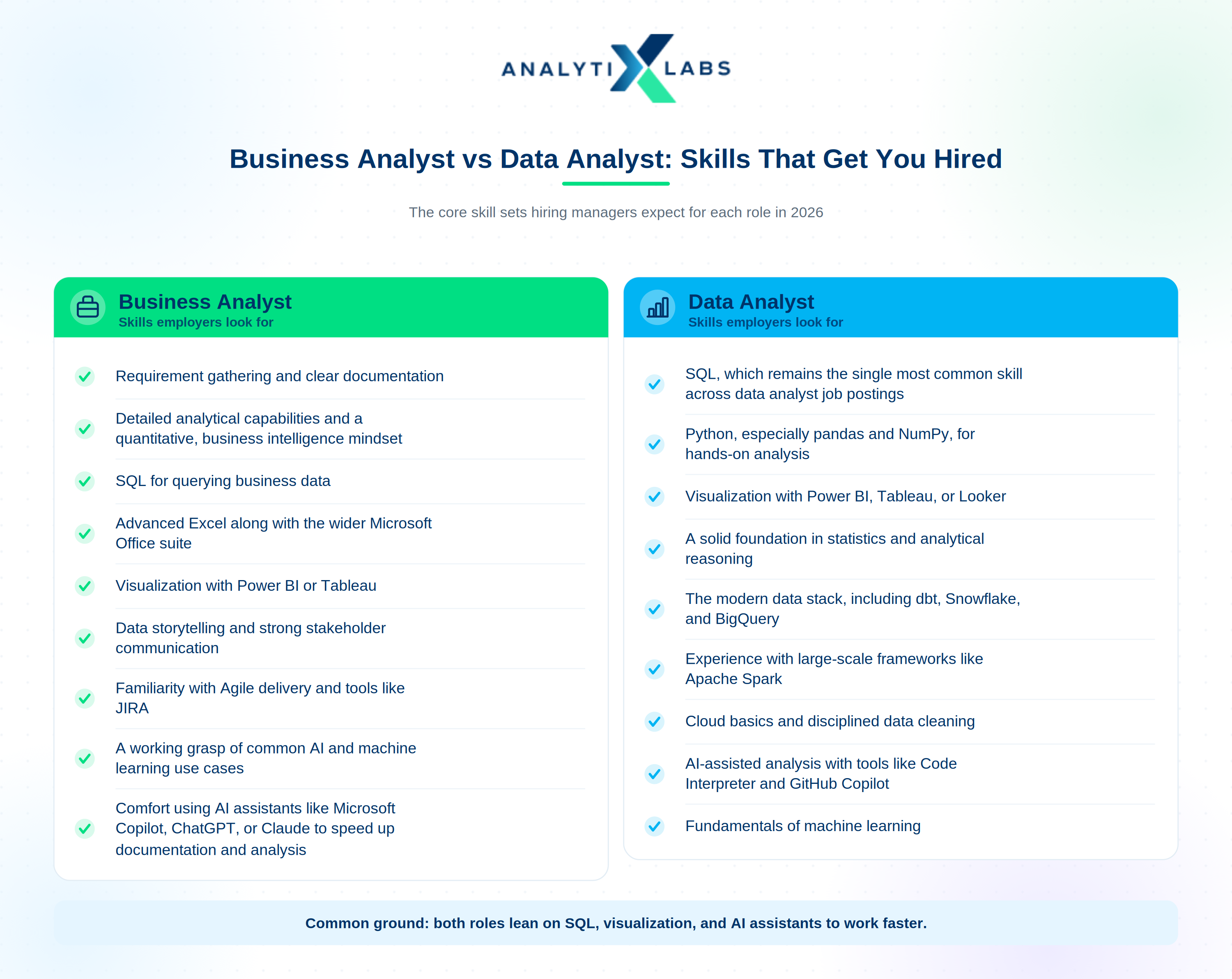
According to PwC, the data skill sets you’ll need vary quite a bit across data-related roles. We also looked at a range of job postings on Glassdoor and noted the skills each role tends to ask for.
[List updated based on what hiring managers are looking for in the current date].
Business Analyst Skills
Requirement gathering and clear documentation
Detailed analytical capabilities and a quantitative, business intelligence mindset
SQL for querying business data
Advanced Excel along with the wider Microsoft Office suite
Visualization with Power BI or Tableau
Data storytelling and strong stakeholder communication
Familiarity with Agile delivery and tools like JIRA
A working grasp of common AI and machine learning use cases
Comfort using AI assistants like Microsoft Copilot, ChatGPT, or Claude to speed up documentation and analysis
Data Analyst Skills
SQL, which remains the single most common skill across data analyst job postings
Python, especially pandas and NumPy, for hands-on analysis
Visualization with Power BI, Tableau, or Looker
A solid foundation in statistics and analytical reasoning
The modern data stack, including dbt, Snowflake, and BigQuery
Experience with large-scale frameworks like Apache Spark
Cloud basics and disciplined data cleaning
AI-assisted analysis with tools like Code Interpreter and GitHub Copilot
Fundamentals of machine learning
How AI Has Reshaped Both Roles?
It’s worth pausing on what AI has done to both of these roles, because it’s easily the biggest change since 2020. AI now writes queries, drafts code, builds first-pass visuals, and summarizes long reports in seconds, which frees you up to spend your time on the harder, more interesting questions.
There is a catch, though, and it’s an important one.
These tools help you most when you already understand the fundamentals. You can’t tell whether a generated SQL query is correct if you don’t understand joins, and you can’t trust a chart you don’t know how to read.
The bottom line is simple: AI handles the routine work, but it doesn’t replace your judgment or your understanding of the business context. That judgment is exactly what keeps both analysts in demand.
How to Acquire the Right Skills?
It’s perfectly alright if some of these skills are missing from your resume right now. Not everyone knows everything, and there is always scope to learn. You may not have the bandwidth to take a full-fledged degree course to acquire each one; and the good news is, you don’t need to.
The time-saving and cost-saving alternative is to look up skill-relevant courses on AnalytixLabs and get yourself enrolled.
These programs focus on industrial needs, skip the unnecessary jargon, and teach you exactly what you need to build a strong career as either a business analyst or a data analyst. Here are a few courses to help you kickstart things:
For the Data Analyst Path
Certification Course in Data Analytics, a beginner-friendly route into analytics
Data Science Using Python, for Python, statistics, and machine learning
For the Business Analyst Path
Analytics Edge: Business Analyst Course, covering Excel, SQL, Tableau, and R
Certification Course in Business Analytics (360), a structured analytics foundation
Advanced Excel Training and Certification, to master reporting and visualization
Ready to Grow Toward AI Roles?
A lot of analysts today don’t want to stop at analysis; they want to grow into AI-driven roles, and that’s a smart ambition to have. If that sounds like you, it’s worth building applied AI skills early rather than playing catch-up later.
To understand more about these courses and your career prospects, contact the AnalytixLabs team now. Hope this answers your queries — and if there’s anything more you’d like to know, feel free to drop it in the comments. Happy learning!
Frequently Asked Questions
Here are quick answers to the data analyst vs business analyst questions readers ask most.
Is a data analyst or business analyst better for freshers?
Both roles welcome freshers, so the better fit really comes down to what you enjoy. If you like working with numbers, tools, and patterns, the data analyst route suits you well. If you prefer untangling business problems and talking to stakeholders, the business analyst path is the more natural home.
Do data analysts and business analysts need to know coding?
Data analysts almost always need SQL and usually Python, since so much of the job is querying and transforming data. Business analysts lean more on SQL and Excel, with coding treated as a valuable bonus rather than a strict requirement.
Will AI replace data analysts and business analysts?
It’s a fair worry, but the honest answer is no — at least not the analysts who keep learning. AI automates the routine parts of the job, yet it still relies on a human to frame the right questions and interpret the results in context. That judgment is precisely what keeps both roles in demand.
Which role pays more in India?
In the data analyst vs business analyst pay comparison, business analysts often start with a slightly higher package, especially in consulting and IT. Over a longer horizon, though, data analysts can out-earn them by moving into high-growth roles like data scientist.
You may also like to read: