Self-learning AI systems that don’t just learn once but continuously improve themselves over time. Unlike traditional ML models that rely on static training data, manual updates, and scheduled retraining cycles, self learning artificial intelligence systems can adapt dynamically. They learn from new data, monitor their own performance, detect weaknesses, and continuously refine their behavior without explicit reprogramming. This ability moves AI closer to truly adaptive intelligence.
A self learning AI model is designed to close the loop between learning, feedback, and improvement. Techniques like reinforcement learning, online learning, and automated AI model optimization enable these systems to refine their behavior in real time. Reinforcement Learning explains how agents can improve decision-making through feedback-driven learning loops, forming the theoretical basis for many self-improving AI systems.
Python is the preferred language for building such adaptive systems. Developers exploring how to make a self learning AI in Python can use its extensive AI-focused libraries to implement continuous learning and advanced AI model optimization techniques efficiently.
In this article, we will understand the concept of self improving AI and explore how to make a self learning AI in Python.
What Is Self-Learning AI?
Self-learning AI systems can improve on their own over time without needing constant human input after being deployed. These systems use feedback to evaluate their performance, spot inefficiencies, and adjust their internal processes to make better decisions in the future. The key feature of self-improving AI models is their autonomy. It treats learning as an ongoing process rather than a one-time event.
The difference between self learning AI and traditional AI models is critical in the real world, where data is always changing.
In fields such as financial markets, healthcare, cybersecurity, and digital services, static machine learning models quickly become outdated. It is due to factors such as concept drift and changes in user behavior. Self-learning AI models continuously adapt to new patterns, ensuring systems stay accurate and relevant over time without needing constant manual updates.
Self learning systems are important because they offer both adaptability and scalability. As systems handle more complex tasks and larger amounts of data, manually retraining them becomes expensive and inefficient. Self-improving AI solves this problem by building learning capabilities directly into its operations.
Learn Python Frameworks to Build Self-Learning AI Models
Upskill with AnalytixLabs👨🏻💻
Learn the popular and essential Python frameworks to build self-learning AI models. Get hands-on training, industry-relevant assigments and projects, and interactive learning experience at AnalytixLabs. Learn from the best at your own comfort.
Enroll now.
- Data Science Using Python
- Machine Learning Using Python
- Deep Learning Using Python
- FullStack AI
- Generative AI
Benefits of Continuous Improvement
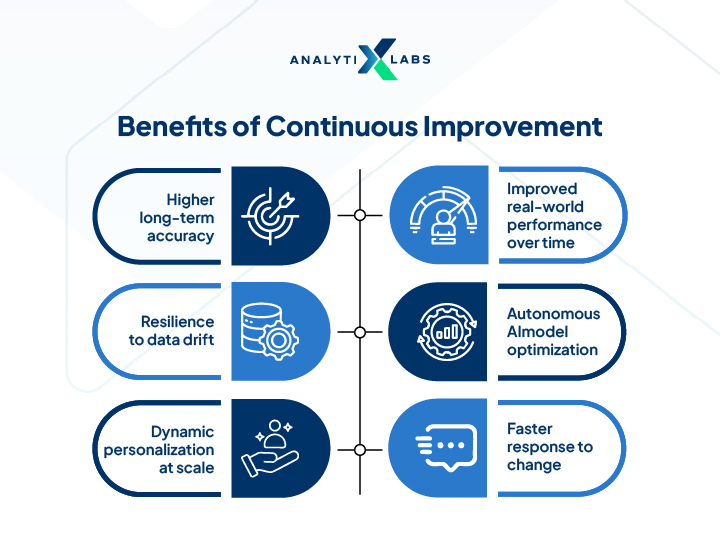
The defining strength of self-improving AI lies in its ability to get better with use. Key benefits of continuous improvement are:
- Higher long-term accuracy: Continuous learning significantly lowers the operational cost of AI systems by minimizing repeated full retraining cycles. Incremental updates save time, computational resources, and engineering effort, making self-learning artificial intelligence more scalable in production environments.
- Improved real-world performance over time: Unlike traditional models that rely solely on historical data, self learning AI models capture post-deployment insights. They learn from live interactions, emerging patterns, and edge cases that were not present during initial training, leading to performance that improves with use.
- Resilience to data drift: Data distributions change frequently. Continuous learning mechanisms enable AI systems to adapt without degrading accuracy. Research on online and continual learning shows that incrementally trained models maintain stable performance while reducing the risk of catastrophic forgetting, a common issue in neural networks.
- Autonomous AI model optimization: Self-improving AI systems continuously refine their parameters, policies, or representations without manual tuning. This automated optimization loop ensures models remain efficient and relevant, even as inputs, user behavior, or external conditions evolve.
- Dynamic personalization at scale: Self learning AI enables real-time personalization without maintaining multiple static models. A single adaptive system can tailor outputs based on user behavior, context, or feedback. It is a capability needed for recommendation engines, intelligent assistants, autonomous systems, and customer-facing AI applications.
- Faster response to change: Self learning AI models can respond to shifts in data patterns almost immediately. They are well-suited for high-velocity domains such as finance, e-commerce, cybersecurity, and real-time decision systems.
These advantages make self learning AI particularly effective for use cases such as recommendation engines, dynamic pricing, fraud detection, and adaptive user experiences.
Difference Between Traditional Machine Learning and Self-Improving AI
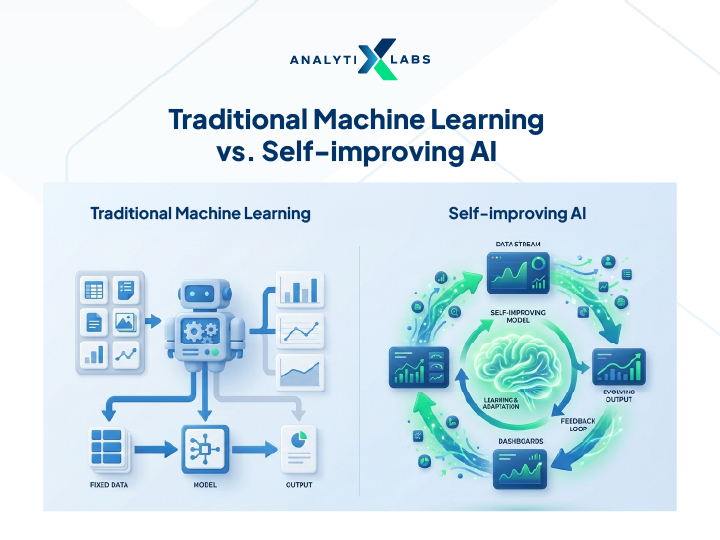
Traditional machine learning follows a fixed workflow from data collection to model training, validation, deployment, and retraining when performance declines. This approach assumes relatively stable data environments and requires ongoing human supervision. Between retraining cycles, the model remains static and unable to learn from new information.
In contrast, self-improving AI treats learning as an ongoing process. These systems incorporate feedback loops that enable incremental updates as new data arrives. Some approaches extend this further through meta-learning, allowing models to adjust how they learn based on performance outcomes. It is a capability that becomes essential when exploring how to make self learning AI in Python and implementing adaptive systems.
Types of AI Self-Learning
Self learning artificial intelligence can be implemented using several learning paradigms, depending on the problem, data availability, and feedback mechanisms:
- Reinforcement Learning (RL): Agents learn optimal behavior through interaction with an environment, guided by rewards and penalties. Research on reinforcement learning in strategy-based games and DeepMind’s innovations demonstrates how feedback-driven learning underpins landmark AI systems such as AlphaGo, recommendation engines, and other adaptive decision-making models.
- Online Learning: Online learning enables models to update incrementally as new data arrives, rather than retraining on entire datasets. They are suitable for streaming and real-time applications such as fraud detection, where patterns evolve rapidly, and immediate adaptation is critical.
- Unsupervised Learning: Systems discover hidden structures, patterns, and relationships in unlabeled data. These enable adaptation to novel or previously unseen scenarios through clustering, dimensionality reduction, anomaly detection, and generative modeling techniques.
In self-improving AI systems, unsupervised learning is often combined with other methods to identify emerging patterns, detect shifts in data distribution, and support adaptive decision-making without constant human supervision.
Why are Python Frameworks ideal for AI development?
Python is the dominant programming language for artificial intelligence and machine learning development. It powers systems that range from early-stage research prototypes to large-scale production deployments. Its adoption is driven by technical simplicity, fast development, and a mature ecosystem of AI-focused libraries and frameworks.
Why Python is best for AI and ML projects
Python’s simplicity and readability reduce the barrier to entry for AI development while remaining powerful enough for advanced research and industrial use cases. Unlike lower-level languages that require extensive boilerplate code, Python allows developers to express complex algorithms concisely, enabling faster experimentation and iteration, which makes it helpful in AI research.
Python’s interpreted nature supports interactive development through tools such as Jupyter Notebooks, where code execution, visualization, and documentation coexist seamlessly. The workflow has become a standard practice for exploratory data analysis, model prototyping, and performance evaluation across the AI community.
Python also benefits from an exceptionally large ecosystem of third-party packages, reducing the need to reinvent foundational components. According to the Python Package Index (PyPI), the platform hosts hundreds of thousands of packages, many of them dedicated to machine learning, deep learning, data science, and reinforcement learning.
Understanding DSPy and Features
DSPy (Declarative Self-Improving Python) represents a new paradigm in Python AI libraries, specifically designed to build self-optimizing language-model pipelines. Rather than relying on manual prompt engineering, DSPy treats prompts, demonstrations, and instructions as parameters that can be automatically optimized based on task performance.
Developers define tasks declaratively, while DSPy manages prompt selection, tuning, and evaluation via optimization. It is valuable for building self-learning AI models, as it enables systems to improve language understanding and generation quality through feedback-driven optimization.
The framework introduces modular abstractions such as signatures, optimizers, and teleprompters, enabling systematic prompt optimization at scale. The official DSPy project documentation provides detailed examples and benchmarks demonstrating improvements in reasoning accuracy and task performance across language model workflows.
Other Popular Frameworks for AI Development
Beyond DSPy, Python’s AI ecosystem includes several mature frameworks essential for building self-improving AI systems. TensorFlow and Keras support large-scale neural network training and deployment, while PyTorch offers dynamic computational graphs, which are favored in research and rapid experimentation. Scikit-learn provides robust classical machine learning algorithms, and Gym with Stable-Baselines3 enables reinforcement learning environments critical for agents that learn through interaction.
Together, these frameworks enable developers to build a self learning AI in Python and implement adaptive, continuously improving systems efficiently.
Step-by-Step guide to build a Self-Learning AI model in Python
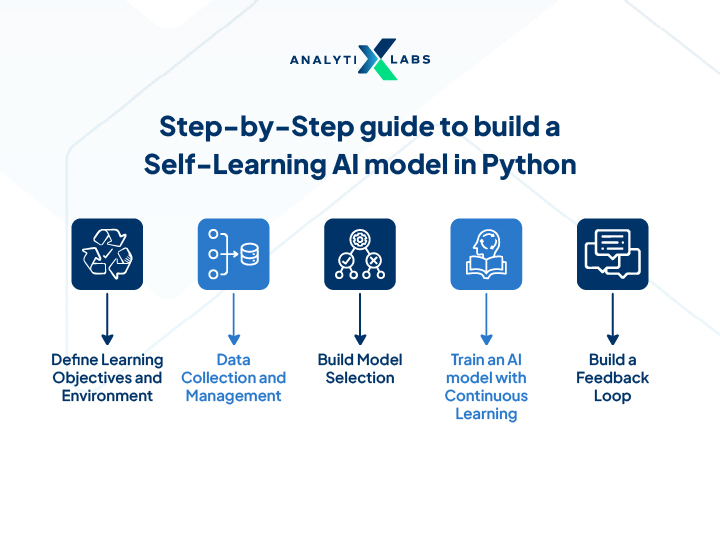
Building a self learning AI model requires careful planning and the implementation of continuous learning mechanisms. This guide explains how to build a self-learning AI in Python. You’ll learn how to create a system that can improve on its own after deployment, without requiring manual updates.
1. Define Learning Objectives and Environment
The first step is to clearly define what the AI system should learn and the environment in which it will operate. To improve on its own, a system needs specific, measurable goals. Examples include maximizing rewards in reinforcement learning or minimizing errors in supervised learning.
Defining the environment is also critical. For a reinforcement learning agent, this means specifying the state space (what the agent can observe), the action space (what the agent can do), and the reward structure (the feedback it receives). Tools like Gymnasium (formerly OpenAI Gym) provide standardized environments for developing and testing RL agents across diverse scenarios, from simple control tasks to complex game-playing environments.
Learning objectives should also account for real-world challenges, such as evolving data patterns, environmental variability, and computational constraints that can affect model complexity and update frequency.
2. Data Collection and Management
Effective data management distinguishes robust self-learning systems from those that stagnate or degrade over time. For online learning scenarios, establish pipelines that can ingest streaming data in real time while enforcing validation, normalization, and quality checks.
Reinforcement learning agents implement experience replay buffers to store past interactions. This technique, central to modern reinforcement learning (RL) algorithms, stabilizes training by breaking correlations between consecutive experiences and enabling multiple learning updates from the same data.
In continual learning, it’s crucial to maintain a diverse dataset. By keeping representative samples from previous tasks, the model can avoid catastrophic forgetting and retain knowledge over the long term.
3. Build Model Selection
Select model architectures that support incremental updates and controlled parameter adaptation. Modular neural networks, elastic weight consolidation, and ensemble-based approaches allow systems to learn new behaviors while preserving previously acquired knowledge.
For self learning AI applications, models with built-in plasticity are preferred. Transformer-based architectures, recurrent models with memory mechanisms, and hybrid systems combining symbolic and neural components can adapt effectively in dynamic environments.
Framework choice is equally important. PyTorch and TensorFlow support custom training loops, gradient accumulation, and dynamic updates, capabilities essential for implementing advanced AI model optimization techniques in self-improving systems.
4. Train an AI model with Continuous Learning
Training self-learning systems requires incremental update strategies rather than batch retraining. In reinforcement learning, agents interact continuously with the environment, update policies based on rewards, and refine behavior over repeated episodes.
Apply proven AI model optimization techniques, such as adaptive learning rate scheduling, gradient clipping, and regularization, to ensure stable updates. Research on deep reinforcement learning shows that algorithms such as Proximal Policy Optimization (PPO) and Soft Actor-Critic (SAC) offer strong stability and sample efficiency in continuous learning scenarios.
Monitoring convergence, policy stability, and generalization performance is essential to confirm that the model is learning transferable behaviors rather than overfitting recent data.
5. Build a Feedback Loop
The feedback loop completes the self-learning cycle by connecting model outputs to future updates. In supervised systems, feedback may come from user corrections or delayed ground-truth labels. In reinforcement learning, reward signals provide a continuous evaluation of performance.
Production-level monitoring systems should track performance drift and trigger additional learning cycles when predefined thresholds are breached. Well-designed feedback mechanisms balance exploration and exploitation, ensuring the model continues to discover better strategies instead of settling into suboptimal behavior.
Building the Self-Improving Model Using Pre-Trained AI Models
Pre-trained models have revolutionized self learning AI development by providing robust starting points that significantly reduce training time and computational requirements. Instead of building models from scratch, developers can use pre-trained models built on large datasets and fine-tune them for specific tasks.
How Pre-Trained Models Fuel Self-Learning AI
-
Accelerated Development:
Pre-trained models eliminate the need for extensive initial training phases. Frameworks such as Hugging Face Transformers provide access to thousands of pre-trained models optimized for various tasks, enabling developers to focus on implementing continuous learning mechanisms rather than foundational training.
-
Improved Performance:
Models pre-trained on diverse datasets capture generalizable patterns that enhance learning efficiency. This foundation enables self learning AI models to achieve stronger baseline performance with less task-specific data, which is particularly valuable in domains where labeled data is limited.
-
Transfer Learning:
Pre-trained models excel at transfer learning, where knowledge from one domain informs learning in another. Python AI libraries such as PyTorch Hub and TensorFlow Hub offer seamless integration of pre-trained weights, enabling rapid deployment of adaptive and self-improving systems.
-
Reduced Computational Cost:
Training large models from scratch requires substantial computational resources. Pre-trained models dramatically reduce this burden, making advanced AI model optimisation techniques more accessible to organizations with limited infrastructure. Fine-tuning requires less computation than full training cycles while delivering comparable or superior performance.
By combining pre-trained foundations with continuous learning mechanisms, developers can build scalable self-improving AI systems that balance efficiency, adaptability, and long-term performance across diverse applications.
Tips and Best Practices for Designing Self-Learning AI Models
Designing effective self learning AI models requires careful attention to architectural choices, learning strategies, and operational safeguards to ensure reliable improvement without instability.
- Start with Clear Success Metrics: Define measurable performance indicators beyond accuracy, track adaptation speed, stability across distribution shifts, and resource efficiency. These metrics guide improvement and detect when learning degrades performance.
- Implement Gradual Learning Updates: Avoid aggressive parameter changes that destabilize learned knowledge. Use AI model optimisation techniques such as adaptive learning rates and regularization, and leverage Python AI libraries for smooth incremental updates. Research on continual learning demonstrates that gradual updates significantly reduce catastrophic forgetting while maintaining adaptability.
- Balance Exploration and Exploitation: Self learning AI models must explore new strategies while exploiting known successful approaches. Implement epsilon-greedy policies or entropy regularization to maintain this balance and prevent premature convergence to suboptimal behaviors.
- Monitor for Drift and Anomalies: Deploy automated monitoring systems that detect performance degradation, concept drift, or unexpected behaviors. Establish rollback mechanisms to revert to previous model versions if updates cause harm.
- Validate in Controlled Environments: Test self-learning capabilities in sandbox environments before production deployment. Simulate distribution shifts and edge cases to ensure robust adaptation without compromising safety.
- Maintain Human Oversight: Critical self-improving AI systems should include human-in-the-loop checkpoints for high-stakes decisions. Combining autonomous learning with human oversight reduces the risk of unintended optimization.
- Document Learning Trajectories: Maintain detailed logs of model updates and performance changes to enable debugging and understanding of system evolution over time.
Challenges in Self Learning AI Model Designs
Despite their transformative potential, self learning AI systems face significant technical and operational challenges that must be addressed to ensure reliable, safe deployment.
Common Obstacles
- Catastrophic Forgetting: A fundamental challenge where models lose previously acquired knowledge when learning new tasks. This occurs when neural network weights optimized for earlier tasks are overwritten during subsequent learning phases, degrading performance on the original capabilities.
- Distribution Shift and Concept Drift: Ongoing threats as real-world data distributions evolve over time. Self learning AI models trained on historical data may fail when encountering novel patterns, requiring continuous adaptation mechanisms that remain effective across changing environments.
- Computational Resource Constraints: Limit the frequency and scope of model updates, particularly in edge computing scenarios. For practical use, it’s crucial to balance learning speed with the available processing power and energy usage.
Mitigation Strategies
The following approaches can help address these challenges:
- Experience replay and elastic weight consolidation: Preserve important knowledge while enabling new learning. Research on memory-augmented neural networks demonstrates how architectural innovations can reduce forgetting while maintaining plasticity.
- Regularization techniques:
- L2 penalties on parameter changes.
- Knowledge distillation maintains stability.
- Ensemble methods combine multiple model versions to provide robustness against individual model failures.
Paving the Road for Superintelligence
Overcoming these challenges paves the way for advanced self-improving AI systems capable of autonomous evolution. As systems learn to recognize and address their own limitations, they enter feedback loops where each improvement boosts their ability to improve further, progressing toward superintelligence. This competitive landscape may favor more capable systems that outperform and replace weaker AI. However, it raises key questions about control, alignment, and how to ensure these powerful systems remain beneficial and governable as they evolve beyond their original design.
Example or Use Case for Self-Improving AI Models
Autonomous Recommendation Systems exemplify practical self learning AI implementation. Consider a streaming platform’s recommendation engine that continuously adapts to user preferences without periodic retraining cycles.
Initially, the system uses collaborative filtering based on viewing history. As users interact with recommendations, the model collects implicit feedback, watch time, skip rates, and completion percentages, creating a continuous learning loop. Through reinforcement learning (RL) algorithms, the system treats each recommendation as an action and user engagement as a reward signal.
The self learning AI model employs online learning techniques to incrementally update recommendation weights. When users develop new interests or seasonal preferences shift, the model adapts in real-time rather than waiting for scheduled retraining. Experience replay buffers store diverse user interactions, preventing catastrophic forgetting of niche content preferences.
Advanced implementations leverage Python AI libraries such as PyTorch and TensorFlow for efficient model updates, while frameworks like Ray RLlib enable distributed training across user segments.
The system demonstrates key self-improving AI characteristics, such as autonomous adaptation to distribution shifts, personalized learning for individual users, and continuous performance optimization without manual intervention. Over months of operation, recommendation accuracy improves as the model discovers nuanced patterns in viewing behavior, content correlations, and temporal trends, achieving performance gains that are impossible with static or periodically retrained models.
FAQs on Self Learning AI Models
-
Can we trust a self-improving AI?
Self-learning AI models can be reliable when they have clear objectives, validation processes, and rollback options. However, critical systems need ongoing audits to ensure their improvements stay aligned with their goals and ethical standards.
-
Are self-improving AI and adaptive AI learning the same?
No. While both involve learning from experience, they differ significantly in scope and autonomy:
| Aspect | Adaptive AI | Self-Improving AI |
|---|---|---|
| Learning Scope | Adjusts behavior within predefined limits | Modifies learning strategies and architecture |
| Autonomy Level | Responds to environmental changes | Autonomously evolves internal mechanisms |
| Optimization | Parameter tuning within a fixed framework | Can rewrite optimization processes |
| Example | Personalized recommendations | Recursive algorithm enhancement |
Adaptive systems respond to changes, while self-improving systems fundamentally evolve their learning capabilities through feedback loops and continual optimization.
-
Which AI coding tool is best for Python development?
Popular tools include PyCharm for comprehensive IDE features, Jupyter Notebooks for interactive experimentation, and VS Code with Python extensions for lightweight development. For self learning AI projects, Jupyter facilitates iterative model development, while PyCharm offers robust debugging for complex Python AI libraries integration.
-
What is a Recursive self-improving AI?
A recursive self-improving AI modifies its own code or architecture to enhance its performance. It then uses these new capabilities to make further improvements, creating a feedback loop where each iteration increases its capacity for improvement. This concept is a theoretical path toward superintelligence through exponential growth.
-
What is the Darwin Gödel machine?
The Darwin Gödel Machine (DGM) is a self-improving AI system that iteratively modifies its own code and validates changes through empirical testing rather than formal proofs. It combines Darwinian evolution with open-ended exploration to maintain an archive of coding agents that continuously evolve and autonomously improve on coding benchmarks.
-
Does a powerful self-improving AI eliminate weaker ones?
As self-improving AI advances, it could find and exploit weaknesses in less capable systems, potentially outpacing or disabling them in competitive settings. More advanced AI might use its superior problem-solving capabilities to outperform competitors, seize resources, or overwhelm their processing power. It creates a scenario where only the most advanced systems continue to thrive.