When Maharashtra launched a Marathi farming app on Bhashini, India's national language AI platform, officials in tribal Nandurbar called asking that Bhili be added too. This was because Bhili is primarily oral, with no standard script or written dictionaries, so the community and local officials had to record spoken words and build the data model from scratch. If you look at it in this context, the complaint was never that AI had failed. It was that AI worked, and they were being left out of it.
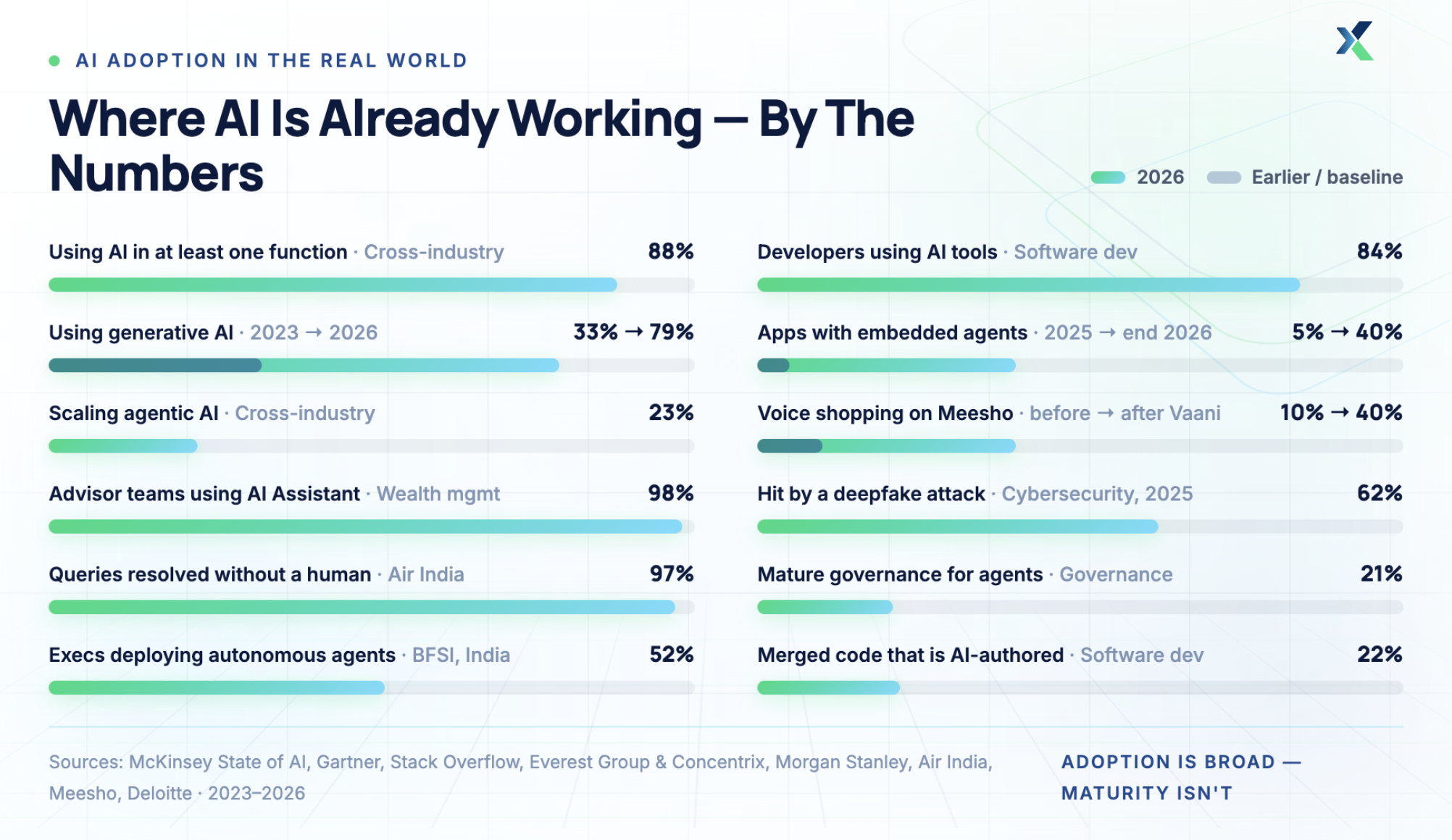
That is what AI looks like once it becomes infrastructure rather than a pilot. Bhashini now processes over 20 million AI inferences daily across more than 800 government websites, sitting inside Aadhaar, PM-Kisan, Rail Madad and multilingual banking. Enterprises show the same curve. McKinsey found 88% of organizations now use AI in at least one function, and Gartner expects 40% of enterprise applications to embed task-specific AI agents by the end of 2026, up from under 5% in 2025.
So the question is no longer what AI is, but how applications are being built on it. This article explains how AI is being deployed and leveraged across multiple industries; each explained with a solid use case and/or example.
Also read: Agentic AI Trends Shaping the Future of Autonomous AI
Top AI Applications Across Industries and Domains
An AI agent is long past the demo phase. It now handles more than a million customer queries, with 97% resolved without human intervention. This is exactly why Chief Digital and Technology Officer, Satya Ramaswamy, is set to deploy over 30 AI-led initiatives across customer service, operations and engineering.
The list of AI applications is growing manifold times since 2020. What was a hype earlier is now a norm. Every day marks the innovation of a new AI model that improves how AI fits into our regular lives.
Most articles on this topic still organize AI by industry: healthcare, banking, retail, agriculture. That framing broke somewhere around 2023. The useful split today is by what the AI does.
Generative AI produces something when asked. Agentic AI pursues a goal and takes action. Nearly every real deployment now sits in one of those two buckets, or stitches them together.
Top 50 AI Applications across industries:
# | Application of AI | Industry |
|---|---|---|
1 | Medical imaging triage and report drafting | Healthcare |
2 | Clinical note and discharge summary generation | Healthcare |
3 | Patient scheduling and follow-up agents | Healthcare |
4 | Claims coding and revenue cycle agents | Healthcare |
5 | Molecule screening for drug discovery | Pharmaceuticals |
6 | Real-time transaction fraud scoring | Banking |
7 | Credit underwriting from unstructured documents | Lending |
8 | KYC and AML alert triage | Banking |
9 | Investment research and earnings call synthesis | Capital markets |
10 | Portfolio rebalancing and robo-advisory | Wealth management |
11 | Claims assessment and settlement | Insurance |
12 | Ledger reconciliation and close automation | Accounting |
13 | Store-SKU-day demand forecasting | Retail |
14 | Autonomous inventory replenishment | Retail |
15 | Agentic shopping and one-click checkout | E-commerce |
16 | Dynamic pricing and markdown optimisation | Retail |
17 | Visual search and product discovery | E-commerce |
18 | Shelf and planogram monitoring | Retail |
19 | Product catalogue copy at scale | E-commerce |
20 | Code generation and pair programming | Software |
21 | Legacy codebase modernisation | IT services |
22 | IT incident triage and resolution | IT operations |
23 | Automated test case generation | Software |
24 | Cloud cost monitoring and optimisation | IT operations |
25 | Threat detection and SOC alert triage | Cybersecurity |
26 | Deepfake and synthetic media detection | Cybersecurity |
27 | Multilingual passenger query resolution | Aviation |
28 | Refund and rebooking workflow execution | Aviation |
29 | Predictive aircraft maintenance | Aviation |
30 | Fare forecasting and route optimisation | Travel |
31 | Predictive equipment maintenance | Manufacturing |
32 | Visual defect inspection on the line | Manufacturing |
33 | Warehouse robotics coordination | Logistics |
34 | Fleet routing and last-mile dispatch | Logistics |
35 | Supplier quote comparison and PO generation | Procurement |
36 | Campaign copy and creative variant generation | Marketing |
37 | Content localisation across markets | Marketing |
38 | Answer engine and search optimisation | Marketing |
39 | Voice synthesis and dubbing | Media |
40 | Video generation and post-production | Entertainment |
41 | Resume screening and candidate matching | Human resources |
42 | AI-led interviews and shortlisting | Human resources |
43 | Contract review against playbooks | Legal |
44 | Case law research and summarisation | Legal |
45 | Adaptive tutoring and learning paths | Education |
46 | Assessment scoring and feedback | Education |
47 | Crop disease detection from field imagery | Agriculture |
48 | Grid load forecasting and balancing | Energy and utilities |
49 | Network fault prediction and self-healing | Telecom |
50 | Vernacular citizen service assistants | Government |
Lets discuss a few AI applications in details below.
Note: The two AI types land differently by sector. Industries with reviewable output adopted generative AI first. Industries where the payoff is a completed transaction moved to agentic AI.
AI Applications in Retail
1. Demand Forecasting and Autonomous Replenishment
Type: Agentic AI
Forecasting models predict what sells where, then trigger replenishment without a planner approving each order. There are two different ways excess stock can hurt you, and they cost different amounts. Let's look at two samples -
If you over-order jeans, you mark them down. You lose margin, but you recover most of the revenue. The loss is partial.
If you over-order bananas, they rot. You recover nothing, and you may pay to dispose of them. The loss is total.
So, the same forecasting improvement is worth more in a grocery aisle than in apparel, because the loss it prevents is a total one rather than a recoverable one.
For instance, Walmart forecasts at store-SKU-day granularity, folding in weather, local events and regional buying patterns, and retrains continuously as those patterns shift. The company reported sales growing nearly 5% while inventory rose only 2.6%, attributing the divergence to automation.
Similarly, McKinsey finds that AI demand-forecasting deployments commonly cut stockouts and overstock by 20% to 50%. Perishables benefit most, because a marked-down jacket still earns something while spoiled produce earns nothing.
2. Hyper-local Assortment and Shelf Availability
Type: Agentic AI
Most retail chains stock their stores from regional templates. A template fits the average store in a region and misses every store that isn't average, which is most of them.
For instance, Walmart forecasts demand at zip-code level instead, so each store stocks what their local customers buy rather than what the region buys on average. Pool toys go where it's hot and winter gear where it's cold, and they split the assortment far finer than that.
Their system also does something less obvious. A patent-pending anomaly forgetting feature deliberately ignores one-off spikes. Without it, a single hurricane or one viral product teaches the model that demand has permanently risen, and the store keeps over-ordering for years.
Walmart reports 30% fewer stockouts and 30 million fewer transportation miles a year. The miles are the interesting number. Better forecasts mean fewer emergency restocking runs, and a truck you never dispatch costs nothing.
AI in eCommerce
3. Agentic Shopping and Zero-click Checkout
Type: Agentic AI
Shopping AI has moved from recommending to transacting. Walmart's Sparky agent can take a request like "plan a camping weekend", check preferences, inventory and weather, assemble a basket with sale items applied, and complete checkout on a single confirmation.
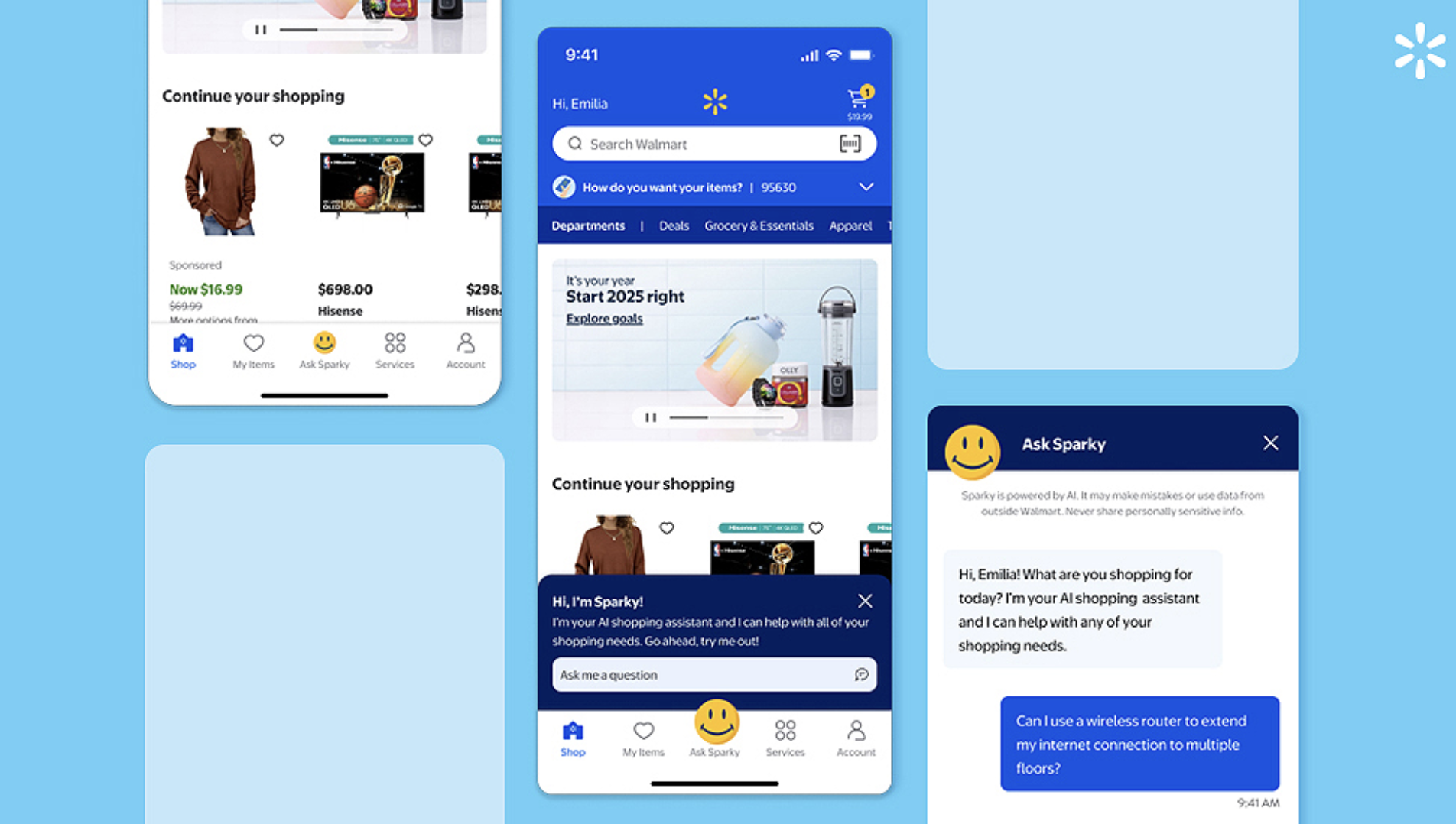
Source: Walmart
A shopping assistant does the heavy-lifting of deciding and paying. You still take the final call, click and pay.
Imagine asking for a tent - the recommendation engine will return results containing tents. Now ask the agent to plan a camping weekend, and it will work out what all you will need. For instance, for camping, the agent will return purchase options for tents, a sleeping bad, torch, and a cooler - none of which you had explicitly mentioned.
From there, it runs checks that you would have run manually. It looks into what is in stock at your nearest store, what fits your budget, and also goes over what you bought last time. Simultaneously, it runs check on items that are on discount and what the weather looks like on Saturday when you want to go camping.
When put together, this entirely changes your shopping experience. You stop buying products and start buying outcomes. You see, nobody wants to browse a category page for a weekend.
While conversational AI changes shopping experience, it also enhances what retailers compete for. A product page optimized for a human reader is worthless if no humans are reading it. The retailers now compete to be the item an agent retrieves and citues, which is a ranking problem with different rules.
Another example is Target's integration with Google's Gemini via the Universal Commerce Protocol. It lets an assistant check local stock and complete a purchase without the shopper navigating the site at all.
4. Conversational Commerce and Visual Search
Type: Generative AI
Conversational interfaces started as ticket deflection but now they capture demand.
Bain called this early but got the timing wrong. Their 2021 India report described voice and vernacular as vital to winning new shoppers. The 2022 edition cited 5x growth in voice-search users and 3x in vernacular search. The 2023 edition reported that 25% to 30% of first-time shoppers used these features. Then Bain dropped both topics from their 2025 and 2026 reports entirely.
The need was real but the technology was not yet ready. Voice search in 2020 transcribed speech into a keyword query, then dropped the shopper into the same filter-heavy interface they could not navigate in the first place. It failed on accents, on code-mixed Hinglish, and on vague intent. Conversion ran below text search. Bain also bet on vernacular platforms like TikTok and Helo, which India banned months after their first report.
What changed is that models now handle the messy part. They parse mixed languages, tolerate noise, infer intent from an incomplete request, and complete the purchase instead of handing off to filters.
Indian origin eCommerce brand Meesho shows what that unlocks. Meesho launched Vaani in February 2026, a Hindi and English voice assistant aimed at the 500 million shoppers in tier 2 and smaller markets who find typing and filters unintuitive. Unlike Amazon's Rufus or Flipkart's Flippi, which handle discovery only, Vaani runs the full journey through discovery, comparison, payment selection and delivery confirmation, built on a multi-agent architecture with speech processed at the edge.
Over 1.5 million users engaged during the first month, and Meesho reported a 22% higher conversion rate along with fewer returns and cancellations. Voice usage on the platform went from roughly 10% of users to nearly 40% among those with access.
India leads here for structural reasons rather than enthusiasm. Here's why:
Around 60% of new online shoppers now come from tier 2 and tier 3 cities.
Bhashini supplies the language infrastructure underneath.
A voice-first shopper, who never adopted desktop search, has no habit to unlearn.
Visual search closes the remaining gap, letting a shopper photograph an item to find matches when they cannot name what they want.
The same vision capability runs the other way on the seller's side. Models like OpenAI's GPT Image 2 model now generate and edit catalog visuals directly—relighting a product shot, removing a background, or producing a campaign variant for a new market without a reshoot—and keep text on labels, logos, and packaging accurate enough for brand-consistent output. That is how a long-tail seller lists thousands of SKUs without a studio budget.
AI Applications in Software
5. Code Generation and Agentic Coding
Type: Agentic AI
Autocomplete sped up typing, which was never where the time went.
A developer fixing a bug spends most of their time elsewhere. They read the ticket, hunt through an unfamiliar codebase for the three files that matter, make a change, run the tests, wait, read the failure, guess again. That loop repeats four or five times before anything passes. Typing the code is maybe ten percent of it.
Agentic tools take the loop instead of the keystrokes. Claude Code, GitHub Copilot Workspace, Cursor and Windsurf accept a described outcome, search the repository themselves, edit across multiple files, run the test suite, read what broke and try again. As a result, the developer reviews a finished attempt rather than supervising each cycle.
That is how agentic coding saves time.
Accenture shows the shift clearly. After deploying GitHub Copilot across their engineering teams, they reported an 84% increase in successful build rates. Builds succeed more often because the agent has already run the tests before a human sees the code. Similarly, McKinsey's survey of 4,500 developers across 150 enterprises found routine coding time down 46%, and DX's analysis of 135,000 developers found daily AI users merge 60% more pull requests.
The gains are real but the friction sits downstream. Anthropic's 2026 report found engineers report a net decrease in time per task alongside a much larger net increase in output volume. The second half is the problem.
More code arrives than before, and someone still has to check it. AI-co-authored pull requests carry roughly 1.7 times more issues, so the bottleneck moves from writing to reviewing.
As a consequence, Agent Orchestration is becoming a distinct skill for developers in 2026 and beyond. The work is no longer writing the solution. It is deciding what to hand over, and how to check what comes back. It resembles reviewing a junior engineer's work more than it resembles programming, except the junior produces ten times the volume and never learns from the last correction.
AI in Wealth Management
6. Advisor Knowledge Retrieval
Type: Generative AI
A wealth firm publishes constantly: research notes, product briefs, market updates, tax commentary, sector views. All of it sits on an internal system which is, ofcourse, searchable. However, searchable is not the same as usable. To find a document, an advisor has to know it exists and guess the words it uses. That can take minutes or more.
Now picture this while an advisor is talking to a client. A client conversation does not give them minutes, even seconds. For instance, if someone asks about the firm's exposure to a currency move, the advisor will need the answer now. Since he/she does not have the time to search up in the system, the advisor answers from memory, or promises to follow up and loses the moment. Yes, there are chances that the advisor might just know the facts, but thats only possible if the advisor has been with the firm for a long period and have probably repeated the same facts numerous times. But all of it is "probability", which is a hard limit to bank on.
This is the gap AI applications are bridging. Looking something up costs more than approximating, so advisors approximate to handle the conversation. At the end, the firm pays analysts to produce research that never reaches the conversation it was written for.
Morgan Stanley closed that gap. Their AI Assistant, built with OpenAI, puts the firm's research behind a conversational interface, and adoption passed 98% of advisor teams while document access rose from 20% to 80%.
The design detail matters here more than the adoption number. Retrieval-augmented generation grounds each answer in verified internal sources, and grounding prompts force citations so any claim can be traced back. In regulated advice, an answer nobody can source is an answer nobody can give. Hence, traceability is not a feature here but the condition that allowed deployment.
Also read: What is Retrieval-Augmented Generation (RAG)?
AI in Banking and Finance
7. Real-time Fraud Detection
Type: Agentic AI on Machine Learning Foundations
A bank has to decide whether a payment is genuine while the payment is happening. Older systems checked overnight, by which point the money had already left.
Present rule-based systems check instantly, but they check against fixed thresholds. A rule cannot tell why a payment looks unusual, only that it crossed a line. So it flags every payment that crossed the line even if most of those are legitimate.
This creates the actual problem. Each flag becomes an alert, and each alert needs a human to clear it. The bank ends up with more alerts than analysts, so genuine fraud waits in the same queue as a large but ordinary transfer.
This is why JPMorgan scores behavior instead of breaking rules. Their system evaluates over 5,700 signals per transaction, including typing cadence, location patterns and payment instruction language. Infact, their OmniAI platform reportedly cut anti-money-laundering false positives by 95%.
That 95% is the number that changes operations. Fraud teams are capped by how many alerts humans can review, not by how much fraud they can detect. Cutting the noise does not just save analyst hours, it lets the same team finally reach the real cases sitting behind the queue.
8. Document Intelligence in Credit and Compliance
Type: Generative AI
Fraud detection reads structured signals in milliseconds while lending reads unstructured paper over days, which is the opposite problem sitting inside the same bank.
Consider a business loan application. It arrives as bank statements, GST filings, salary slips, tax returns and audited accounts, each in a different layout from a different institution. A credit analyst opens all of them, cross-checks the numbers against each other, and writes a credit memo. That not just takes days but also requires a skilled analyst.
Two things make this the gap where AI applications land hardest.
First, the work is high-volume and rule-bound, but the input is unstructured, which is exactly what older automation could not read.
Second, the delay costs revenue directly. Most applicants apply to several lenders at once and take whoever answers first, so every extra day is a chance for the borrower to accept someone else's offer.
This is why Perfios built CAM AI for that job, combining domain-specific LLMs, retrieval pipelines and agentic tooling to extract and reconcile data across financial documents, and then generate the credit assessment memo. They report underwriting turnaround falling by up to 85% and lenders processing twice the applications with the same teams. Similarly, L&T Finance confirmed a 30% turnaround reduction across SME underwriting through Project Helios.
The competitive effect is turnaround, not headcount. A lender who decides in hours rather than days converts more applicants without loosening a single credit criterion. The borrower who would have signed elsewhere by Thursday is still deciding on Tuesday.
AI in manufacturing
9. Predictive Maintenance
Type: Agentic AI
A machine that stops mid-shift stops everything behind it. In a steel rolling mill, an hour of unplanned downtime runs into hundreds of thousands of dollars in lost throughput, scrap and expedited freight. So plants service equipment on a calendar. Every bearing gets replaced at a fixed interval, whether it needs replacing or not.
That is the gap, and it fails in both directions. Parts with months of life left get thrown away, which wastes money on maintenance. Meanwhile the one component actually degrading fails between scheduled checks, because wear does not follow a calendar. A plant pays for over-servicing and still gets the breakdown.
The reason nobody solved this earlier is that failure signals exist but are unreadable to a person. A bearing announces itself weeks in advance through tiny shifts in vibration frequency, temperature and sound. No technician can detect a fractional change across thousands of assets on a walkthrough. The data was always there but reading it at that scale is what AI applications made possible.
For instance, Tata Steel put sensors on furnaces, motors and rolling mills to monitor vibration, thermal patterns and acoustic anomalies, and their models flag failures roughly two weeks ahead. Published case studies report unplanned downtime falling between 22% and 50%, equipment life extending around 25%, and annual savings near Rs 40 crore. Similarly, JSW Steel now runs predictive maintenance across ten plants and more than 2,900 assets.
What decides whether this pays off is whether the alert becomes work. A prediction nobody acts on changes nothing. This is why generative interfaces now sit on top, turning a technician's spoken observation into a structured work order. The person nearest the machine no longer has to be the person comfortable with the software.
10. Visual Defect Inspection
Type: Generative AI with Computer Vision
Predictive maintenance catches a failure before it happens. Inspection catches one after it happens, but before it reaches a customer.
Someone stands beside a line and checks parts as they pass. That has always been the weak link, for two reasons rather than one.
The first is fatigue. Inspection accuracy drops 15% to 25% across a four-hour shift and keeps falling. The line speed does not change.
The second matters more and gets discussed less. Two inspectors looking at the same borderline part will classify it differently. So the defect data a plant collects is unreliable, which means it cannot be used to find the cause upstream. The plant keeps catching the same defect without ever fixing why it appears.
The gap sits in why older automation could not help. Rule-based machine vision needs a defect described in advance as a measurable threshold, and most real defects resist that. A hairline crack, a paint flaw or a misaligned weld looks different every time. AI applications closed this by learning defect patterns from labeled production images instead, which lets a model recognize a defect type it has not seen in that exact form before.
Jidoka Technologies runs deployments on this basis for Maruti Suzuki, Nestlé and Diageo. Siemens applies the same approach to microscopic defects in electronics at full production speed.
The economics come from the Rule of Ten: correcting a defect costs roughly ten times more at each subsequent stage. A fault caught on the line costs a rework. The same fault caught by a customer costs a warranty claim, a possible recall and a reputation built over decades.
Conclusion
Three things changed at once, which is why adoption moved from pilots to production inside two years.
The AI models became usable by non-specialists, so a technician, an advisor or a shopper can operate them by speaking. The tooling became standard, with protocols like MCP and UCP replacing bespoke integrations. And the infrastructure arrived, whether that is Bhashini underneath Indian language services or foundation models available as an API call rather than a research project.
The result is that AI applications stopped being a technology decision and became an operating one. A lender who decides in hours competes differently from one who decides in days. A plant reading its own machines runs differently from one servicing on a calendar.
The numbers below show where that has landed by sector, and the last two rows show what has not kept pace.
FAQs
What are the main applications of artificial intelligence in 2026?
The clearest way to organize them is by what the AI does rather than which industry uses it. Generative AI produces output on request, covering content, code, summaries, imaging reports and conversational answers. Agentic AI pursues a goal across multiple steps, covering refund processing, inventory replenishment, incident resolution, contract review and underwriting. Almost every current deployment falls into one of those two categories or combines them.
What is the difference between agentic AI and generative AI?
Generative AI hands you a draft. Agentic AI completes the task. A generative model summarizes 500 support tickets, while an agent resolves them. The practical test is what the output is: if it is a document, you need generative AI, and if it is a changed record in a live system, you need an agent. Agents also hold memory across a task, call tools, and write to systems, which is why they carry higher governance requirements.
Which industries use AI the most?
Adoption is close to universal on generative AI, so the useful question is which industries have moved to agentic AI. Banking and financial services lead in India, with 52% of financial executives deploying autonomous agents. Software development shows the highest individual adoption, at 84% of developers using or planning to use AI tools. Manufacturing, retail and aviation follow, and government services now run at population scale through Bhashini.
Is AI replacing jobs, or changing them?
The evidence so far points to changed work rather than removed work. Air India maintained call volumes while doubling passenger traffic, which absorbed growth instead of cutting staff. In software, output volume rises faster than time per task falls, so the bottleneck moves from writing code to reviewing it. What disappears is the repetitive middle of a process. What grows is oversight, exception handling and orchestration.
What are the risks and side effects of AI applications?
Two categories matter. Synthetic media is the first, with deepfake fraud rising from 0.1% of fraud attempts in 2022 to 6.5%, and 62% of organizations reporting a deepfake attack within 12 months. India responded through the IT Amendment Rules 2026, which require labeling of synthetically generated information and takedowns within two to three hours. The second is autonomy itself, since an agent acts rather than suggests, and only 21% of organizations have mature governance for autonomous agents.
What skills do I need to work with agentic AI and generative AI?
For generative AI, learn prompting patterns, transformer fundamentals, retrieval-augmented generation, vector databases and fine-tuning with Hugging Face, PEFT and LoRA. For agentic AI, learn orchestration with LangChain, LangGraph, CrewAI and AutoGen, interoperability through MCP, multi-agent coordination, and deployment with FastAPI or Streamlit. Non-technical learners can start with no-code orchestration in n8n or Make.com. Guardrails and human-in-the-loop design now count as core skills rather than optional extras.
Are AI agents actually working in production, or is this still hype?
Both, and the split is measurable. Real deployments exist with published numbers, including Air India resolving 97% of queries without escalation and Meesho reporting 22% higher conversion through voice. At the same time, only 23% of organizations are scaling agents anywhere in the enterprise, and Gartner expects more than 40% of agentic projects to be cancelled by the end of 2027. Narrow, well-scoped deployments succeed. Broad autonomous ambitions mostly do not.