

Data Science Course in Bangalore
Certified Data Science Course in Bangalore with Placement Support
6-8 Months
546 Hours
*TIH Partnerships via Edzor CAITE

Courses Included



Artificial Intelligence Engineering
₹ 20000/-
Artificial Intelligence Engineering
₹ 20000/-
Artificial Intelligence Engineering
₹ 20000/-
₹ 65000/-
₹ 48000*/-
Optional Course
Data Science using R
₹ 20,000
₹ 4000/-

Classroom Sessions
INR 87,320/-*
(Pay in Easy Installments)
INR 68,440/-*
(Pay in Easy Installments)

Interactive Live Online
INR 80,240/-*
(Pay in Easy Installments)
INR 59,000/-*
(Pay in Easy Installments)

Blended eLearning
INR 70,800/-*
(Pay in Easy Installments)
INR 53,100/-*
(Pay in Easy Installments)
Course Fees
(Program fees starts from)
INR 70,800/-*
(Program fees starts from)
INR 53,100/-*
Overview of the Data Science Course in Bangalore

No of classes X Hours
65 x 3 = 195 hours
+ 20 hours e-learning

Self Study Hours
422 (8-10 hours/ week)
38 hours of Assessment

Placement Readiness Program
8 Weeks
(Post Certification)
This data science course in Bangalore takes you from the basics of data to building machine learning models on real business data. You learn SQL, Python, statistics, Power BI, and predictive modeling, then apply them in projects. The course also covers generative AI and large language models, so you can use AI tools in your data work.
You can learn at our Bangalore center in HSR Layout, or choose live online or blended learning. All three follow the same curriculum and lead to the same certification. The entire Advanced Certification in Data Science program runs for 6 to 9 months.
Every learner earns NASSCOM-FutureSkills Prime certification, an initiative of MeitY, Government of India. You can also add certification from TIH at IIT Bombay or IIT Patna on top of it.
This course is built for beginners, so you do not need prior coding experience. If you already work with data, you will move faster through the foundations and spend more time on modeling.
Learn Data Science in Bangalore at Our HSR Layout Center
Our Bangalore learning center is at the back gate of the BDA Complex on 12th Main Road, Sector 6, HSR Layout, opposite A2B. It is close to Silk Board junction and the Outer Ring Road, within easy reach of Koramangala, BTM Layout, Agara, and Bellandur.
Classroom batches run on weekdays and weekends. You can enroll in a scheduled batch or first attend a free demo class, at the center or online. Sign up for a free demo class.
Why Bangalore? There are global capability centers, product companies, and a pool of startups in Bangalore aggressively hiring for data science roles. Most companies in Bangalore are now open to remote and/or hybrid positions across different data scientist roles. This is why we include course projects that use the kind of business data that these companies work with.
Choose batches that match your schedule. If you are in a hybrid role, enroll for oura weekend batch; it lets you study around your office days.
Classroom Batches in Bangalore
Classroom or Live Online: Which Suits You?
| Classroom at HSR Layout | Interactive live online | |
|---|---|---|
| Travel | Close to Koramangala, BTM Layout, Agara, and Bellandur. | No commute. You join from home or the office. |
| Schedule | Weekday and weekend batches at fixed times. | Weekday and weekend batches, held live at fixed times. |
| Interaction | Face-to-face teaching, in-person doubt clearing, and peer discussion. | Live discussion and Q&A with faculty in every session. |
| Fee | INR 68,440, or INR 87,320 with certification from TIH at IIT Bombay or IIT Patna | INR 59,000, or INR 80,240 with certification from TIH at IIT Bombay or IIT Patna |
| Best for | Learners who live or work nearby and prefer a classroom. | Working professionals with long commutes or variable hours. |
Visit Our Bangalore Center
Our center is at Bldg 51/2, First Floor, 12th Main Road, Sector 6, HSR Layout, Back Gate of BDA Complex, opposite A2B (Adyar Ananda Bhavan), Bangalore, Karnataka 560102. Get Directions.
No of classes X Hours
65 x 3 = 195 hours
+ 20 hours e-learning
Self Study Hours
422 (8-10 hours/ week)
38 hours of Assessment
Placement Readiness Program
8 Weeks
(Post Certification)
Data Science Certification Course Syllabus in Bangalore
Our Data Science course syllabus is a ground-up learning path, so you do not need prior coding experience. It moves from SQL, Power BI, Python, and statistics to predictive modeling and machine learning. It then covers generative AI and large language models. Every module includes hands-on case studies drawn from real business problems.
Orientation & Fundamentals of Analytics
Introduction to Analytics & Life Cycle of Data Analytics Projects
- What is Analytics, Data Science, and AI? – Definition
- Difference between Business Analytics, Data Analytics, Data Science vs. AI
- Types of data (Structured vs. Unstructured vs. Semi-structured)
- Understand the impact and use of data analysis based on the real-world examples
- Stages of Analytics (Introduction to types of data analysis – Descriptive vs. Diagnostic vs. Predictive vs. Prescriptive vs. Cognitive)
- Analytics Methodology & problem-solving framework (Steps to solve a Data Analysis problem.) – Life Cycle of Analytics Project
- What is AI, GenAI, Agentic AI?
- The role of AI in Data analytics
- The applications of AI in day-to-day work?
- How is AI changing the roles over time?
- Expectations from the Employers
Data Analytics with SQL(MySQL)
RDBMS - SQL
- Basic RDBMS Concepts (ERD, Data Modeling, Schema, Normalization, ETL, etc..)
- Introduction to MySQL Server
- Overview of SQL Commands (Overview of DDL, DML, DCL, DQL), SQL Syntax basics, Operators, Order of execution etc.
- Data-based objects creation (DDL Commands – Data Gathering – CRUD Operations)
- Data manipulation (DML Commands) & DQL (Data Query), Data Preparation & Analysis (Data Aggregations & Summarizations)
- Accessing data from Single & Multiple Tables using SELECT statement & Clauses, inbuilt functions
- Advanced SQL (Advanced Joins, Subqueries, Window Functions, Views, CTEs, Stored Procedures etc.)
- Integrating SQL for Analytics (Databases & Schema, Python integration)
- AI-Powered SQL & Optimization (AI-Assisted Querying and Optimization)
Visual Analytics & Dashboarding using Power BI
PowerBI
- Introduction to Data Visualization concepts, BI, Power BI
- Data Preparation and Modelling (Power Query) – Extracting data from various sources, Load Data Model – Manage Relationships
- Data Analysis Expressions (DAX)
- Reports Development (Basic & Advanced Visuals in Power BI) – Types of visuals, mapping charts with analysis, and chart formatting
- Data-Driven Story Reports
- Creation of Dashboards – Wire Frames, Slicers, Filters, Tooltips, buttons – KPI-Based Dashboarding – E-commerce Case
- Advanced / Other Power BI Concepts (Parameters, Dynamic measures, Insights presentation etc.)
- Power BI Analytics
- Publishing workbooks and Workspace
- Overview of Power BI Service
- AI-Enhanced Presentations or design of dashboard with ChatGPT/Claude
Foundations of Programming Logic
(Python Core Programming)
- Introduction to Python for Data Science
- Essentials of Python Programming (Environment, IDE’s, syntax rules, objects, indentation, comments, assignment rules, file handling, etc.)
- Data Types (numeric, string, date time, etc.) & Operators-Operands, Expressions
- Data Structures (Lists, tuples, dictionaries, sets) – Accessing Data (Indexing & Slicing)
- In-Built Functions & Methods, Packages
- Conditional, iterative, or Control Flow Statements (if, ifelse, loops, comprehensions, etc.)
- User-Defined Functions (args, kwargs), Lambda functions, Classes
- Error & Exception Handling
- File Handling
- AI-Enhanced Coding Fundamentals – AI-Assisted Coding: Pair Programming with ChatGPT
Python for Data Science
(EDA + Visualization)
- Python Packages for Data Analytics & Data Science
- Operations with NumPy (Numerical Python) – Operations
- Mastering data with Pandas
- Reading (handling diverse data formats), Auditing, Cleansing, Preparing Data with Python & packages (numpy, pandas, datetime, regex, etc.), core techniques in data wrangling (basic & advanced)
- Python-SQL integration to extract data – performing SQL codes in Python
- Data Analysis (EDA (Descriptive, Diagnostic) – statistical analysis) using Python & packages (numpy, pandas, datetime, regex, etc.)
- Data Visualization using Python & packages (matplotlib, seaborn, etc.)
- AI-assisted coding – AI-Powered Data Wrangling with PandasAI
Applied Statistics
Statistics
- Statistics Fundamentals
- Descriptive and Inferential Statistics (Measures of Central tendency, variance, deviation, frequency, symmetry, peakedness, ranking, etc…)
- Understanding data distributions (Discrete, continuous) & relationships
- Sampling & Statistical Inference
- Concept of standard error and the central limit theorem
- Concept of Confidence Intervals
- Hypothesis Testing
- Statistical Methods – Z/t-tests (One sample, independent, paired), ANOVA, Correlation, and Chi-square – Applications – Implementation in Python (scipy-stats module)
Predictive Modeling, Machine Learning & Deep Learning
Predictive Modeling & Machine Learning (Supervised & Unsupervised), Introduction to Deep Learning
- Predictive Modeling, Types of Business Problems, Getting Started with Machine Learning & Foundations of ML
- Different Phases of ML Models, Data Preparation for ML, Feature Engineering
- Concept of Supervised Learning
- Supervised Learning – Regression and Its Applications – Model Building & Validation
- Supervised Learning – Classification and Its Applications – Model Building & Validation
- ML Algorithms (Linear, Logistic Regression, Decision Trees & Ensemble Learning (Random Forest, XGboost, etc)), Tuning the parameters
- Unsupervised Learning (K-Means Clustering)
- Introduction to Deep Learning
- Introduction to Artificial Neural Networks
- Deep Learning Frameworks (Keras, Tensorflow)
- AI for ML model building
Generative AI & Nocode Agentic AI
AI Foundations
- AI vs. Automation vs. Analytics
- AI, Machine Learning (ML), Deep Learning (DL) – differences & connections
- Narrow AI vs. General AI vs. Super AI
- Core AI applications (NLP, CV, Robotics, Predictive Analytics)
Generative AI Basics
- Traditional AI vs. Gen AI
- Every day, GenAI applications
- How does GenAI work?
- Key models (GPT, Claude, Gemini, LLaMA)
- Text generation & completion techniques
- Prompt Engineering basics: role, task, context
- Core Prompting Tasks (Text generation & completion, Summarization (short & detailed), Rewriting in different tones/styles)
- Prompt Structures (instructional, role-based)
- Prompting Techniques (Zero-shot prompting, Few-shot prompting, Chain of Thought (CoT) prompting
- Role Prompting, Multi-turn interactions (context retention), etc..
- Limitations of prompting
- Evaluating GenAI output quality
Large Language Models (LLMs): How They Work
- Introduction to transformers
- LLMs vs. SLMs
- Popular LLMs (GPT, Claude, Gemini, LLaMA) – Overview – Strengths & Limitations
- Introduction to Embeddings
Introduction to Agentic AI
- No-code AI overview
- Intro to workflow automation tools
- Introduction to Zapier basics (triggers & actions), n8n workflow design, Make.com integrations
- AI-powered productivity with Notion AI for task automation & summarization, Airtable for data storage & automation, Glide for mobile app prototyping, etc.
- Design & Storytelling Tools
- Integrating AI into everyday workflows – Linking AI workflows with business processes
- Prototyping with no-code/low-code tools
What is an AI Agent? How it differs from chatbots
- Agentic AI vs. AI Agents
- Key components of Agentic AI: memory, planning, tool use, autonomy
- AI Orchestration with no-code tools
- Agent frameworks (LangChain, AutoGen, CrewAI – overview)
AI challenges: Bias, hallucination, privacy & security issues
- Responsible AI principles: Fairness, Accountability, Transparency, Explainability
- Global AI Ethics Frameworks
- Safe & Responsible usage
- Responsible AI: Guardrails
*The programme also includes additional modules designed to enhance your learning experience.
Download the brochure to view the complete course curriculum and module details.
Request a Call back
Data Science Course Eligibility in Bangalore
This data science course is built for beginners. You do not need to know Python, R, or programming to start. The curriculum’s depth also makes it useful for working professionals who want to formalize skills they picked up on the job.
Who This Course Suits
| Learner | Profile |
|---|---|
| Fresh graduates | From any stream, looking to start a career in analytics, data science, or AI. |
| Working professionals | In IT, BPO, or operations, moving into a data scientist role. |
| Analysts and reporting professionals | Moving beyond Excel into Python, machine learning, and predictive modeling. |
| Managers and team leads | Wanting a hands-on understanding of the data science and AI tools their teams use. |
Data Science Careers in Bangalore
Bengaluru has more global capability centers than any other Indian city. It holds about 29% of India’s GCC units and 34% of their workforce (Nasscom-Zinnov GCC Landscape Report 2026).
These centers, along with the city’s product companies and startups, hire data scientists to build forecasting, pricing, and customer models. Most people start in an entry-level role, then move to senior data scientist or machine learning roles.
Job Roles You Can Explore
| Role | What you do day to day | Tools |
|---|---|---|
| Data Scientist (entry level) | Build and test predictive models that answer business questions. | Python, SQL, statistics, machine learning |
| Machine Learning Engineer (entry level) | Prepare data, train models, and evaluate performance. | Python, machine learning libraries, model evaluation |
| Data Analyst | Pull data with SQL, spot trends, and explain what changed and why. | SQL, Power BI, Excel, Python |
| Business Intelligence Analyst | Design the dashboards and data models managers use to track performance. | Power BI, SQL, data modeling |
| AI Analyst | Use generative AI tools to speed up data preparation, analysis, and reporting. | Generative AI tools, prompt design, Python |
Our data science certification course does not require any prior knowledge to enroll. However, if you have basic know-how of programming languages like Python, R, and SQL, you will find it easier to proceed with the course materials.
Our curriculum is continuously updated to meet industry demands and market needs. Currently, the Data Science Certification Course will help you master the following skills and tools:
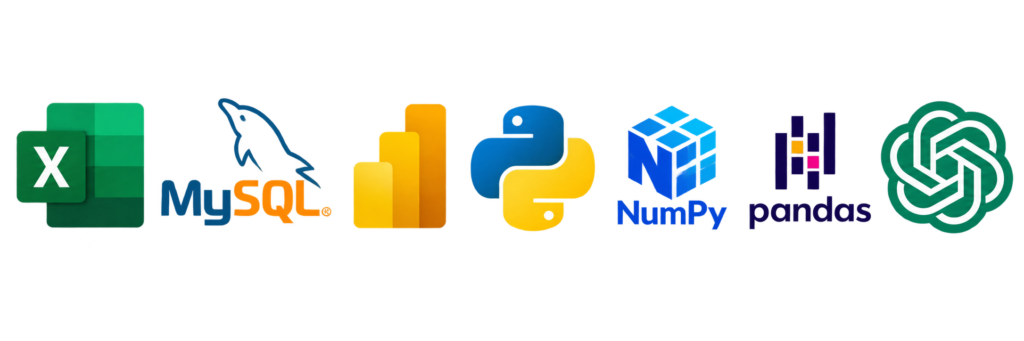
Python
Python is a versatile programming language widely adopted for various applications, including web development, data analysis, and machine learning. Its simplicity, extensive libraries, and readability make it popular among developers and data scientists.
NumPy
NumPy, or Numerical Python, is a versatile array processing package that utilizes the powerful features of N-dimensional arrays. It is a fundamental library in Python that fosters an efficient execution of a wide range of scientific computations. NumPy supports high-level logical and mathematical functions, linear algebra operations, advanced random number generation, Fourier transform capabilities, and manipulation of array shapes. Additionally, it seamlessly integrates with low-level languages such as C, C++, and Fortran.
Pandas
Pandas, a Python library for data analysis, specializes in tasks such as data munging, cleaning, manipulation, and analysis. It empowers data scientists working with Big Data by providing efficient and adaptable data structures in tabular and multidimensional formats.
Pandas accelerate data manipulation tasks by streamlining data wrangling processes and offering high-level abstractions. A wide range of features are available, with a user-friendly syntax designed to handle missing data effectively. One notable advantage of Pandas is its capability to create customized functions that can be applied to different data series.
SciPy
SciPy, also known as Scientific Python, builds upon the functionality of NumPy and is extensively used in Big Data projects, particularly in scientific and technical computing.
It provides a comprehensive set of pre-built commands and functions that facilitate various tasks such as handling differential equations, manipulating data, and visualizing results.
Matpolib
Matplotlib, a Python library in Big Data, offers impressive visualization capabilities with 2D plotting graphics. It is a powerful tool for data scientists, enabling them to create various visualizations, such as bar charts, scatter plots, histograms, error charts, power spectra, and more.
One of the key features of Matplotlib is its object-oriented API, which makes it easy to embed plots in applications. It utilizes GUIs like Tkinter and wxPython for this purpose. Matplotlib is known for its low memory consumption and efficient runtime, ensuring smooth performance.
Another significant advantage of Matplotlib is that it is free to use, making it a viable alternative to MATdevwp. It is also compatible with various operating systems and output types, offering users flexibility.
SkLearn
Sklearn, or Scikit-learn, is an extensive Python library with a comprehensive set of machine-learning tools. It provides a complete package for constructing and assessing various machine-learning algorithms.
This feature-rich library is a powerful resource for all aspects of machine learning solutions. It encompasses many functionalities, including data preprocessing and transformation and statistical modeling, which includes regression, classification, clustering, and dimensionality reduction.
Sklearn also offers tools for testing and validating data using cross-validation techniques and metrics to evaluate the performance of the trained models.
Seaborn
Seaborn, a Python library, is a powerful tool for creating statistical visualizations built on Matplotlib. It seamlessly integrates NumPy and Pandas, making it convenient to work with data structures commonly used in statistical analysis with SciPy and statsmodels.
With Seaborn, users can effortlessly generate visually appealing charts by leveraging its predefined styles and color palettes, requiring only a few lines of code. It is important to note that Seaborn is designed to complement Matplotlib rather than replace it, meaning familiarity with Matplotlib is necessary for fine-tuning Seaborn’s default plots. It is compatible with Python 3.7+ but no longer supports Python 2.
Statsmodel
Statsmodels is a Python library specifically designed for data analysis, data science, and statistical modeling. It is a component of the Python scientific stack and relies on the powerful numerical libraries NumPy and SciPy.
Statsmodels seamlessly integrates with Pandas, a popular library for data manipulation, and utilizes Patsy, which provides a formula interface similar to R, for convenient modeling.
Keras
It is an open-source deep learning framework that aims to streamline the process of building deep learning models and provide a platform for quick experimentation with deep neural networks.
Keras is advantageous and user-friendly, making it ideal for individuals new to deep learning. Due to its simplicity, intuitive syntax, and ease of use, it is widely regarded as the top framework for beginners.
The framework’s syntax is designed for readability and straightforward application. The major users are CERN, Google, Netflix, and Uber.
R (Optional)
Data analysis and visualization are frequently done using the statistical computer language R. With its extensive number of packages and functions, R provides a full environment for statistical modeling, machine learning, and graphical representations, making it a favorite tool for researchers and data scientists.
SQL
SQL (Structured Query Language) is ideal for manipulating and managing relational databases. It helps store, retrieve, update, and delete data efficiently, making it an essential skill for working with databases and performing data-related tasks in various industries.
Data Visualization Tools:
Tableau (Optional)
The potent data visualization tool Tableau allows users to build dynamic dashboards and reports that are pleasing to the eye. Its easy drag-and-drop interface and rich functionality simplify exploring, analyzing, and communicating data insights, enabling businesses to make more successful data-driven decisions.
Excel
Excel is widely used to organize and analyze data effectively. It offers useful features such as formulas, charts, and pivot tables..
PowerBI
Microsoft’s PowerBI is a robust and user-friendly tool designed to facilitate efficient data analysis. Rather than functioning as a conventional programming language, PowerBI operates as an application tool similar to Excel.
Soft Skills:
Be comfortable with pattern identification. You must acquire the skills to detect anomalies in a data set and the know-how to analyze it.
Learn about machine learning and its related algorithms.
Master basic computing skills to use numerical analysis, database systems, and data management principles.
Be proficient in implementing statistical models and algorithms that facilitate artificial intelligence and several other business processes.
Master programming languages such as Python, SQL, R, or Java to code and create a program framework for data analysis.
As a data scientist, you must know how to tell the story behind the data and graphically represent it to stakeholders.
Master analytical or critical thinking to provide data-backed insights and solutions to several business problems.
Companies in Bangalore That Have Hired Our Alumni

Projects and Assignments Included
The Data Science Certification course explores applying data science and analysis techniques to solve complex business challenges and drive informed decision-making in various industries and functional areas. Projects and assignments span across:
- Business problem-related data handling, creation of dynamic dashboards, and performing ad-hoc analysis using Excel, SQL and PowerBI
- Exploratory Data Analysis - Marketing Insights for Leading E-Commerce Company
- Building a Predictive Model (Probability of Default Model) for Leading Bank using Regression
- Marketing Insights for E-Commerce Company
- Woman Clothing E-Commerce Platform- Customer Review Analysis
- Deployment of ML model and create Flask application
Projects and Assignments Included
The Data Science Certification course explores applying data science and analysis techniques to solve complex business challenges and drive informed decision-making in various industries and functional areas. Projects and assignments span across:
- Business Problem Understanding
- Marketing Analytics
- Risk Analytics
- Operations Analytics
- Digital Analytics (Web Analytics)
- Business problem-related data handling, creation of dynamic dashboards, and performing ad-hoc analysis using Excel, SQL and PowerBI
- Exploratory Data Analysis - Marketing Insights for Leading E-Commerce Company
- Building a Predictive Model (Probability of Default Model) for Leading Bank using Regression
- Marketing Insights for E-Commerce Company
- Woman Clothing E-Commerce Platform- Customer Review Analysis
- Deployment of ML model and create Flask application
Projects Included
Exercise on Basic Excel functionalities
Problems Related to Basic Statistics
MS Excel: Sports Analytics
Click Here to See List of All Projects
MS Excel: Consumer Reviews Analysis
PowerBI: Retail Analytics
PowerBI: Digital Analytics
RDBMS-SQL: Retail Data Analysis
RDBMS-SQL: Manufacturing Analytics
Basic Python case study (Core Python)
Data Manipulation- Visualization exercises
Exploratory Data Analysis – Retail Analytics
Exploratory Data Analysis – Credit Card Analytics
Exploratory Data Analysis – Insurance Claims Analytics
Data Visualization – Case Study
Basic Statistics –Statistical Methods Case study –
Statistical Methods-Campaign Analytics
Statistical Methods-Customer Experience
Regression – Predicting Rate of Interest for a given loan
Predicting Price of Car Model- Demonstrate case study
1. Regression Projects
Predicting the Rate of interest for a given loan
Banking Case Study – Predicting consumption of credit cards for next 3 months
2. Classification Projects
Credit Risk Case Study – Building PD Model – Demonstrate case study
Cyber Security Case Study – Predicting type of cyber attack by users
3. Segmentation Projects
Telecom Case Study – Segmenting customers for marketing campaigns
Retail Case Study (RFM) – Segmenting retail customers based on RFM
4. Data Science Project (End to End)
Marketing Insights for E-Commerce Company – Capstone Project
5. Forecasting Projects
Tractor Sales Forecasting Case Study
Electricity Consumption Forecasting for the Next year
EDA – Capstone Project -Marketing & Sales for E-Commerce
- Sentiment Analysis for leading hotel chains by analyzing customer reviews
- SMS Spam Filtering
- Social Media Analytics Case Study
- Woman Clothing E-Commerce Platform- Customer Review Analysis
Building Flask Applications and deploying ML models on various clouds (examples of Cloud: Heroku, GCP, Azure)
Working on a project related to how to improve the efficiency of tools using GenAI tools or Extensions
Data Science Skills and Tools You Will Learn
- Generative AI
- Prompt engineering
- Statistical Analysis
- Data Visualization
- Data wrangling
- Predictive modeling
- Data blending & manipulation
- Machine Learning
- MIS reporting analytics
- Deep learning and NLP
- Analytical thinking
- Problem-solving approach
- Critical thinking
- Product understanding
- No code Agentic AI
Data Science Certification in Bangalore
| Certification | Who earns it | What it is |
|---|---|---|
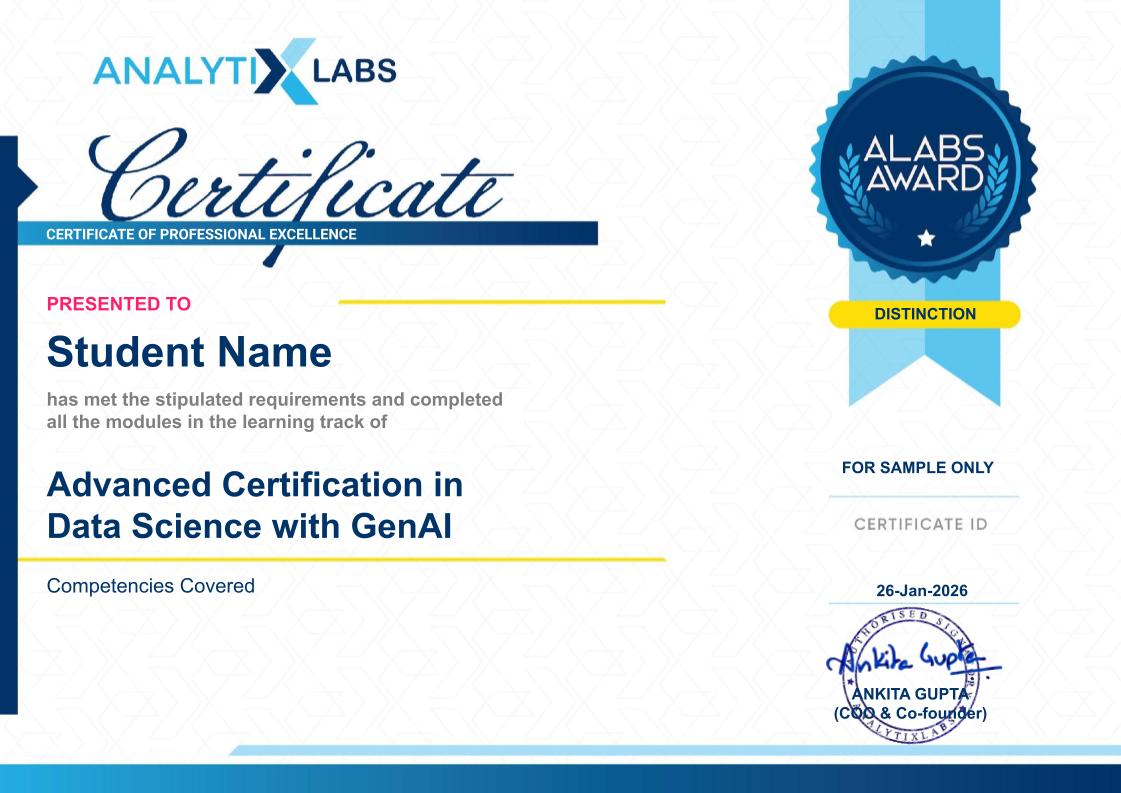
| Advanced Certification in Data Science | All learners | AnalytixLabs program certification. |
| NASSCOM-FutureSkills Prime | All learners | NASSCOM-approved certification, supported by MeitY, Government of India. |
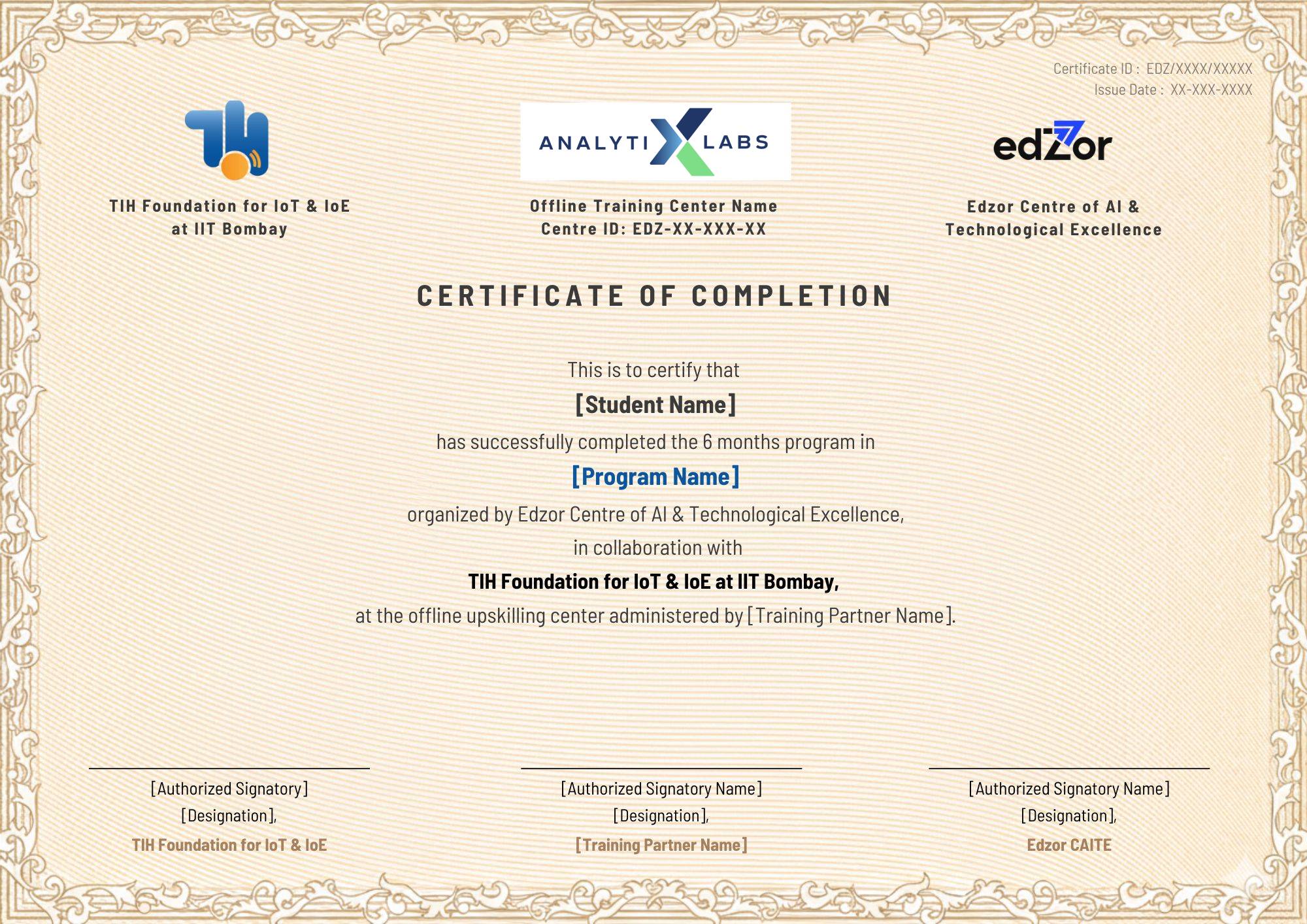
| TIH Knowledge Partner Certification | Optional (choose one at enrollment) | TIH at IIT Bombay (TIH Foundation for IoT & IoE) or TIH at IIT Patna (Vishlesan I-Hub Foundation). Includes virtual guest lectures by TIH-associated experts. |
How Certification Works
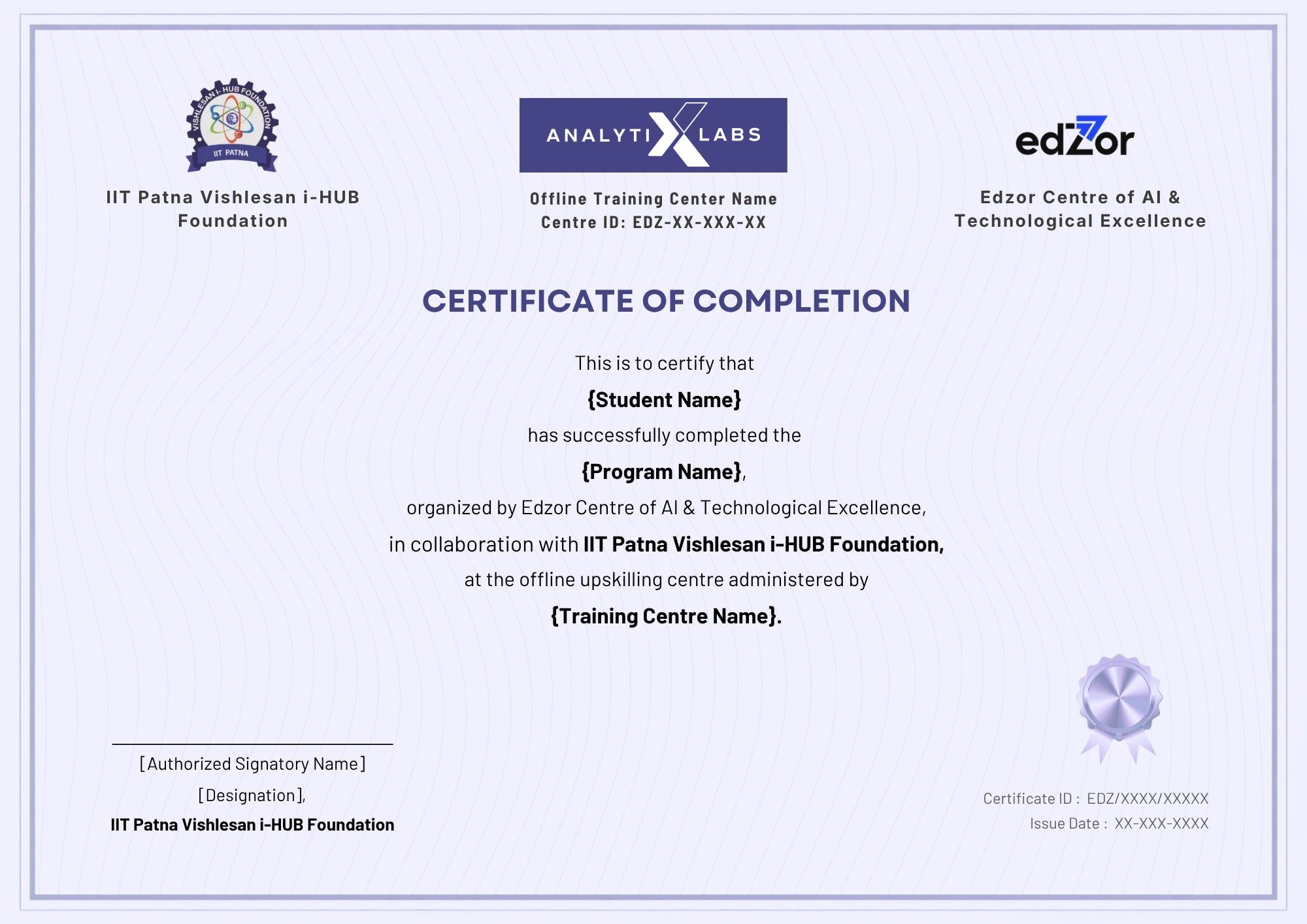
You earn certification by passing the case studies, MCQs, and viva built into the course. You must complete certification within one year of enrollment.*TIH partnerships via Edzor CAITE.


Data Science Projects You Will Build
You apply each module to real business data. By the end of the course, you have a portfolio of projects you can walk through in interviews.
Data Science Course Fees in Bangalore
| Learning mode | TIH at IIT Bombay or IIT Patna + NASSCOM-FutureSkills Prime | NASSCOM-FutureSkills Prime only |
|---|---|---|
| Classroom & Bootcamp (Bangalore) | INR 87,320 | INR 68,440 |
| Interactive live online | INR 80,240 | INR 59,000 |
| Blended eLearning | INR 70,800 | INR 53,100 |
The TIH option costs more because it adds certification from TIH at IIT Bombay or IIT Patna, plus guest lectures by TIH-associated experts. All fees include taxes You can pay in installments or use 0% interest EMI through our education financing partners.
How to Apply
There is no entrance exam or long application process.
- Get in touch. Call us, fill in the enquiry form, or request a callback. You can book a free demo class first.
- Speak with a learning advisor. They understand your background and goals, then recommend the right course and training mode.
- Reserve your seat. Classroom batches at our HSR Layout center fill up, so book early.
- Complete payment. Pay in one go, in installments, or with 0% EMI through our financing partners.
Classroom & Bootcamp
An immersive, in-person learning experience designed to accelerate skill development through intensive, hands-on training and expert mentorship. It bridges the gap between theory and real-world application, equipping learners with the expertise and skills needed to succeed in today’s dynamic professional landscape.
Interactive Live Online
Blend the dynamic experience of traditional classroom with engaging, real-time interactive sessions, carefully tailored to meet the demand of busy schedules. This innovative approach ensures effective learning, fostering a deeper understanding and retention of knowledge.
Blended eLearning
Fuse the rich atmosphere of classroom instruction with the flexibility and accessibility of eLearning modules, meticulously integrated to accommodate learning preferences. This unique blend ensures an optimal learning experience, empowering participants to delve into subjects deeply.
Data Science Certification Course Fees in Bangalore
The Data Science Course in Bangalore adheres to industry standards. This course lasts 8 months or 750 learning hours, and the costs vary according to your chosen learning mode.
Classroom Sessions
₹ 68,440/- including taxes
EMI starts @ 8,260
EMI Options
*Pay in easy EMIs starting at INR ₹6387 per month.
- Fees payable in up to 3 installments
- 0% Interest EMI – Pay in Easy Installments (though education financing partners)
- Cost-effective courses with high ROI, making it worth every penny you invest.
Interactive Live Online
₹ 59,000/- including taxes
EMI starts @ 8,260
EMI Options
*Pay in easy EMIs starting at INR ₹6387 per month.
- Fees payable in up to 3 installments
- 0% Interest EMI – Pay in Easy Installments (though education financing partners)
- Cost-effective courses with high ROI, making it worth every penny you invest.
Blended eLearning
₹ 53,100/- including taxes
EMI starts @ 8,260
EMI Options
*Pay in easy EMIs starting at INR ₹6387 per month.
- Fees payable in up to 3 installments
- 0% Interest EMI – Pay in Easy Installments (though education financing partners)
- Cost-effective courses with high ROI, making it worth every penny you invest.
Data Science Course in Bangalore with Placement Support
Career support is built into the course from the start. Our placement team works with you based on your education and work experience.
Learn more about our Job Guarantee Program: https://www.

Placement Readiness Program
After certification, you join a 6 to 8 week Placement Readiness Program.
It covers resume building, interview coaching, real-world simulations, and job search planning. You get personalized feedback and industry referrals along the way.

Diverse Job Opportunities
Job opportunities come through our direct links with organizations, recruiters, and the AnalytixLabs alumni network.
Companies in Bangalore that have hired our alumni: CultFit, Flipkart, Bank of India, Infosys, JP Morgan, Accenture , Genpact, etc.
Results depend on both your effort and our support. Active participation and finishing the course on time make the biggest difference.

Continued Career Support
Support continues after the Placement Readiness Program ends.
Our team keeps sharing job openings, helps with interview preparation, and guides you until you reach your career goal.
How To Apply
select your course, complete the registration form, and make payment.

Submit your application
Submit your application by filling out the form, providing necessary details, and clicking submit to complete the process.

Give a selection test
Take the selection test to demonstrate your skills and knowledge. This will help us assess your readiness for the course.

Reserve your seat
Reserve your seat today to secure your spot in the course. Act fast, as spaces are limited and fill quickly!

Payment
Complete your payment to finalize your enrollment in the course. Choose your preferred payment method and follow the prompts to proceed.
What Students Say About Us?
True Stories, Transformative Career Experience
Piyush Ganar, Class of 2012 IIM Ahmedabad
(Director of Operations, Kenty.AI)
The course material is very easy to understand and the case studies were based on real time business problems. What I love the most about Sumeet and his team is that they never operated the institute like a typical commercial enterprise but more like a temple for learning. The gates of Alabs are always open for students for any kind of help and guidance. I would recommend ALabs to all.
Raajeev Kumar Sahu
(Senior Manager – Data Science, FinTech Startup)
I am from Advance Big Data Science course of Nov 2016 batch. The course was very structured and got real world problems to practice during the final case studies. It has also boosted my skills to start participating in the hackathons. Chandra sir was really helped me in preparing my resume right from very beginning of the course. Also, the placement team was very well organized and connected to industry leaders so that people get the right opportunity right after completing the course. I really recommend this institute, who are interested to transition into analytics field.
Sumit Asthana
(Assistant Manager, Senior Data Scientist)
The rapid pace at which the institutes are mushrooming all over India and Facebook newsfeed being inundated with thousands of options for analytics training, there are only handful of training institutes or rather say only couple of places where they prepare you to foray into rapidly growing analytics vertical. I have been working into legacy systems for past 5 years and was quite apprehensive if I will ever break into data science successfully.
Surbhi Sultania
(Analytics Manager, Mastercard Data & Services)
I took three months Big Data training from Analytix labs. Before joining this course, I had so many questions and doubts that will this course be worthy enough but later I found myself lucky to join this program. All trainers are amazing and always ready to help. Live examples and Case Studies are given which helps in understanding the concept and hands on practice.Not only they help in quality in depth knowledge transfer but also tend to give right direction to your career.
Vibhu Gautam
(Professor of Practice – Computer Science, UPES)
I had been associated with AnalytixLabs since 2012. This has been possible because of the mentor ship and support you get from faculty there specially from Sumeet and Chandra.I did a Business Analytic course with a focus on Marketing Analytic. The course deliver had been great and most importantly you never feel like you are part of formal classroom teaching. You are mentored there at every step, from Code Errors to Understanding Statistics behind it.
Upcoming Batches
Sign up for a Free Demo Class
Benefits of Demo Account
- Get access to trial sessions to choose the most suitable course.
- SAVE UP TO 40% on specialization learning tracks.
- JOB ORIENTED COURSES crafter and delivered by industry experts.
- INDUSTRY RELEVANT programs with latest curriculum.
Want to see how it works?
Frequently Asked Questions
What are the data science course fees in Bangalore?
Fees depend on the learning mode and certification option. Classroom training costs INR 68,440, or INR 87,320 with certification from TIH at IIT Bombay or IIT Patna. Live online starts at INR 59,000 and blended eLearning at INR 53,100, with installment and 0% EMI options.
Do you offer offline data science classes in Bangalore?
Yes. Classroom batches run at our HSR Layout center on weekdays and weekends. If you cannot travel, you can join the same course in live online classes.
Is this data science course in Bangalore offered with placement support?
Yes. After certification, you join a 6 to 8 week Placement Readiness Program with resume reviews, mock interviews, and referrals. You can also opt for our Job Guarantee Program. Eligibility criteria apply, and the full terms are on our placements page.
Where is the AnalytixLabs data science institute in Bangalore?
Our center is at the back gate of the BDA Complex, 12th Main Road, Sector 6, HSR Layout, opposite A2B. It is close to Koramangala, BTM Layout, Agara, and Bellandur. Find us on Google Maps.
How do I choose a data science course in Bangalore?
Look at four things. Check the projects you will build, who teaches, the placement terms in writing, and whether you can attend classes in person. Ask for a demo class and the full syllabus before you pay. Check that the certification comes from a recognized partner.
I am not a programmer. Can I join the data science course?
Yes. The course starts with Excel, SQL, and Python basics, so you do not need prior coding experience. If you already code, you move faster through the foundations.
How long is the data science course in Bangalore?
The course runs for 6 to 8 months, depending on the batch and learning mode. Weekday and weekend batches follow the same curriculum.
Which certification will I receive?
Every learner earns the Advanced Certification in Data Science from AnalytixLabs and NASSCOM-FutureSkills Prime certification, an initiative of MeitY, Government of India. With the TIH option, you also earn certification from TIH at IIT Bombay or TIH at IIT Patna.
Who teaches the course?
Faculty include IIT and IIM alumni with industry experience in data science and analytics. They teach through case studies drawn from real business problems.
Should I choose the data science course or the data analytics course?
Choose data science if you want to build predictive models with machine learning. Choose data analytics if you want to report, visualize, and explain business data. See the Data Analyst Course in Bangalore for its syllabus.
Can I attend a demo class before I enroll?
Yes. Anyone interested can attend a free demo class, at our HSR Layout center or online. It shows you the teaching style and pace before you enroll.
What happens if I miss a class?
You can catch up through the learning management system, which you can use for the full course duration. You can also clear doubts with faculty by email, online, or in person at the center.
Data Science Course in Other Cities
The same course is also offered in other cities and online:
Excited?
Talk to Expert
Counselor
to gain insights into your profile and
strategize your next career move!
