Data science and the use of predictive models have impacted many industries. One such industry is finance. Credit Bureaus, banks, and other institutions involved in money lending have developed credit scoring models.
“Shape the future. Enroll in AI Engineering course today”
“The storage capacity is expanding at a compound annual growth
rate of 19.2% between 2020 and 2025”
Thus, companies need mechanisms to save and retain all this data today. Data warehouses play a major role in this regard. This article will explain data warehouses’ various aspects, including their definition, types, stages, tools, and more. Let’s start with the definition.
Download Our Latest Industry Report for FREE:
Data Science Skills Survey Report 2024
What is a Data Warehouse?
Data warehousing in DBMS is crucial for organizations today. It allows businesses to generate meaningful insights from the large volumes of data available. It also plays a crucial role in the data management process, enabling the easy storage and analysis of large volumes of data.
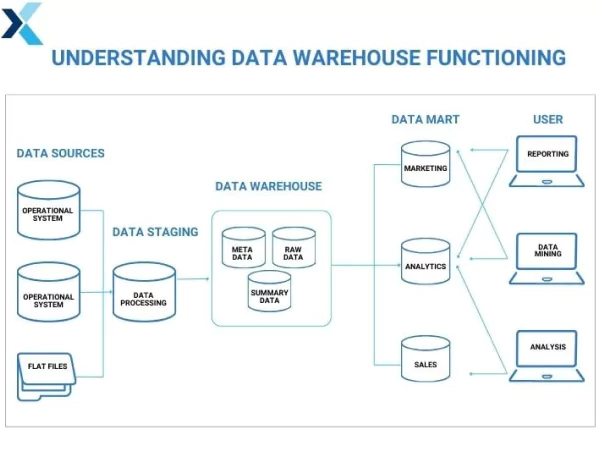
Let’s understand what a data warehouse (DWH) is.
Preparing for the data warehouse interview, check out our latest article on Data Warehouse Interview: Top 30 Questions and Answers [2024 edition]
Definition
Data warehousing is the process of developing, managing, storing, and securing data in a digital warehouse (DWH). In a DWH, the data is stored in a specific structured way, allowing businesses to use it for numerous purposes, such as data analytics and model building.
Unlike other software commonly used in data science that allows users to perform analytical operations, data warehouses cannot analyze data alone. Instead, they rely on data analysis and querying tools like SQL.
One must remember that a data warehouse is a data storage resource and is different from its peers, such as data lakes because it has a well-defined structure and organization. Still, numerous ways and strategies exist for creating a data warehouse (which will be discussed later).
“Shape the future. Enroll in AI Engineering course today”
Types of Data
The focus of any data warehouse is to hold data to find useful insights at any point in time to help the business make better decisions. A data warehouse allows data to be stored for a long period, and the data can be historical and act like a library of historical information.
A data warehouse allows the user to update information to this historical data by moving new data to it. This is why data warehouses can often hold data that varies in age. It is common for a data warehouse to include data generated in near real-time and have data from a week, month, or even years back.
Let’s understand this data warehouse concept with an example. Suppose you work in an organization that has a data warehouse. In that case, you will encounter various stored data, such as business transaction data, logs from operating systems and applications, network traffic, authorization requests, user authentication, CI/CD operations, etc.
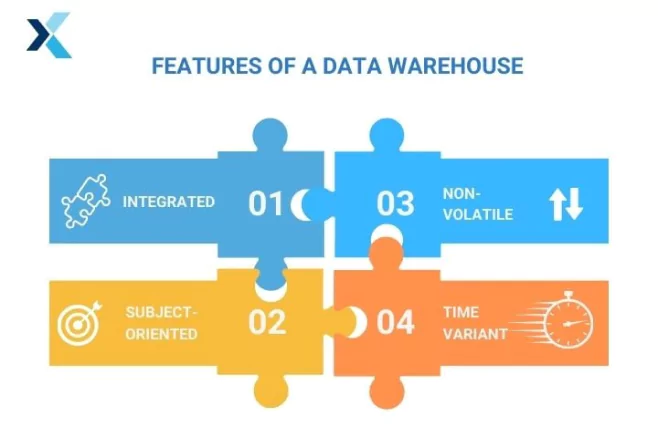
Key Characteristics
“Hundreds are making the right decision every month”
1. Subject Oriented
Data warehouse provides topics rather than overall information on the various business processes. These topics can be sales, marketing, inventory, etc. Let’s take an example of the data warehouse. Suppose you, as an organization, intend to analyze your sales. In that case, you will create a data warehouse that focuses on holding data related to sales so that questions like “Who are the top 5 spending customers?” can be answered. Thus, the data is subject-oriented in data warehouses.
2. Integrated and Consistent
As mentioned earlier, a data warehouse is a repository that follows a particular structure. Hence, data within a data warehouse is standardized into a uniform format across diverse sources. This ensures consistency in the warehouse’s naming, coding, and formatting, promoting universal acceptance and seamless integration. This eases the downstream applications like data analytics and predictive modeling.
3. Non-Volatile
All data in a data warehouse is read-only and remains unchanged once it enters the warehouse. The warehouse’s capacity needs to be maintained, as the old is not erased upon the arrival of new data. This characteristic of a data warehouse allows users to understand what happened and when.
4. Time Variant
A data warehouse (DWH) facilitates trend analysis by storing data with a temporal component. Usually, data includes a primary key with a time element (e.g., day, week, month), or time-related documentation, whether explicit or implicit, for comprehensive temporal analysis. Now, if the definition of data warehouse is clear, let’s explore how data warehouses work, but first, a short note.