Top Business Analyst Skills in 2026
For long, students and professionals have chased MBA as the coveted degree that was almost a must-have to land a rewarding job scope. But things have started changing, not slowly, if I must say.
Degrees are great but what if that thought of doing an MBA is because everyone did it? What if I tell you, the real rewarding step is to learn real skills first. And I am saying this after reading countless stories of professionals who chose to learn skills first rather than do an MBA.
One such story is of Nikita Singh, who is currently part of Zepto's team as a business analyst. Her interview with Financial Express revealed how she almost gave in to the peer pressure of doing an MBA. Nikita's decision points to a larger shift. Companies look for demonstrated business analyst skills instead of relying only on the degrees. The right skillset combinations will drive more opportunities that degrees alone can't.
This article breaks the top business analyst skills that you will need into four clear buckets. We will cover technical, analytical, business and domain, and soft skills. These are the buckets that decide whether you climb or plateau in the job world. Add to this, you will find the tools that align with each skills, laying down a perfect roadmap to learn or upskill. From how employers test candidates at each career stage to how AI is enhancing (and outdating) several business analytics roles.
By the end, you will know exactly which gaps to close first.
Let us start with why these skills matter more now than they did even two years ago.
Why Learn Business Analytics Skills Now?
Companies have moved on from relying on instincts to believing dashbords, A/B tests, and forecasts when it comes to business decision making. This is exactly why the role of a business analyst has also shifted.
A business analyst in the modern business is a hybrid profile that has blurred the lines between business analysts, data analysts, and analytics consultants. Now, companies want a combination of all these roles in one person. While it might look intimidating, it is more about upskilling, reskilling, and understanding how business dynamics have changed over the years.
The SQL query is same, so is the dashboard and the stakeholder pitch that shows up across all the three roles. So what exactly has changed?
Well, for the start, your skills now needs to expand beyond your title. It is important to understand another quick shift in the hirng world - companies are no more hiring for titles. Strong business analyst skills can navigate multiple career paths. The more core skills you build, the more value you drive for a company. The flipside of this is - the bar is now very high than it was in 2023. AI literacy and basic programming have moved from nice to have to baseline.
This calls for a reshuffling of the definition of who is a business analyst.
Who is a Business Analyst?
A business analyst is the one who bridges the gap between business problems and data-driven solutions. This person sits at the intersection of leadership, product teams, and engineers. A business analyst can translate vague questions luke why are sales falling into a specific analysis that offers a clear answer.
A typical day for a business analyst involves three core things:
Gather requirements from the stakeholder
Analyze data using SQL, Excel, or a BI tool
Build reprots and dahsboards that drive decisions
Business analyst role often overlaps with data analyst, product analyst, and analytics consultant positions.
Having said that, lets take a look at the core business analyst skills that you must master to build a career in an AI-first workforce.
Core Business Analyst Skills to Master
The business analyst skills fall into five categories: technical, analytical, business and domain, soft, and documentation. Your goal is to master all these skills instead of fixating on one or a few.
Learning recommendation: We suggest you start learning one-by-one instead of trying to learn it all together. Pick one group, build depth, then move to the next.
1. Technical Skills
Technical business analyst skills are the entry ticket. Without them, you do not get past the screening round. There are six technical skills matter most.
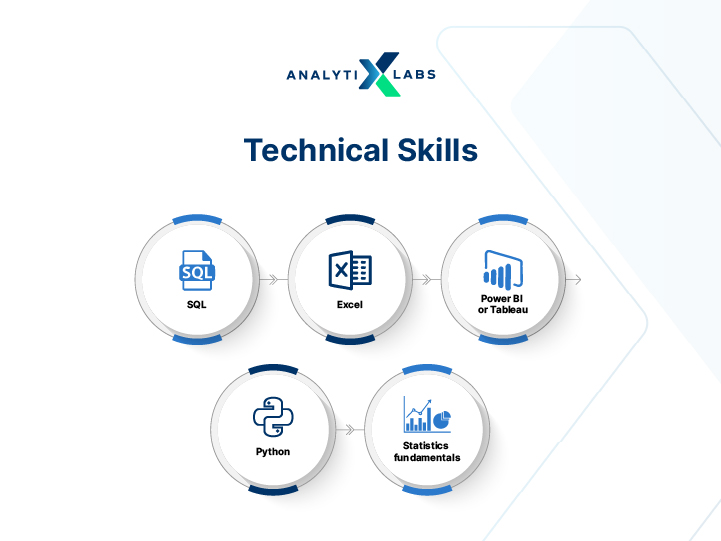
SQL
SQL is the language of every relational database your company runs on. Without it, you wait for someone else to pull your data. A stakeholder asking "why did Tuesday revenue drop?" becomes joins across orders, products, and customers tables.
Text-to-SQL tools like Power BI Copilot and Snowflake Cortex now generate queries from plain English. They fail on complex schemas, ambiguous joins, and business logic. As a result, the skill has shifted from writing every query to verifying and refining AI-generated SQL.
Excel
Excel runs on every desk in business. Finance sends budgets, operations tracks inventory, and HR plans headcount in Excel. A typical business analyst spends a day with a messy expense sheet, a same-day variance request, and a quick pivot to answer it.
Copilot in Excel handles formulas and patterns, but it produces wrong answers on messy or non-standard data. Hence, your skill shifts toward modeling, scenario building, and Power Query. AI accelerates the typing but you own the logic.
Power BI or Tableau
BI tools translate raw data into visualizations stakeholders actually use. Most companies run hundreds of dashboards. A telecom BA might build a churn dashboard pulling from four data sources, used by leadership every Monday morning.
Power BI Copilot and Tableau AI now generate charts from natural language. The choice of what to chart, which filters matter, and how to lay out the story is still your judgment. This is because AI does not know your stakeholders or which metric is the real KPI versus the vanity number.
Python
Python handles work that Excel and SQL cannot. Think automated weekly reports, datasets too big for Excel, or API calls to external systems. A logistics business analyst might need to write 30 lines of Python to fetch shipping data daily, saving four hours per week.
GitHub Copilot and Cursor now generate Python that runs first try. What you need is Python literacy to read what AI wrote, debug failures, and modify it when requirements change. AI generates the code and you decide if it is right.
Statistics fundamentals
Statistics tells you when a 5% lift is real versus noise. For instance, a product business analyst running an A/B test must know when to end it. Reading confidence intervals correctly is the other half of the skill.
Statistical software runs the tests. Your job? To pick the right test, validate the assumptions, and interpret results in business language. AI tools run analyses but miss when data violates the assumptions of the test.
2. Analytical and Problem-Solving Skills
Tools without analytical thinking produce noise. Four such business analyst skills decide whether your analyses land.
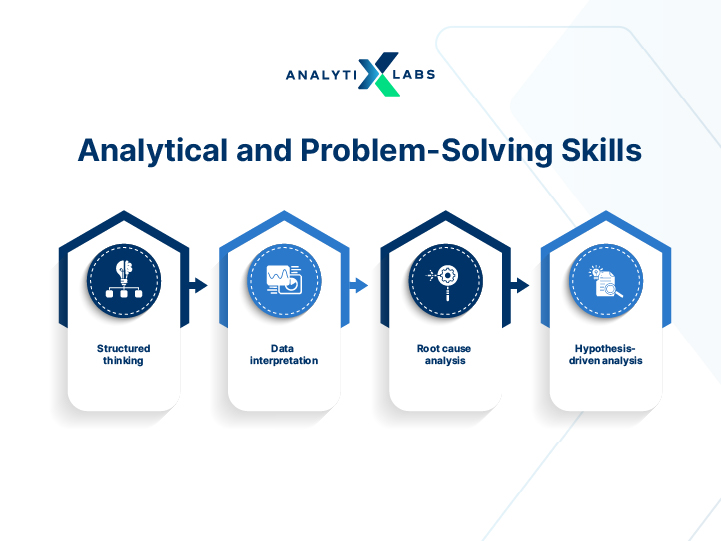
Structured thinking
Most business questions are vague. For example, "Why are sales down?" can mean ten different things. A structured business analyst must knwo to split the question by product, region, segment, and time, and then run analyses on each branch.
It is important to know that often LLMs are confidently wrong on ambiguous questions. They answer what you ask, not what you should have asked. This is why you need to master structured thinking. Structured thinking frames the right question before AI chases the wrong one.
Data interpretation
Pulling data is easy, reading what it means is hard. For example, a churn spike after a price change might be caused by the price, or by three other changes that week that went unnoticed. This is why you should learn to interpret data correctly so you can drive conclusions in the right direction.
AI can generate summaries from data, but it pattern-matches without questioning context. This might lead to spurious correlations getting reported as findings. As a business analyst (and human), you must have the ability to decide whether the pattern actually means what the AI says it means.
Root cause analysis
Most "problems" reported in business are symptoms, not causes. Customer complaints up 30% might mean staff shortage, a product UX change, or a billing bug. Root cause analysis digs from symptom to driver, often producing a completely different fix.
AI tools can suggest possible causes, but they lack organizational context. A business analyst might just know what changed two months ago and which team owned those changes. Even if you are new, you will have the instinct to cross-check the root causes within your organization before you joined. AI accelerates question-asking but it cannot replace contextual judgment.
Hypothesis-driven analysis
Writing down what you expect before pulling data prevents confirmation bias. For instance, if a business analyst suspects mobile users convert worse than desktop, it means that he/she has already expected the gap before pulling the data. If reality differs from that hypothesis, that gap is the insight.
AI tools can analyze anything you point them at and find patterns. Without a hypothesis, you get a wall of charts with no decision. This is why a business analyst needs to set the hypothesis that will direct the analysis and get to the answer faster.
3. Business and Domain Skills
Technical skill earns very different salaries depending on whether you understand the business. Domain depth is the multiplier.
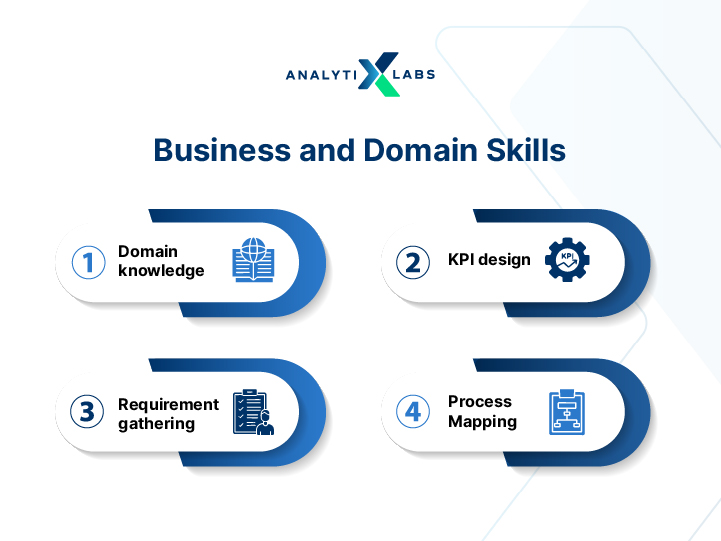
Domain knowledge
A business analyst without domain knowledge is just a query writer. For instance, a BFSI business analyst understands that NPA classification has regulatory weight while the same role in retail understands inventory turnover, basket size, and seasonality takes the lead. Understanding your domain is very important before you start handling data. Each domain has different requirements and data speaks different from domain to domain.
While AI can summarize a textbook on banking, it can never understand the contextual depth of your domain. Things like an industry's regulatory environment, customer segments, or business model continue to be on the shoulders of an analyst. The simple reason is AI cannot flag which slice of your loan book is of highest risk. This is why they say: Domain knowledge compounds with experience.
KPI design
Companies that track everything optimize nothing. For example, a business analyst working with a SaaS brand will pick metrics like activation rate, week-2 retention, and expansion revenue for a launch. The KPI choice defines what the team optimizes for.
While AI can list 50 metrics for any business, it does not know which 5 will actually matter to your CEO this quarter. KPI design requires judgment about strategy, stakeholder priorities, and historical context. This is where you step in as an analyst.
Requirement gathering
Most analytics work fail because the wrong question was asked. For instance, a stakeholder might ask for "a sales dashboard" but a skilled business analyst will ask who will read it, what decisions will it drive, and what will trigger action when a metric goes red.
You see, AI does not sit in stakeholder meetings. It does not know your VP is actually trying to decide whether to fire a regional head or not. Requirement gathering is a human conversation which AI can document, but not perform the work.
Process mapping
To recommend a better process, you need to know the current one. If you are a business analyst at an insurance company, you will map the claim-processing flow while finding four redundant approvals that cut handling time from 12 days to 5.
AI can draw a flowchart from a description but cannot sit with the ops team to find out what actually happens versus what the SOP says. Again, process mapping is observational work that AI documents but cannot perform.
4. Soft Skills That Actually Get Tested
Soft skills sound vague until you see them tested in an interview round. Four such communication skills that matter most include:
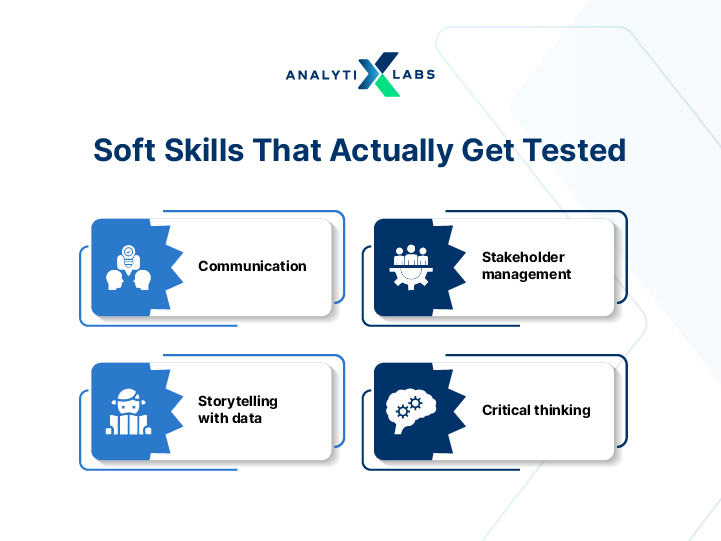
Communication
The best analysis no one uses is worthless. Assume a business analyst wraps a three-week segmentation study with 10 minutes to present to the CMO. The deliverable is not a 40-page notebook; it is "reallocate spend from segment B to C, here is why."
This is something you might thing AI can also do. True, but AI can generate only summaries. It does not know your CFO hates jargon, your COO needs specific numbers, and your CEO wants one slide. Communication is audience-aware; AI is audience-agnostic. What you do as an analyst functioning alongside AI is train your AI tool to deliver communications just the way your stakeholders need according to the problem statement.
Stakeholder management
A business analyst often juggles 5 to 10 stakeholders with conflicting priorities. Product wants behavior analysis, finance wants forecasting, and operations wants efficiency metrics. You have bandwidth for two and the call is yours. Can AI help here?
AI does not have political capital. It cannot read the room, build trust over coffee, or know that the head of marketing is on thin ice. Stakeholder management is the human work that decides which analyses get used.
Storytelling with data
Data alone is not a story. A story has a question, an answer, and a recommendation. A business analyst reporting 60% week-2 churn frames it with two ranked changes, not just a number. Thats a story with data.
AI might not be a good option because it generates summaries that sound like stories but lack the recommendation. The story-with-recommendation gets you promoted. (PS. The story-without-recommendation gets you the next analysis request).
Critical thinking
Most data is wrong somewhere. A 200% growth metric should prompt: was the definition changed, was there a backfill, is this a pipeline error? Half the time, the "growth" disappears once you check.
While AI confidently reports whatever the data shows without doubting the source, critical thinking is the human ability to say "this does not sit right" before publishing the analysis. Master this skill to find the edge in your role when the world is glued to AI.
5. Documentation and Reporting Skills
Documentation is the unglamorous skill that quietly decides promotions. Three things matter most.
BRDs, FRDs, and user stories
Documentation is the bridge between analysis and engineering. A vague BRD on a churn model costs weeks in rework. A clear BRD names edge cases, assumptions, and success criteria, so engineers build to a spec.
Can AI do this? AI can draft a BRD from notes. You edit it, make trade-offs explicit, and sign off. Documentation done well is judgment about what matters; AI accelerates the typing, not the decisions.
Self-explanatory dashboards
Every dashboard that requires a meeting to interpret is a failure. As a business analyst you build dashboard that are self explanatory. A finance dashboard with clear titles, units, time periods, and annotations on outliers works for years without questions. The same dashboard without these dies on the first Monday review.
Can AI do this? AI can build a dashboard but cannot predict that your finance team confuses MoM with QoQ and will misread your default view. Documentation inside the dashboard itself is human craft.
Git basics
Version control protects analysis work the way it protects code. Without it, "my SQL from last quarter" is unrecoverable. With Git, you pull the exact query run on the exact date, six months later.
Can AI do this? AI tools generate code that ends up in version control. An analyst who can branch, commit, and review pull requests works alongside data engineers as a peer, not a dependency.
Top Tools Every Business Analyst Uses
The tools you use as a business analyst map directly to the skills above. Here is what the modern business analyst skills stack look like.
| Tool | Category | What you use it for |
|---|---|---|
| SQL | Data querying | Pulling clean data from relational databases |
| Excel | Spreadsheets | Quick analysis, pivots, dashboards |
| Power BI | BI / dashboards | Interactive reports, DAX, executive dashboards |
| Tableau | BI / visualization | Visual storytelling and ad-hoc analysis |
| Python | Programming | Data wrangling, automation, light modeling |
| Jira / Confluence | Project management | Requirements, user stories, BRDs |
| Lucidchart / draw.io | Process mapping | Flowcharts, BPMN, swim lanes |
A few practical notes on the stack.
Pick one BI tool (Power BI or Tableau), not both. Get fluent in SQL early and stay with it.
Treat Python as your second technical skill, not your first. Most business analyst roles in India still test SQL and Excel before they test Python.
Do not skip the basics chasing the buzzword. Once you are solid on SQL and a BI tool, layer Python on top for automation and quick wrangling.
How to Build Business Analyst Skills From Scratch
You do not build all five skill groups in parallel, you build them in layers. Each layer takes 4 to 8 weeks of focused effort if you stay consistent.
Layer 1: Foundation (6–8 weeks). Excel and SQL come first. Practise on free public datasets from Kaggle, data.gov.in, or the World Bank. Your goal is to query and clean any dataset you are handed.
Layer 2: Visualization (4–6 weeks). Pick Power BI or Tableau. Build three dashboards on real data. Do not copy tutorials line by line.
Layer 3: Programming (4–6 weeks). Python basics, pandas for data wrangling, basic visualization with matplotlib or seaborn. You are not building machine learning models yet. You are automating the work you currently do by hand.
Layer 4: Business and soft skills (ongoing). Pick a domain like BFSI, retail, or healthcare. Read three case studies in that space. Practise framing problems out loud.
Layer 5: Portfolio (4 weeks). Two or three projects on GitHub or a public portfolio. Each project answers a real business question and includes a clear writeup. This is what hiring managers actually look at.
Resume tip. List business analyst skills in priority order, not alphabetical. Pair each skill with one project that proves it. "SQL: built revenue cohort analysis pulling from 8 tables" beats "SQL: proficient" every time.
Business Analyst Skills by Experience Level
Skills do not matter equally at every career stage. What gets you hired at year one is different from what gets you promoted at year five.
| Career stage | Skills that matter most | What employers test for |
|---|---|---|
| Entry-level (0–2 yrs) | Excel, SQL, basic statistics, communication, BRD writing | SQL queries, problem framing, willingness to learn domain |
| Mid-level (3–5 yrs) | Power BI / Tableau, Python basics, stakeholder management, KPI design | End-to-end ownership of analyses, dashboard quality |
| Senior (6+ yrs) | Domain depth, strategic thinking, mentoring, light ML literacy, executive storytelling | Business judgment, ability to influence decisions |
A few patterns hold across stages. SQL never goes away. Communication grows in importance as you climb. Domain knowledge separates you from peers more than any technical skill once you cross 4 years. The mistake most analysts make is over-investing in technical skills past year three.
By that stage, every analyst on your team can write SQL. What sets you apart is judgment: the questions you ask, the metrics you pick, and the stakeholders you can influence.
Look at your own profile honestly. If you are 2 years in and weak on stakeholder management, no amount of new SQL syntax fixes that. Build the skill that is actually blocking your next role.
Want to see how these skills get tested in interviews? Read the AnalytixLabs guide to business analyst interview questions for stage-by-stage prep.
Common Skill Gaps That Hold Business Analysts Back
Most business analysts do not fail because they lack a skill. They fail because they over-index on the skills they enjoy and ignore the ones they do not. Five gaps show up most often.
Strong technically, weak at communication. You write beautiful SQL and build clean dashboards but cannot explain either to your CFO in plain English. Your career will plateau at the senior analyst level.
Strong at building dashboards, weak at framing the right question. You answer every question asked but do not notice the wrong questions are being asked. Strong analysts push back before they pull data.
Comfort with Excel, fear of SQL. This can cost you the next role. SQL-fluent analysts unlock data analyst, BI analyst, and analytics consultant positions. Excel-only analysts stay in their lane.
Domain ignorance. The same SQL skill earns very different salaries depending on whether you understand the business. A BFSI analyst who understands credit risk will earn more than one who does not, even at identical technical skill.
No portfolio. Business analyst skills you cannot prove do not count in a hiring decision. Every analyst at your level claims SQL on their resume. The one with three live projects on GitHub gets the call.
Conclusion
Business analyst skills break into four core buckets: technical, analytical, business and domain, and soft. Documentation acts as the connective tissue. Most career plateaus come from neglecting one of them. You do not have to learn everything at once.
Look at your current profile, find the weakest bucket and fix that one before moving to the next. The fastest path is layered: Excel and SQL first, then a BI tool, Python basics, domain depth, and a lastly a public portfolio. AI literacy threads through all of these now instead of existing as a separate skill. It is a multiplier on the rest. Skills, not degrees, decide where the analytics career goes next. The MBA can always come later.
Pick one gap from this article.
Start there this week.
Six months of focused work on the right gap beats two years of scattered study on every BA skill listed.
Frequently Asked Questions
What are the most important business analyst skills?
The most important business analyst skills fall into four buckets: technical, analytical, business and domain, and soft skills. The top picks inside each are SQL, Excel, and a BI tool (technical). Structured thinking and root cause analysis (analytical). Domain knowledge and KPI design (business). Communication and stakeholder management (soft). No single skill is enough on its own.
What technical skills does a business analyst need?
A business analyst needs five core technical skills: SQL, Excel, a BI tool (Power BI or Tableau), basic Python, and statistics fundamentals. SQL is the most-tested skill in interviews. Power BI or Tableau handles dashboarding. Python automates repetitive work and runs quick analyses. Depth in these five matters more than breadth across ten.
What business analyst skills do freshers need?
Freshers need SQL, Excel, basic statistics, and clear communication. A small project portfolio with two or three live projects helps you stand out. Domain knowledge is bonus, not entry criteria. Most companies hire freshers for trainability, not deep skill. Show that you can write a clean SQL query, build a basic dashboard, and explain your work in two minutes.
What business analyst skills should you put on your resume?
List business analyst skills on your resume in priority order, not alphabetical. Lead with SQL, Excel, and your BI tool. Add Python basics, stakeholder management, and requirement gathering. Pair each skill with one project that proves it. Avoid generic claims like "strong analytical thinker." Hiring managers skip those. Specific, project-backed skills get the callback.
How long does it take to learn business analyst skills?
A focused learner builds entry-level business analyst skills in 4 to 6 months. Mid-level proficiency takes 18 to 24 months of on-the-job experience plus continued study. The fastest paths combine a structured course with consistent project work on real data. Self-taught learners can match this timeline if they follow a layered path.
Do business analyst skills change with AI?
Yes. AI literacy and prompt engineering for analysis tasks are now part of the business analyst skill set. Judgment over AI-generated outputs matters too. Core skills like SQL, statistics, and communication still matter. They matter more, not less. AI accelerates the work of strong analysts and exposes gaps in weak ones. The bar for entry-level BA roles has risen.