Five years ago, a business analyst would pull data with a SQL query, clean it in Excel, and assemble a dashboard that explained what happened last month. It was tedious and time-taking. But in 2026, the same analyst works with an AI assistant, automating all the manual labor and getting it done under 5 minutes. AI assistants can now draft queries, clean data, and summarize results on demand.
You see, the job did not disappear, it moved up a level with time. Today, a business analyst in India works along side AI while asking the right business questions, judging whether the data can be trusted, and persuading a decision-maker to act on the answer.
The demand behind this shift is large (and still growing). India's data analytics market is estimated to reach $28.9 Billion by 2034; up from $3.3 Billion in 2025. Add to this, the ManpowerGroup Global Talent Shortage Survey 2026 revealed that 82% of Indian employers are unable to find the skilled talent they need, with AI skills topping the shortage list for the first time. It is safe to conclude that companies are no longer hiring analysts, they are hiring analysts who can work with AI.
This article gives you the full picture of business analytics in India: what it means, why it is growing, the roles and salaries you can expect, and the study routes that get you there, including how today's AI-assisted certification courses compare with the newer MBA in business analytics and AI.
We will keep an India lens throughout, from national demand to the city hubs where hiring concentrates, such as Bengaluru, Mumbai, Delhi NCR, Hyderabad and Pune.
Why Business Analytics in India is Growing?
Every major sector runs on data and they need people who can turn that data into decisions. This is one of the strongest reasons why business analytics in India is seeing a strong growth surge. The wide-spread digital adoption across all city tiers, a booming digital economy, and a wave of global companies setting up analytics teams in India, have together created a sustainable, long-term demand for analytics talent.
Demand for business analytics in India
The clearest signal of demand is the size of the market and how fast it is expanding. India's analytics market is predicted to touch $27B. by 2033 suggesting a compound annual growth of more than 27%. That is close to a tenfold expansion in under a decade. The market is no more inching forward; it is multiplying and how.
What follows size is where the jobs sits - the second demand signal. According to Nasscom, India now hosts more than 2117 Global Capability Centers (GCCs), the in-house technology and analytics arms that multinational companies run from Indian cities. These centers handle data analytics, business intelligence and AI work for parent companies abroad, and they have become one of the largest sources of high-skill analytics jobs in the country.
The third signal is hiring momentum on job platforms. Salary and hiring trackers such as Naukri and AmbitionBox have reported demand for analyst roles growing by more than 25% over a two-year window, with the sharpest growth in IT services, e-commerce, BFSI and consulting.
Put simply, more companies are creating analytics roles every quarter than the talent pool can comfortably fill.
What is driving this growth?
Several forces are pushing this demand at the same time, and it helps to see them as a stack rather than a single cause.
Digital adoption at scale: Everyday life in India now generates enormous volumes of data. Think of the billions of UPI transactions flowing through the payments system each month. Every one of those is a data point a bank or a fintech can analyze to understand spending, detect fraud, or design a new product.
BFSI leading the way: Banks, insurers and financial-services firms were early movers. A bank uses analytics to decide who qualifies for a loan, to flag a suspicious transaction within seconds, and to predict which customers might leave. These are not experiments. They are core operations that depend on analysts.
E-commerce and consumer internet: When an online store recommends a product, prices an item dynamically, or decides which warehouse should ship your order, an analytics model is working behind the scenes. India's large and growing online shopper base makes this work continuous and high-stakes.
Global Capability Centres: As noted above, global firms increasingly run their analytics from India. This brings world-class problems, and world-class pay, to analysts working from Bengaluru, Hyderabad, Pune and Gurugram.
The takeaway is straightforward.
Analytics is no longer a niche function inside a few large companies. It has become a standard capability that almost every serious organization in India is trying to build. That is what makes the demand durable rather than a passing trend.
While understanding the impact of business analytics in India, it is also necessary to understand how this field is different from other analytics role - data analytics.
Business Analytics vs. Data Analytics vs. Business Analyst
These three terms are constantly confused, partly because they overlap and partly because companies use the titles loosely. The distinction is worth getting right, because it shapes which jobs you apply for. Here is a simple way to hold them apart.
Business analytics is the field.
Data analytics is a closely related field that sits more on the technical, pattern-finding side.
A business analyst is a job role, a person who sits between the business teams and the data or technical teams.
You can think of analytics as the discipline and the business analyst as one of the people who practice it. We will look at salary differences between these in a later section.
Also read for detailed Insights: Business Analytics vs. Data Analytics: A Complete Comparative Guide
| Aspect | Business Analytics | Data Analytics | Business Analyst (role) |
|---|---|---|---|
| Focus | Using data to drive business decisions and strategy | Examining data to find patterns and answers | Understanding business needs and translating them into solutions |
| Question it asks | What should the business do to grow or save money? | What does the data tell us? | What does the business need, and how do we deliver it? |
| Typical output | Forecasts, recommendations, decision models | Reports, dashboards, trend analysis | Requirements, process maps, project specs |
| Tools | Excel, SQL, Power BI, R, Python, forecasting models | SQL, Python, visualization tools | Excel, SQL, documentation and BI tools |
Business analytics is the practice of using data to answer business questions and guide decisions. It combines statistics, tools and business understanding to look at what happened, why it happened, what is likely to happen next, and what a company should do about it. In short, it turns raw data into clear, profitable choices.
Here is a plain example. Imagine a clothing retailer notices that sales dipped last month. Business analytics is the discipline you use to pull the sales data, find that the dip came mostly from one region, trace it to a stockout of a popular size, forecast how much demand was lost, and recommend a smarter restocking rule so it does not happen again. Notice that the goal was never the data itself. The goal was a better business decision.
Business Analytics: Current India Landscape Overview
Business analytics is not new to India, but it has changed shape dramatically. In the early years, much of it lived inside spreadsheets, with analysts building manual reports in Excel. Formal analytics training in India began taking root around 2011, when the first dedicated programs appeared and the field started to professionalize.
Through the 2010s, the work shifted toward business intelligence platforms and self-serve dashboards, and then toward predictive modeling with R and Python. The most recent shift, the one defining 2026, is the arrival of AI and automation into the analyst's daily toolkit. The thread running through all of it is constant. Indian companies kept asking for sharper, faster, more forward-looking answers, and the field kept evolving to provide them.
Types of Business Analytics
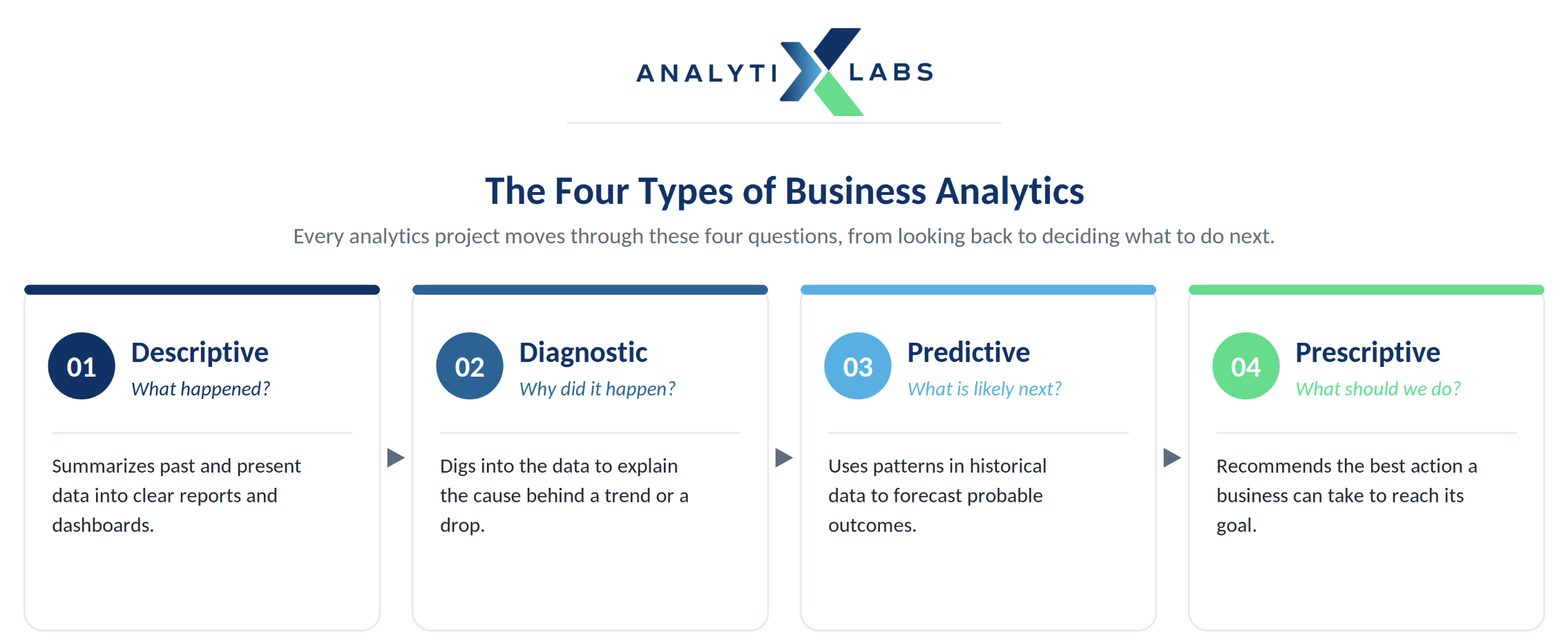
Business analytics is usually grouped into four types:
Descriptive analytics tells you what happened
Diagnostic analytics tells you why it happened
Predictive analytics tells you what is likely to happen
Prescriptive analytics tells you what you should do about it.
Together they form a single workflow that moves from looking backward to deciding forward. Let us make each type concrete with the same retail example so you can feel the difference between them.
Descriptive analytics. Your monthly dashboard shows that sales fell 8 percent. This is the foundation, the clear summary of what actually happened. Most reporting and dashboards live here.
Diagnostic analytics. You drill into the numbers and discover the drop came almost entirely from one region where a best-selling size was out of stock. Now you understand why, not just what.
Predictive analytics. Using past demand patterns, you forecast that the same stockout next season would cost roughly 12 percent of sales in that region. You are now looking forward, with probabilities rather than certainties.
Prescriptive analytics. Your model recommends a new reorder threshold for that product in that region, balancing the cost of holding stock against the risk of running out. This is the most advanced type, because it suggests the action itself.
Most real analytics careers begin with descriptive and diagnostic work and grow toward the predictive and prescriptive end as your skills deepen. You do not need to master all four on day one.
The analytics lifecycle: from data to decision
Behind those four types sits a repeatable workflow. Understanding it helps you picture what the day-to-day job actually involves. Here is a workflow that reflects a regular workday for a business analyst in India.
Define the question. A business team asks something specific, for example, why are deliveries late in the south zone?
Collect and clean the data. You gather the relevant data and fix the messy parts, the duplicates, the blanks, the wrong formats. This unglamorous step often takes the most time.
Analyze and model. You explore the data, test ideas, and build the analysis or model that answers the question.
Communicate the insight. You turn the result into a clear chart, dashboard or recommendation that a non-technical manager can act on.
Drive the decision. The business changes something, a process, a price, a policy, and you measure whether it worked.
The fifth step is what separates analytics from data for its own sake. An analysis that never changes a decision has not really done its job.
Business Analytics in India: Careers and Salary Benchmarks
Yes, business analytics is a good career in India. The field offers strong demand, clear progression, and pay that climbs quickly with experience. Salaries commonly start in the range of a few lakh rupees per year for freshers and grow into the high lakhs or beyond for senior and leadership roles, especially in metro hiring hubs.
Job roles and what you actually do
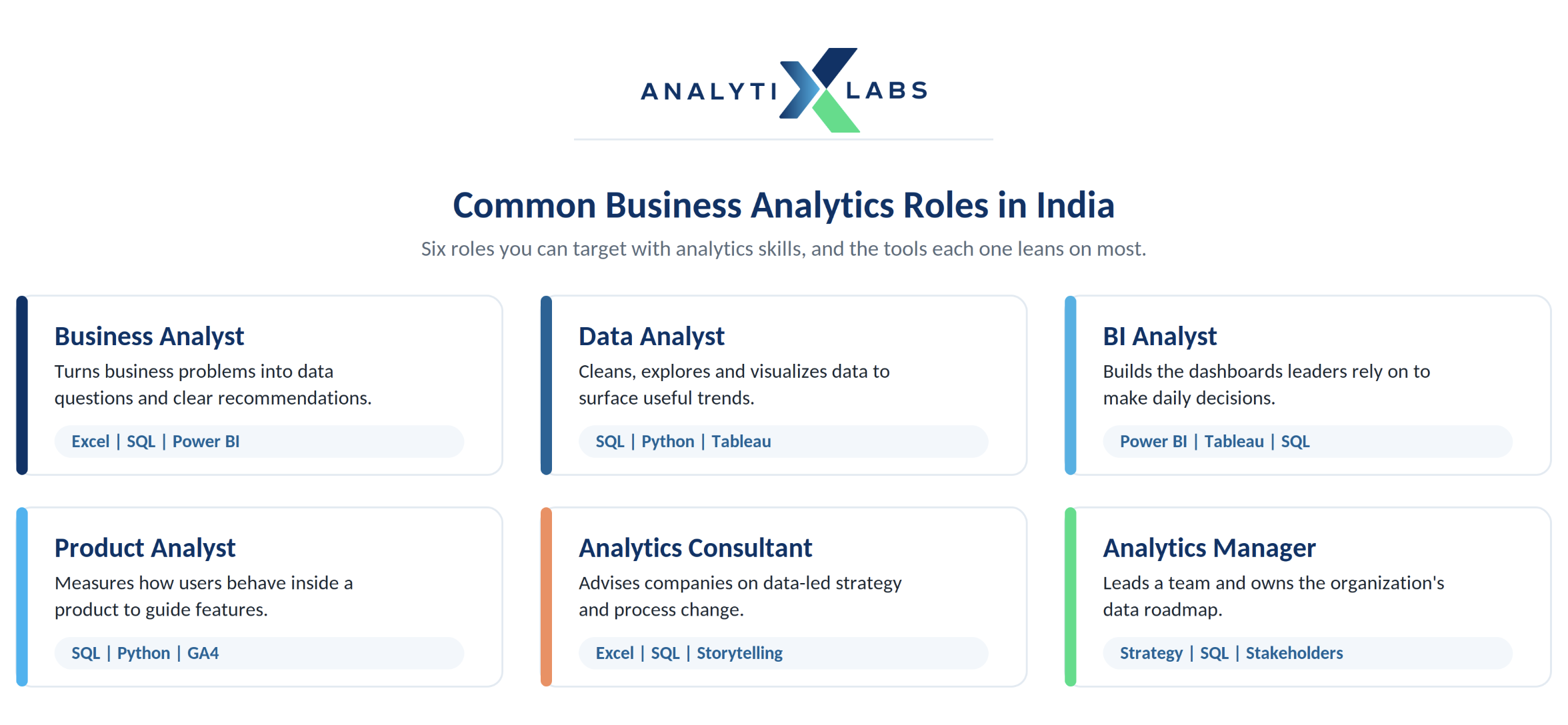
Business analytics is not a single job. It is a family of related roles, and knowing them helps you aim your applications. Here are the most common ones in India, with the kind of work each involves and the tools each leans on.
| Role | What you do | Typical tools |
|---|---|---|
| Business Analyst | Sit between business teams and data teams. Turn vague business problems into clear questions and recommendations. | Excel, SQL, Power BI |
| Data Analyst | Clean, explore and visualize data to surface trends and answer specific questions. | SQL, Python, Tableau |
| BI Analyst | Build and maintain the dashboards that leaders use to make daily decisions. | Power BI, Tableau, SQL |
| Product Analyst | Measure how users behave inside a product and guide what gets built next. | SQL, Python, GA4 |
| Analytics Consultant | Advise companies, often as an external partner, on data-led strategy and process change. | Excel, SQL, storytelling |
| Analytics Manager | Lead a team of analysts and own the data roadmap for a function or company. | Strategy, SQL, stakeholder management |
A useful way to read this table is as a career ladder as much as a list. Many people enter as a data or business analyst, move into BI or product analytics as they specialize, and grow toward consultant or manager roles as they take on strategy and people. The tools overlap heavily, which is why a strong foundation in Excel, SQL and a visualization tool serves you across almost all of them.
Business analytics salary in India
Salary is one of the most searched questions in this field, so let us be specific while staying honest about the ranges. The figures below are indicative bands drawn from salary aggregators such as AmbitionBox, Naukri and Indeed for 2025 and 2026.
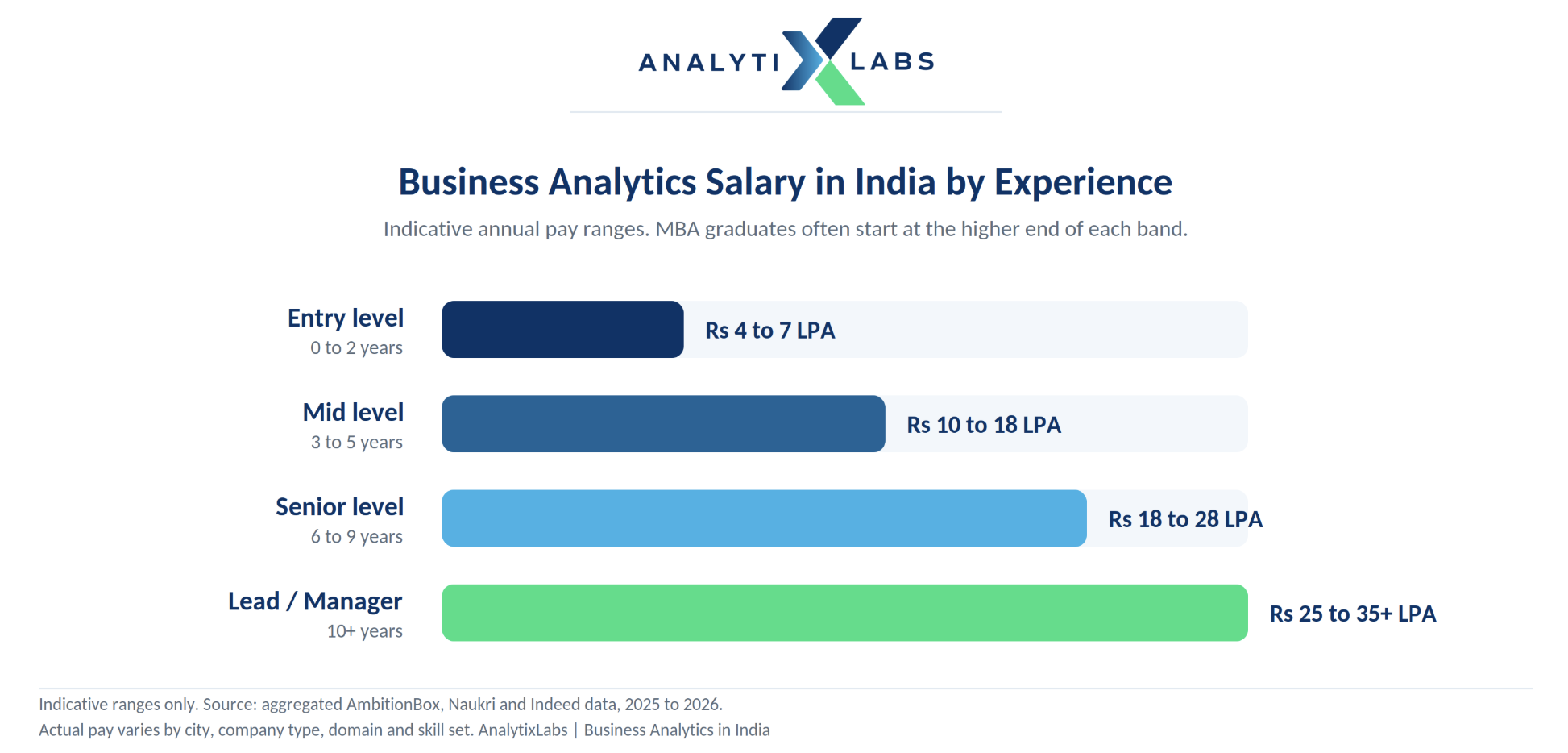
Entry level, 0 to 2 years: roughly ₹4 to 7 lakh per year. Freshers from a strong MBA or with a recognized certification often start at the higher end.
Mid level, 3 to 5 years: roughly ₹10 to 18 lakh per year, as you take ownership of projects and specialize.
Senior level, 6 to 9 years: roughly ₹18 to 28 lakh per year, with leadership of complex work or small teams.
Lead or manager, 10 years and beyond: roughly ₹25 to 35 lakh and upward, especially in product companies, consulting and global firms.
Two patterns are worth calling out.
First, a professional certification in business analytics tends to lift starting pay, because employers value structured business thinking alongside analytical skill.
Second, location matters. Bengaluru typically leads, driven by product firms and Global Capability Centres, with Mumbai, Gurugram and Hyderabad close behind.
Entry paths for freshers and working professionals
How you break in depends on where you are starting from. There is a clear path for each situation.
If you are a fresher or recent graduate, the fastest route is to build job-ready skills in Excel, SQL and a visualization tool, complete one or two portfolio projects on real datasets, and target entry roles like data analyst or junior business analyst. A focused certification course plus a strong project portfolio often beats a generic degree with no hands-on work.
If you are a working professional, you can usually pivot by layering analytics onto the domain you already know. A finance professional who learns SQL and Power BI becomes a strong candidate for a finance-analytics role, because the domain knowledge is already there. Many people make this switch through evening or weekend programs while staying employed.
If you are an MBA graduate, you are well placed for business analyst and analytics-strategy roles, and jobs after an MBA in business analytics often sit at the higher end of the fresher salary band. Pairing the degree with practical tool skills makes the profile much stronger.
Whichever path fits you, the common thread is the same. Employers want to see that you can work with real data and communicate a result, not just that you have studied the theory.
How to Study Business Analytics in India?
There are three main routes into business analytics in India: a certification course, an MBA in business analytics and AI, or a general MBA with an analytics specialization. A Masters or MSc is a fourth, more technical option.
A certification course is the fastest and most affordable route to a job, while the MBA routes suit those aiming at leadership and strategy. The right choice depends on your time, budget and your goal.
Before comparing the routes, keep one fact about 2026 in mind. Employers are no longer asking only for analytics skills. They are asking for analytics skills paired with AI fluency. The same ManpowerGroup survey mentioned earlier put AI skills at the top of India's talent shortage for the first time. So whichever route you choose, the programs worth your money are the ones that teach you to work alongside AI, not around it.
Certification Course vs MBA in analytics and AI vs general MBA
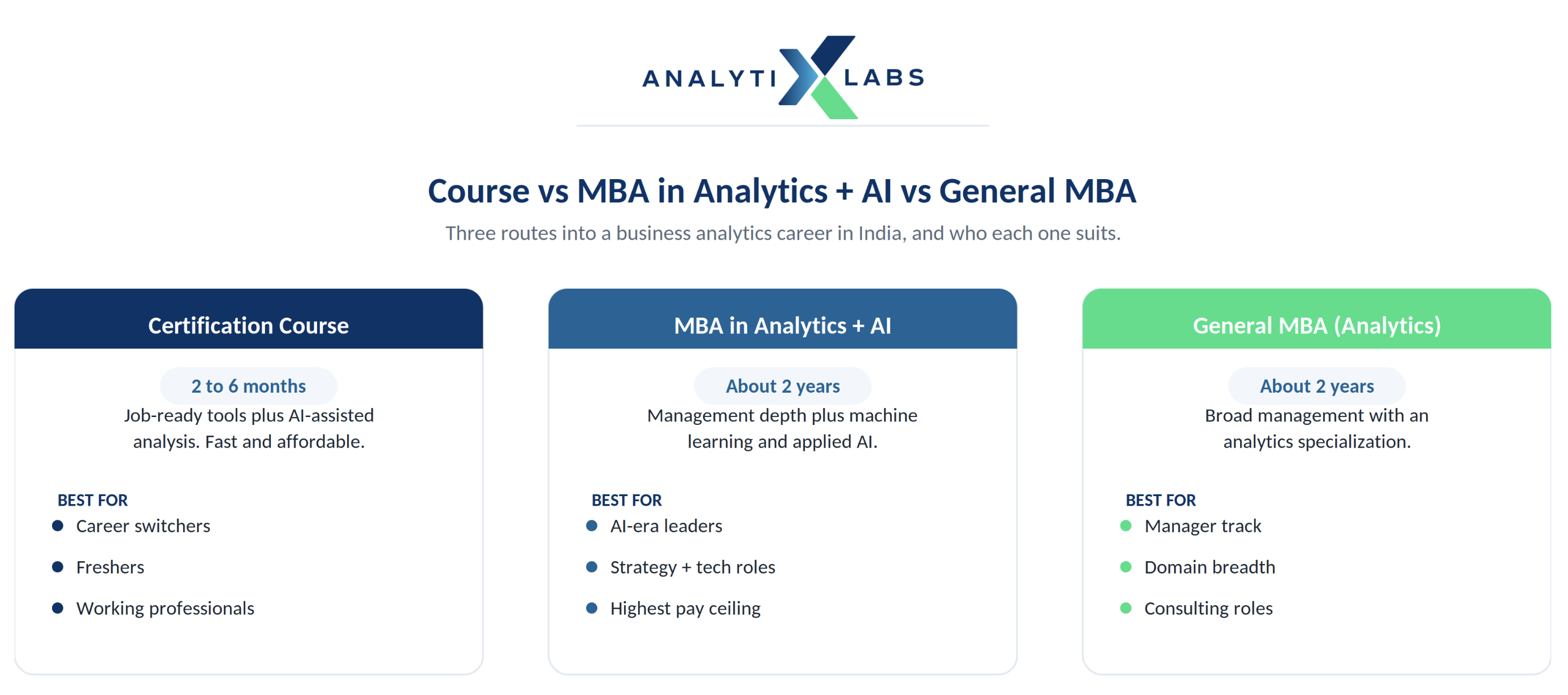
These three routes are not really competing for the same person. They suit different goals, budgets and timelines. The table below lays out the trade-offs from an India perspective, so you can match a route to your situation. Treat the cost and salary figures as indicative ranges, since they vary widely by institute, city and skill set.
| Dimension | Certification Course | MBA in Business Analytics + AI | General MBA in Business Analytics |
|---|---|---|---|
| Duration | 2 to 6 months | About 2 years | About 2 years |
| Indicative cost (India) | Rs 30,000 to 1.5 lakh | Rs 8 lakh to 26 lakh and above | Rs 5 lakh to 20 lakh |
| Main focus | Hands-on tools, statistics and AI-assisted workflows | Analytics, management, machine learning and applied AI | Broad management with an analytics specialization |
| Role of AI | Everyday workflow aid, taught from day one | Core specialization, including ML and generative AI | Usually an elective, lighter coverage |
| Entry requirement | Open to any graduate, no entrance exam | Graduate degree plus an entrance test (CAT, GMAT, etc.) | Graduate degree plus an entrance test |
| Time to a job | Fastest, within months | About two years | About two years |
| Typical first roles | Business, data, BI or MIS analyst | Analytics manager, AI strategy, senior consultant | Business analyst, manager, consultant |
| Best for | Fast, affordable entry for freshers, switchers and working professionals | AI-era leadership and strategy careers | Management breadth with an analytics edge |
| Earning ceiling | Strong entry pay, grows with experience | Highest long-term ceiling, AI-skills premium | High management ceiling |
The decision really comes down to three questions. How soon do you need to be working? How much can you invest, in both time and money? And what role do you ultimately want?
If you need a job quickly and want the lowest-cost, lowest-risk entry, the certification course wins, and nothing stops you from adding an MBA later. If you are aiming for leadership in an AI-driven company and can invest two years, the MBA in business analytics and AI is the forward-looking choice. If you want broad management credibility with an analytics tilt, a general MBA still serves well.
Our Business Analytics Certification Course is at par with any MBA course (whether general or BA+AI). We teach industry-relevant skills, tools, and AI-fluency through hands-on training, practical projects, and industr-relevant assignments.
Conclusion: Scope and Future of Business Analytics in India
The biggest question on most people's minds is what AI and automation will do to these jobs. The honest answer is that they are changing the work more than they are eliminating it. Routine tasks, the manual report-building and basic data cleaning, are increasingly automated. That is genuinely good news, because it frees analysts to spend time on the parts machines are bad at: framing the right question, understanding business context, and persuading people to act on an insight.
Picture an analyst in 2026 using an AI assistant to write a first draft of a SQL query or to summarize a dataset in seconds. The analyst still has to know whether the query is asking the right thing, whether the data can be trusted, and what the result means for the business. Those judgment skills are becoming more valuable, not less. The roles most likely to grow are the ones that blend analytics with domain expertise and clear communication, such as the AI business analyst who bridges new technology and business strategy.
So the practical guidance for the next few years is simple. Learn the foundational skills well, get comfortable working alongside AI tools rather than fearing them, and keep building the business judgment that no tool can replace. Do that, and the field's growth works in your favor.
Frequently Asked Questions
Is business analytics a good career in India?
Yes. Business analytics is one of the strongest career choices in India right now. Demand is growing across BFSI, e-commerce, IT services and consulting, salaries climb quickly with experience, and the field offers clear progression from analyst to manager. The rise of AI is reshaping the work rather than shrinking it, which keeps the long-term outlook healthy.
What is the salary of business analytics in India?
Salaries vary by experience and city. Freshers typically earn around Rs 4 to 7 lakh per year, mid-level professionals with 3 to 5 years of experience around Rs 10 to 18 lakh, and senior or leadership roles Rs 25 lakh and beyond. Metro hubs like Bengaluru, Mumbai and Gurugram pay at the higher end. These are indicative ranges from salary aggregators and depend heavily on skills and employer.
What is the scope of business analytics in India?
The scope is broad and expanding. Almost every major industry now hires analysts, the market is projected to grow at more than 25 percent a year through the early 2030s, and AI is creating new hybrid roles rather than removing existing ones. For someone entering in 2026 with current skills, the long-term scope across industries and roles is very strong.
Which is better, an MBA or a Masters in business analytics?
It depends on your goal. An MBA in business analytics suits people aiming for management, strategy and consulting roles, because it blends business training with analytics. A Masters or MSc suits people who want a deeper technical and research focus and plan to work as specialists. If you want to lead teams, lean MBA. If you want to go deep on methods, lean Masters.
What is the difference between business analytics and a business analyst?
Business analytics is the field, the practice of using data to guide business decisions. A business analyst is a job role, a person who sits between business teams and data teams to translate needs into solutions. So business analytics is what the discipline is called, while a business analyst is one of the people who works within it. The two terms are related but not interchangeable.
Can freshers get business analytics jobs in India?
Yes, freshers regularly enter the field. The most reliable path is to build hands-on skills in Excel, SQL and a visualization tool, complete one or two real-data projects to show in a portfolio, and target entry roles such as data analyst or junior business analyst. A focused certification course paired with practical projects often opens doors faster than a degree alone.