Did you know that 87% of data science projects never go into production? One key reason? Using the wrong tools for the job. Choosing the right tools for data engineering and data science is one of the most critical decisions you can make, as it impacts how cleanly and efficiently your work reaches customers.
We now have two amazing composers: Python and Flutter. Both are well-known for many applications. Python is a widely used programming language, while Flutter is a framework for building mobile applications. We will discuss both options to help you decide which is best for you.
/
Learn with AnalytixLabs
Course Alert:
Learn the essentials of data science and data engineering from data experts today. Enrol for our data science courses to elevate your data science and engineering career. Explore ongoing courses:
Data Science Certificate Course
Python for Machine Learning
What is Flutter?
The Flutter framework was developed by Google in 2015 and was officially launched in the market in 2018. When Flutter was created, the main idea behind it was to allow developers to create applications that run on different platforms using the same codebase. It is not meant for data engineering or data science; it focuses on building interactive and refreshed apps.
While Flutter excels at app development, it lacks functionality for data processing and analysis. However, Flutter still has many beneficial features.
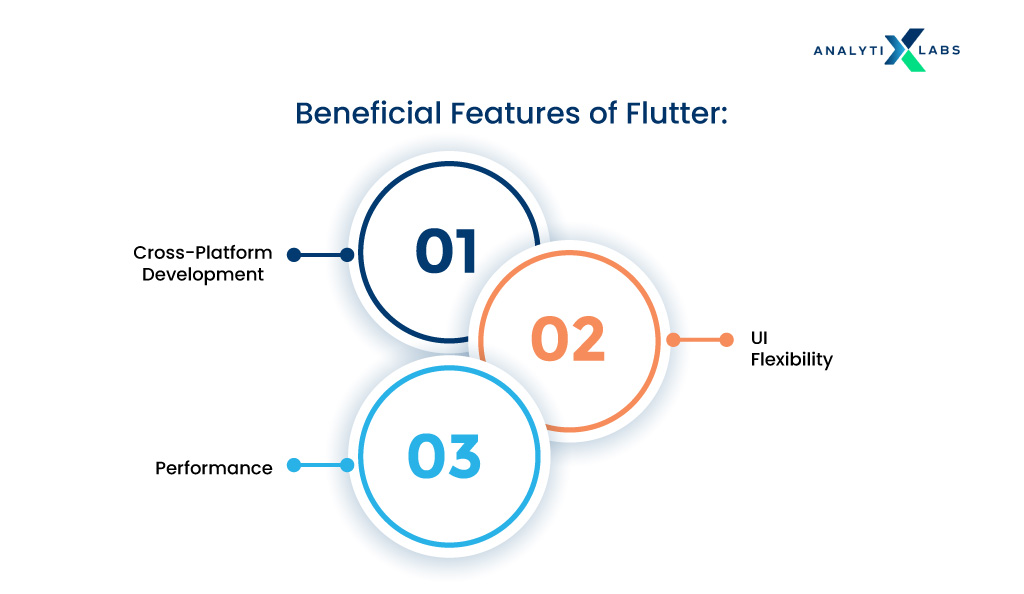
- Cross-Platform Development
You can write the same code for iOS, Android, the web, or even desktop-based applications using Flutter. From the perspective of developers, it is a time-saving way to write apps, as it eliminates the need to write platform-specific code from a single codebase, thereby reducing development time and effort. If you want to create a cross-platform data visualization app, Flutter mobile app development is indeed a good choice.
- UI Flexibility
One of the advantages of Flutter is its widget-based system, which allows developers to build highly customized and responsive UIs. Using Flutter’s design properties, you get to create your app as you had envisioned it, be it sleek charts, intuitive graphs, auditable dashboards, etc.
-
Performance
Because Flutter applications are compiled to native code, they can run smoothly and efficiently. It allows for a quick, responsive user interface, even during heavy or intense graphical content or animations.
What is Python?
Python is a well-known programming language, invented by Guido van Rossum in the late 1980s. The first release of Python occurred on February 20, 1991, and it has become popular among data engineers and data scientists for good reasons. It is strong and generic enough to be applied with confidence in a variety of data-related machines, from everyday businesses to enterprise data processes.
The benefits of using Python include:
-
Ease of Use
Python’s syntax is so simple that it is easily learnable by beginner programmers. The language’s readable nature means that less time is spent on debugging. Thus, it is considered an easy language to learn and use, mainly due to its English-like syntax and versatility.
-
Libraries and Framework
One of Python’s greatest strengths is its extensive ecosystem of libraries for data manipulation, analysis, and machine learning. Data manipulation, cleaning, and processing are an essential part in any machine learning project. Python has the right tools in place to achieve that, whether you want to clean messy data, perform statistical analysis, or build predictive models.
- Community Support
Lastly, there are many people in Python’s community. This means that if something breaks, you’ll likely be able to find tutorials, forums, and resources online. The Python community has enough information, which simplifies the learning, development, and debugging process.
Why Flutter vs. Python?
At the very beginning of the discussion, talking about Flutter and Python seems irrelevant. The frontend for the interactive user interface is built using Flutter, and the Python side handles the backend logic. But since you know the strengths of data-dependent apps, you’re in a better position to choose the tool for the job or, more importantly, how they can work together. Here’s why the comparison is meaningful:
- Data visualization
Python has excellent libraries for creating detailed graphs and charts, such as Matplotlib and Plotly. This enables it to transform the application into interactive components using Flutter. There, you can show how you split the tasks, process the data in Python, and then display it in Flutter.
- Performance
Python uses highly numerical libraries, such as NumPy and Pandas, which are intended for data scientists to work with larger datasets and perform more complex calculations. Flutter is about responsive UI, not heavy data processing. Displaying it in Flutter and performing that computation in Python shouldn’t cause any slowdown in performance.
- Ease of integration
Python connects easily to databases, APIs, and machine learning models. Flutter excels at showing results in a sleek interface. Knowing how to integrate both lets you build powerful, data-driven apps without overloading your front end.
Benefits of Using Python for Data Science and Engineering
Using the Python programming language provides the most effective solution for data requirements. The data processing workflow in Python features an easy system that reduces complex tasks, including data pipeline development together with machine learning model training. The programming methodology in Python enables people to accomplish advanced tasks while avoiding confusing concepts within the system. The following explains this well:
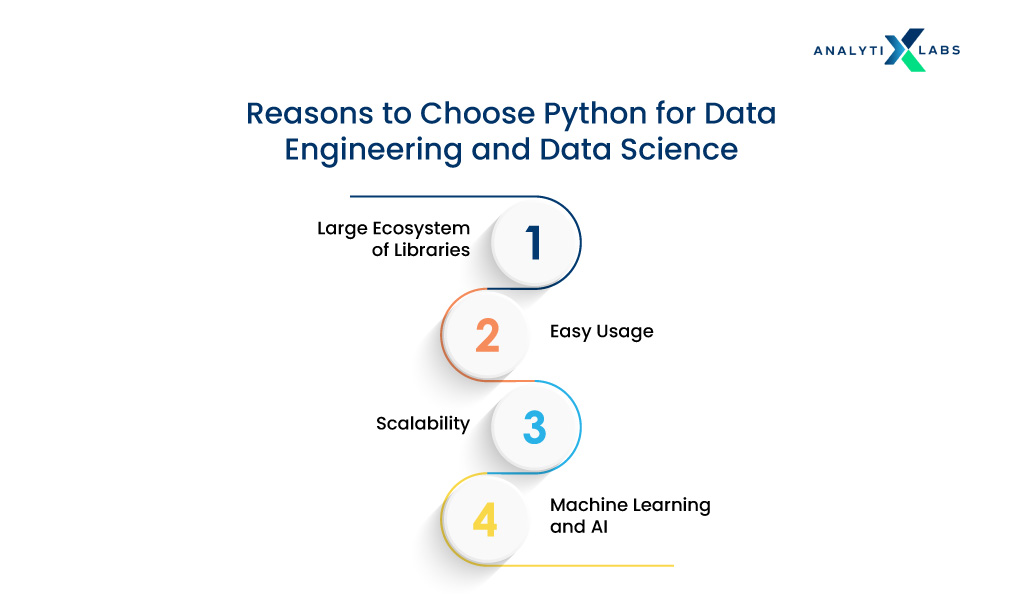
1. Large Ecosystem of Libraries
The Python programming environment features multiple data operation libraries that serve different data types. Data cleaning operations are available among Python libraries, along with libraries for creating AI models. These tools reduce your workload and allow you to focus on problems while taking the burden of writing all content off your hands.
- The libraries help users perform data transformation when starting data analysis with Pandas. Starting with a massive dataset enables developers to restructure data through short code segments and also perform filtering across the whole data range.
- Quick and efficient numerical processing needs generate a demand in the system. You have NumPy here. The system effectively automates the processing of complex mathematical array data, which involves high-dimensional arrays.
- Through its design, machine learning becomes more accessible, and its documentation provides essential information to simplify machine learning while offering pre-built models that reduce the need to develop algorithms from basic principles.
2. Easy Usage
Python provides simple language structures that help new users learn but keep their produced texts easily understandable. Python achieves its powerful data-related tool position because of its large volunteer community.
- The use of Python scripts accelerates data acquisition, reducing the need for cleaning and making the data suitable for analysis.
- Python applications become easier to debug and understand where problems occur. The testing process becomes faster since you already know where to focus your attention.
- The Python community is huge. The generous community has already addressed most issues. Stack Overflow and GitHub serve as extensive sources of beneficial discussions and references.
3. Scalability
Python also works well with big data tools , so you can scale up to process large amounts of data without performance issues. Small projects can start and evolve into production-grade things.
- If you prefer an intermediate between Hadoop and a MapReduce snake, Python easily integrates with Apache Spark. In other words, your data will be divided into more manageable pieces and processed in parallel across multiple servers.
- Dask libraries allow you to parallelize computations on your local machine. Pandas with added scalability for processing large datasets.
- The uses of Python are databases, cloud storage, and APIs. Whether the bottleneck is on your SQL databases or in the cloud, retrieval, transformation, and migration of your data won’t cause you a ton of headaches.
4. Machine Learning and AI
Python is the top language for machine learning and AI. It has all the tools you’ll ever need to build, train, and deploy models. Whether you’re just playing around with data or building AI systems, Python does it all.
- Keras, TensorFlow, and PyTorch provide ready-to-use tools for image classification, natural language processing, and recommendation systems.
- Python provides a more straightforward approach for users to conduct experiments. The experimentation process is made possible by Python because different algorithms can be tested easily by adjusting parameters and trying new techniques.
- The process of deploying your model becomes straightforward once it is complete. You should use one of the adjacent libraries, such as Flask or FastAPI, to transform your model into a web service that can be integrated into larger applications.
Benefits of Using Flutter for Data Science and Engineering
As Flutter is cross-platform compatible, has good visualization features, high performance, and easy integration, it is an ideal technology to build data-intensive apps. Flutter is one framework that helps you create analytics platforms, reporting tools, or real-time monitoring systems faster and more effectively. The reasons to choose Flutter for data science:
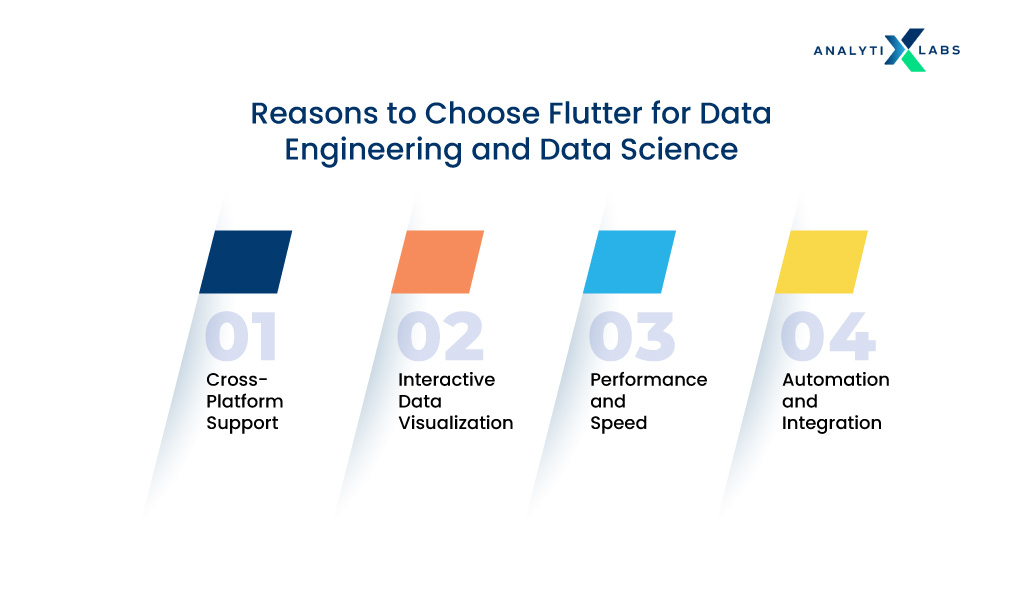
1. Cross-Platform Support
Developing cross-platform, adaptable applications with Flutter follows a cohesive approach, resulting in clean and efficient applications. Data engineering, together with data science, finds this solution to be their perfect fit. Cross-platform operability is a key feature of this tool, which offers interactive visualizations that integrate smoothly and seamlessly.
Flutter allows developers to build data applications that deliver high usability and effectiveness.
- Using a single coding foundation, developers can create mobile applications, as well as web and desktop applications, with Flutter.
- The tool facilitates quick development periods, especially for the reporting and data analysis stages.
- The deployment of data applications across multiple platforms becomes possible without modifying the test code base through this method, which reduces delivery time.
- Flutter features seamless integration capabilities that enhance the process of connecting backend systems to create data pipeline connections and API convergence between different environments.
2. Interactive Data Visualization
Analyzing complex data requires visual elements that effectively engage viewers. The widget-based system of Flutter enables native creation of lean and interactive graphs and charts. Visual elements generated according to your specifications let users visualize conclusions with ease. A feature of this platform allows animation, which provides excellent visuals for displaying data movements.
- The widget-based framework of Flutter enables developers to produce responsive and dynamic graphs together with charts and dashboards.
- Visual representations built by the system transform ambiguous data into understandable forms for users.
- The animation features provide visual indicators that show how data changes over time.
- Users gain better data insight through live interaction on the platform.
3. Performance and Speed
The Dart language, along with its performance rating, helps process large datasets through real-time data processing procedures. Dart serves as the initial programming language for Flutter, which is then compiled into native code for rapid execution. The performance of the internal rendering engine in Flutter has been enhanced to benefit users working with applications that process large volumes of data, such as real-time monitoring and analytics applications.
- Flutter’s native code compilation function, using the Dart languag,e produces fast performance throughout any data size variations.
- The system relies on this feature to operate active data processing and tracking applications where real-time information updates remain active.
- Every interaction on business user interfaces functions smoothly because of the rendering engine within the framework, making it especially important for data-intensive applications.
4. Automation and Integration
Most operations within data engineering and science fall into the realm of repetitive work, including data ingestion and report generation. Using Flutter enables automatic execution of applications that run workflows, which both speeds up the process and minimizes mistakes. The technology integrates nicely with well-known libraries like Firebase and TensorFlow, making it easy to incorporate custom tools into existing systems through optimized data pipelines.
- The integration between Flutter and automation tools enables the streamlining of processes for both data cleaning jobs and document creation tasks.
- The system supports the transfer of data through important data science platforms, including Python and TensorFlow, together with the Firebase framework.
- The development of custom applications using Flutter enables you to create automated processes that interact with your systems for data pipeline tasks.
- Flutter enables simple connections to live data sources through its web sockets while providing REST API support for third-party services.
Which One to Use for Your Projects?
Flutter and Python operate through different functions, but they achieve better results when combined in a single implementation. The workload, which requires vast amounts of data, falls to Python, while Flutter creates attractive application interfaces to show that data.
Understanding tool capabilities enables you to make proper project framework selections and execute combined implementations that produce optimal results. The following quick evaluation will help you choose a suitable tool based on your requirements.
| Requirement | Python | Flutter |
|---|---|---|
| Data Processing and Analysis | Ideal for handling large datasets, cleaning data, and performing complex calculations with libraries like Pandas and NumPy. | Not designed for data processing, but can display processed data visually. |
| Machine Learning and AI | Perfect for building, training, and testing predictive models with tools like TensorFlow and Scikit-learn. | Not suitable for model training, but can be used to visualize model results in a user-friendly app. |
| Data Visualization | Great for generating static and interactive visualizations using Matplotlib, Seaborn, or Plotly. | Suitable for creating interactive and dynamic data visualizations in apps for a seamless experience. |
| Automation and Scripting | Excellent for automating repetitive tasks, managing ETL pipelines, and scheduling workflows. | Not meant for automation, as it focuses on UI development rather than backend processes. |
| Building User Interfaces | Basic UI capabilities with libraries like Streamlit, but not as flexible for complex interfaces. | Built specifically for creating visually appealing, interactive, and responsive app interfaces. |
| cross-Platform Application Development | Limited to web apps or through frameworks like Django, which aren’t cross-platform by default. | Built for cross-platform development, allowing apps to run on iOS, Android, web, and desktop. |
| Real-Time Dashboards | Can process live data and feed it to dashboards, but UI options are more limited. | Perfect for building real-time dashboards with live data updates and responsive visual elements. |
| Database Integration and Management | Easily connects to databases like SQL and MongoDB, making data retrieval and storage simple. | Limited database support typically relies on backend services for data handling. |
| Prototyping and Experimentation | Fast to write and test code, making it great for quick data experiments and algorithm testing. | Better suited for UI prototyping, not data experiments. |
Conclusion
Python is a prominent language for data engineering and research, offering powerful capabilities and the flexibility to handle complex data tasks. Flutter, on the other side, specializes in creating visually appealing and responsive user interfaces. When Python and Flutter work together, they form a formidable team for a wide range of tasks. Understanding the strengths of each tool is critical, and talking with a reputable python app development services company can provide valuable insights to help you make the best decision.