In 2026, the average salary of a Data Scientist in India is approximately 11 LPA, reflecting a steady upward trajectory fueled by the AI and GenAI adoption wave. The range of salaries of data scientists in India, however, is wide, with annual salaries spanning from ₹4 LPA to ₹30+ LPA.
Several factors affect one’s salary, including skills, experience, industry, and location. Notably, the emergence of a two-tier salary structure — traditional data science vs. AI-specialized roles — has further widened this range, with AI specialists commanding a 25–40% premium over generalist data scientists.
In this article, the aim is to expand on the various factors that affect a data scientist’s salary in India. However, to understand how these factors affect the salaries and to what extent, you need to understand what data science is all about and the various components that this discipline is composed of.
What is Data Science?
Data science is a multidisciplinary field. It is an amalgamation of multiple disciplines such as statistics, computer programming, domain expertise, business intelligence, storytelling, visualization, machine learning, AI, and natural language processing.
While data science tends to achieve several objectives, its primary aim is to extract actionable insights from large and diverse datasets to guide business decisions. It serves as the foundation for any data-driven organization that relies on insights to improve performance, identify opportunities, and predict future outcomes.
In the modern digital economy, data has grown rapidly across devices, sensors, social media, and web logs — with over 221 zettabytes of data expected to be created globally in 2026 alone. This surge has made data science one of the fastest-growing and most in-demand fields across industries. To understand what drives remuneration, one must examine its tasks, required skills, and overall significance.
Want to speed up your career in Data Science? Learn from the top experts. Our experts merge real-life experience with theoretical knowledge, and give you a learning experience that will help you rebuild your career.
Enrol for our Data Science Course and build a lucrative career in data science and AI. Or explore our Full Stack AI Course for end-to-end AI Engineering skills.
Explore our other ongoing courses in Data Analytics, Data Visualization, and AI. DM us for more information on learning tracks, admission process, and career assistance.
Core Process of Data Science
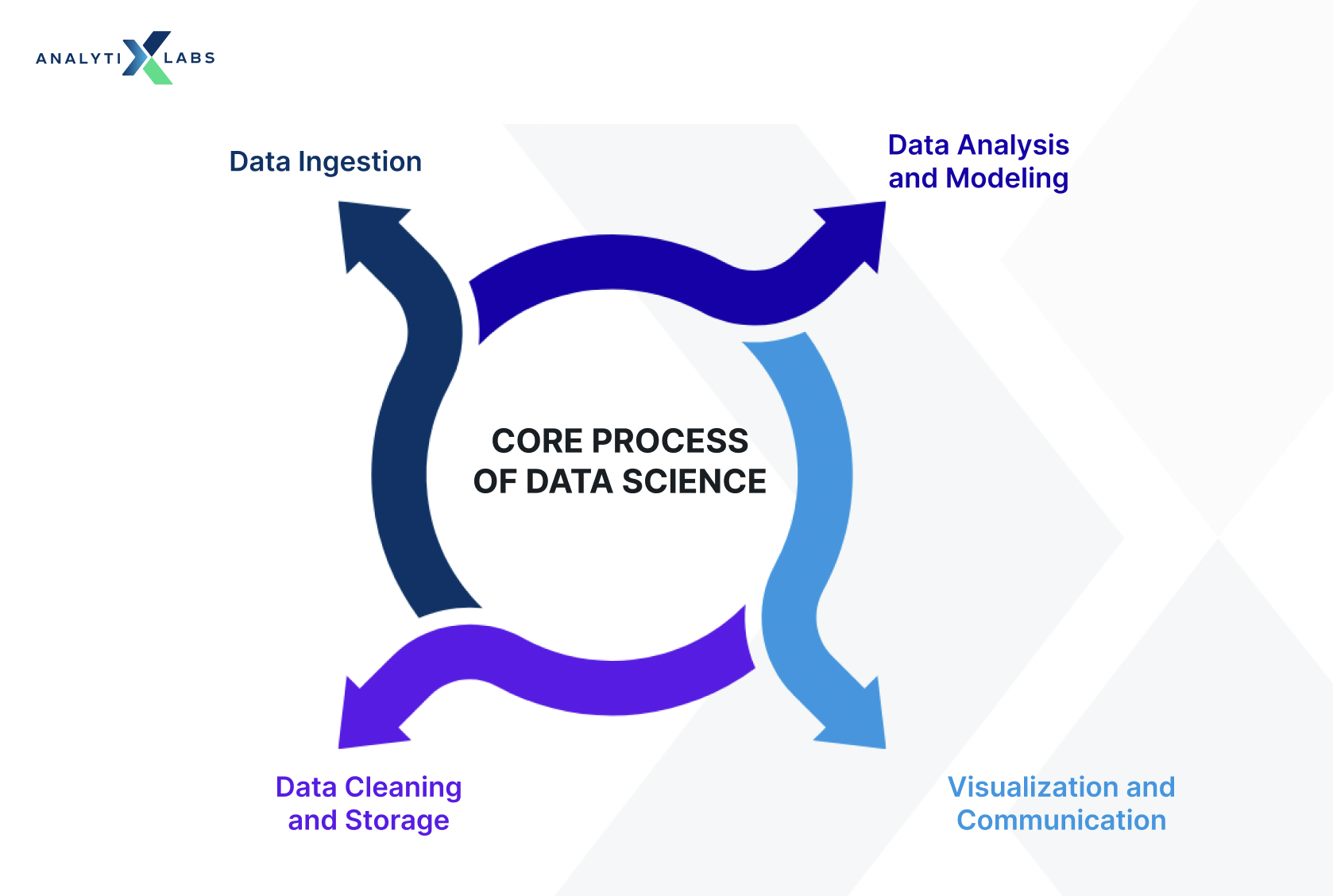
A typical data science lifecycle consists of multiple stages:
-
Data Ingestion: Collecting raw data from varied sources such as APIs, sensors, or databases.
-
Data Cleaning and Storage: Ensuring data quality through deduplication, transformation, and integration into data lakes or warehouses.
-
Data Analysis and Modeling: Using EDA that involves using various statistical and computational techniques to find patterns and test hypotheses, followed by building different predictive or prescriptive models.
-
Visualization and Communication: Data science is also responsible for presenting insights using visual tools or dashboards to guide decision-making. Explore our Data Visualization & Analytics course to master this skill.
Thus, the lifecycle of a data science project involves understanding what happened, why it happened, and what might happen next, making it a complete decision-support framework.
What are the Key Skills in Data Science?
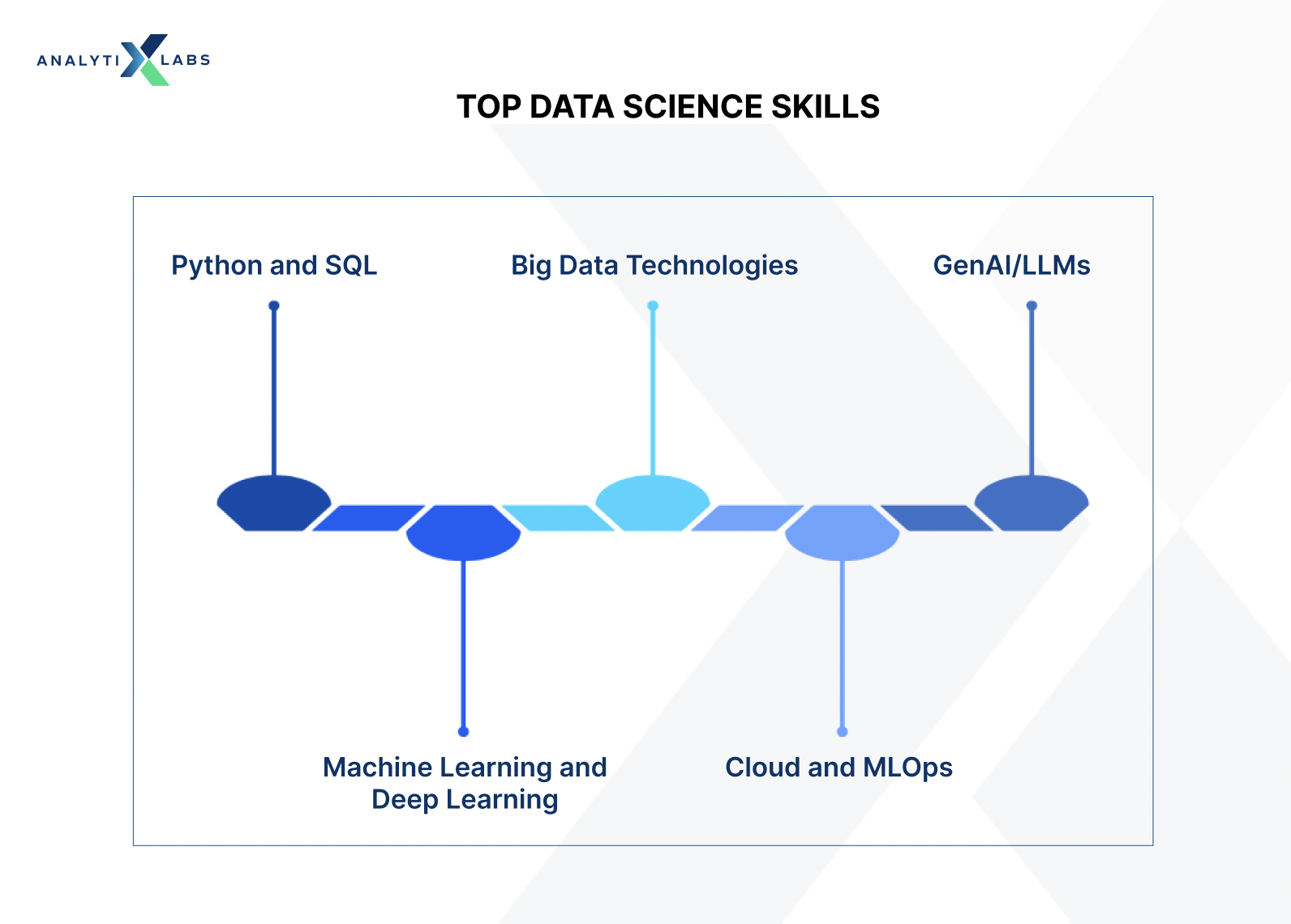
The salary of a data scientist in India varies significantly based on technical skill sets and specialization. The key skills in Data Science are as follows:
-
Python and SQL: Python is widely used for data analysis with libraries like NumPy, Pandas, and Matplotlib. SQL is essential for querying and managing relational databases efficiently. Knowledge of R is also helpful for statistical analysis. Get started with our Data Science using Python course.
-
Machine Learning and Deep Learning: Skills in TensorFlow, PyTorch, or Scikit-learn help build predictive and intelligent models. Our Machine Learning using Python and Deep Learning with Python courses cover these in depth.
-
Big Data Technologies: Knowing Spark, Hadoop, and NoSQL helps manage and process large-scale data effectively.
-
Cloud and MLOps: Experience with AWS, Azure, or Google Cloud enables scalability and automation in data science projects.
-
GenAI/LLMs: Understanding Generative AI and large language models (LLMs) is increasingly valuable for NLP and automation tasks. Frameworks like LangChain have become essential tools for building LLM-powered applications. Our Generative AI Course and Agentic AI Course prepare you for these cutting-edge roles.
Why Data Science Matters?
Data science is vital for turning raw data into insights that drive innovation and improve business efficiency. It helps reduce uncertainty in decision-making across industries. Applications of Data Science span healthcare analytics, personalized shopping, fraud detection, and risk management, proving its global importance.
As industries across banking, healthcare, and technology adopt AI-driven systems, the demand for data science professionals has continued to grow rapidly. According to the U.S. Bureau of Labor Statistics, data scientist employment is projected to grow 36% through 2033 — much faster than the average for all occupations. In India specifically, AnalytixLabs’ AI Skills Playbook 2026 highlights that while traditional data science roles are evolving, AI Engineering has emerged as a parallel high-growth career track.
Data science is a dynamic field and offers great remuneration and job growth. Let’s understand the factors affecting a data scientist salary in India.
What are the Factors Affecting Data Scientist Salary?
The salary of a data scientist in India is influenced by several factors — it is a function of experience, skills, industry, geography, and employer type. As organizations increasingly rely on AI and data-driven decisions, the salary of a data scientist in India varies widely based on how deeply they contribute to business impact and innovation. Understanding these factors is key to navigating your way in the data science job market.
Note: All salaries are mentioned in INR Lakh per annum (LPA) and reflect 2026 market data.
1. Experience Level
Experience remains by far the most significant determinant of a data scientist’s salary in India per month. The fresher data scientist salary in India is the lowest, as they are handed out foundational responsibilities such as data cleaning and visualization, while mid-level professionals handle model deployment and cross-functional projects.
At senior levels, data scientists lead teams, define strategy, and drive AI adoption. Such roles not only demand technical knowledge but also business acumen. As professionals advance, their ability to deliver measurable business outcomes directly impacts compensation.
This creates a steep pay curve where salaries accelerate sharply after 5–7 years of proven performance. Data scientist highest salary in India is commanded by those scientists who have more than eight years of experience.
| Level | Typical Responsibilities & Why it Pays | Salary |
|---|---|---|
| Fresher / Entry (0–2 yrs) | EDA, feature work, supervised by seniors (rapid learning phase) | ₹6-10 LPA |
| Mid (3–7 yrs) | Own models, production handoffs, cross-functional ownership | ₹10-22 LPA |
| Senior / Lead (8+ yrs) | Strategy, team leadership, product impact — (large uplift in remuneration) | ₹30-55+ LPA |
2. Skillset and technical depth
The breadth and specialization of technical skills strongly influence the data scientist salary in India. The following are the key skills that cause differentiation.
- Python & SQL: These remain baseline skills for data manipulation, automation, and analytics. You need to have these skills to be considered job-ready.
- Machine Learning (ML): ML expertise, especially model optimization and production-level deployment, typically leads to higher-paying roles like ML Engineer or Applied Scientist.
- Deep Learning & NLP: Specialists in neural networks and NLP earn premium pay due to the complexity and commercial value of their work.
- Cloud Computing: Skills in AWS, Azure, or GCP allow scalable AI deployment, which organizations prioritize for enterprise-level operations.
- GenAI and LLMs: The GenAI surge has redefined salary benchmarks in 2026, with professionals capable of integrating large language models, building AI agents, or fine-tuning generative architectures into products being among the highest-paid data science professionals. An AI-specialized data scientist typically earns 25–40% more than a generalist.
In addition to all these specific skills, employers also value cross-domain proficiency, i.e., if you can combine statistical, programming, and business understanding to provide the solution, then the organization values you more and has a higher average salary for a data scientist in India.
| Skill cluster | Typical role & Why it pays | Indicative salary (INR) |
|---|---|---|
| Python + SQL (baseline) | Core data manipulation, EDA, reporting (minimum-hire skills) | ₹6-9 LPA |
| Machine Learning (classical ML) | Model design, validation, deployment (higher product/impact value) | ₹13-20 LPA |
| Deep Learning (CV / advanced NLP) | Complex data science skills such as vision, speech, and natural language models (provides specialist premium) | ₹16-30 LPA |
| Big Data (Spark, Hadoop, Data Engineering) | Scale, pipelines, and big data handling (more pay due to complex engineering requirements and scale expertise) | ₹16-24 LPA |
| Cloud + MLOps (AWS/Azure/GCP) | Productionalisation, cost/scale optimisation (premium due to development of enterprise-grade applications) | ₹15-26 LPA |
| GenAI / LLM skills | Fine-tuning, prompt engineering, agentic AI, product integration (high demand and niche skills allow for higher premiums) | ₹22-40 LPA |
3. Industry
Different sectors offer distinct compensation bands based on data volume and business stakes. The variance stems from how critical analytics is to each industry’s core value chain.
- Product and Tech Companies: Firms in SaaS, AI, and digital products typically offer the highest salary of data scientist in India due to data-centric models and innovation budgets.
- BFSI (Banking, Financial Services & Insurance): Roles in risk modeling, fraud detection, and algorithmic trading attract strong pay due to regulatory complexity and financial exposure.
- IT Services and Consulting: Offer consistent but moderate salaries with opportunities to work across multiple client domains.
| Industry | Nature of Job and Factors that Affect Remuneration | Average salary |
|---|---|---|
| IT Services / Consulting | Volume hiring and client-billable roles; steadier but generally lower salary base | ₹15 LPA |
| BFSI / Fintech | High-stakes model creation (risk, fraud); Premium pay due to direct revenue/risk impact of data science solutions | ₹17.5 LPA |
| Product / SaaS companies | Develops data-driven features and applications; deep involvement in data science and high investment in it attracts top-tier pay | ₹18.5 LPA |
4. Company Type
Apart from the industry, the company size and business maturity also play a pivotal role in explaining the salary variation.
- MNCs and Tech Giants: Such companies offer structured career paths, stability, and global-scale data systems. Therefore, they have higher pay bands and additional perks such as bonuses and stock options.
- Startups: Often trade fixed pay for growth potential or equity. This typically appeals to candidates seeking rapid learning or future upside. While exposure is much more in startups, the variable component of the salary is generally higher, which is tied to the funding stages or equity. Another thing to note is that the salary range is typically much wider compared to other industries.
| Company Type | Nature of Job and Factors that Affect Remuneration | Average salary |
|---|---|---|
| MNCs / Tech Giants | Data Science plays a critical role, with large budgets being allocated to dedicated data science departments involved in the creation of software products, thereby providing high data science salaries | ₹18 LPA |
| Startups / Unicorns | Extremely varied nature of work with the role of data science being extremely limited to critical; this causes a wide variance with the structure of remuneration ranging from lower fixed pay + equity (early-stage) to top pay (well-funded) | Extremely wide range; it depends on the technology involved |
5. Location
Geography is a major defining factor in Indian salary structures. Tech hubs such as Bengaluru, Gurgaon, and Hyderabad offer the highest compensation due to dense startup ecosystems and MNC presence. These regions host large clusters of AI and analytics firms competing for limited senior talent. Conversely, Tier-2 cities like Ahmedabad or Jaipur offer lower pay but are offset by the lower cost of living. This pattern is not unique to India and mirrors global trends where metropolises pay a premium due to proximity to other innovation centres.
| City | Local market dynamics affecting salaries | Average Salary |
|---|---|---|
| Bengaluru | The biggest tech cluster, ample job opportunities, and high competition for talent, attracting premium pay | ₹16.5 LPA |
| Gurgaon | Large MNC & fintech presence ensures strong demand and competitive pay | ₹17.2 LPA |
| Mumbai | The financial capital of India ensures a higher premium, especially in the BFSI sector | ₹15.2 LPA |
| Hyderabad | Growing tech hub and is competitive but slightly below Bangalore in a few roles | ₹15.8 LPA |
| Pune / Chennai | Strong IT presence, but has a moderate cost of living, leading to modest pay | ₹15.2 LPA |
| Tier-2 Cities (e.g., Jaipur, Kochi, Indore) | Lower demand concentration leading to lower base pay, but this can be offset by significantly lower cost of living | ₹12 LPA |
6. Top-paying companies in India
Despite all the factors, different companies offer different pay based on how they value data science within their chain of value creation. The following are the top data science salary-paying companies.
| Company | Reason for offering high Data Science Salary | Average Salary |
|---|---|---|
| Works on cutting-edge data-driven products | ₹37 LPA | |
| Microsoft | High salary for senior roles, and has strong product/enterprise demand | ₹35.5 LPA |
| Amazon / AWS | Works on Product + large-scale ML systems; often pays top-tier packages for senior ML roles | ₹33.5 LPA |
| Apple | Uses data for developing numerous features for their Apple ecosystem | ₹22 LPA |
| Fractal Analytics / Tiger Analytics / McKinsey / Accenture | Analytics & consulting firms provide competitive senior pay and client-facing premiums | ₹19.5 LPA (Fractal) |
| Top Indian product firms/unicorns (Flipkart, Jio, Zoho) | Well-funded product firms often match or exceed typical market rates for critical ML hires | ₹29 LPA (Flipkart) |
Data scientist salaries in India are shaped by a dynamic mix of experience, technical specialization, industry maturity, geography, and employer scale. While entry-level roles reward core competence, real acceleration in remuneration comes with experience, domain mastery, and the acquisition of cutting-edge and niche skills. If you are a data scientist and are planning to continue in this field or are a fresher who is thinking about entering this field, then it becomes crucial to assess how viable data science is going to be in the future, and that’s what is explored next.
Future Outlook of Data Scientist Salary in India
The next five years in India will be defined by the convergence of numerous technologies, viz. AI, cloud computing, and Generative AI (GenAI). All these technologies are not only already reshaping the nature of work but are set to drive rapid salary growth. Professionals who evolve alongside these trends will not only see consistent pay acceleration but will also become indispensable and won’t risk stagnation in this fast-moving job market.
1. Rising demand driven by AI and GenAI adoption
To understand how the demand would be for data scientists, let’s have a quick look at the past trends. Between 2020 and 2026, data science transformed from a niche field into one of the most sought-after careers.
The adoption of Generative AI skills jumped from 20% of job postings in 2020 to over 80% by 2025, and this number has continued climbing into 2026. The World Economic Forum’s 2025 Future of Jobs Report placed data roles in five of the top fifteen fastest-growing jobs globally.
This dramatic rise has led to the creation of new, high-paying roles such as LLM engineers, AI product scientists, agentic AI developers, and prompt engineers. This trend is set to continue as more and more organizations embed AI into everything from marketing analytics to product development. Thus, the demand for experts who can design and maintain intelligent systems will skyrocket, making AI-proficient data scientists rank among the highest-paid professionals globally.
2. Upskilling
The strongest driver of salary growth between 2026 and 2030 will be upskilling. Those data scientists who expand their expertise in cloud platforms (AWS, Azure, GCP), machine learning, and GenAI frameworks will earn more than their peers without these advanced capabilities.
Today, employers increasingly value adaptability, i.e., professionals who are skilled in cutting-edge skills such as prompt engineering, LLM fine-tuning, agentic AI workflows, and MLOps are being rewarded with faster promotions and higher compensation. The trend toward online certifications and skill-based hiring also means that continuous learning is going to outweigh traditional degrees in driving long-term earning potential.
AnalytixLabs offers several pathways for upskilling: from the Data Science Specialization Course for building a strong foundation, to the Full Stack AI Course and Agentic AI Course for those ready to specialize in the highest-demand areas.
3. Projected salary and market growth
Globally, the data science job market is forecast to grow by 36% through 2033, with projections showing 11.5 million data-related job openings by late 2026. The data science market size is projected to grow to $470.92 billion from 2023’s $96.25 Billion. As a result, data scientist average salary in India is expected to rise by 15–20% annually through 2030, particularly for professionals with hybrid skills spanning GenAI, cloud, and advanced ML engineering.
The next decade will mark a shift from generalist data roles to specialized, AI-powered careers. While it’s true that entry-level positions may grow a bit more competitive — the data job market in 2026 is seeing more candidates than ever due to the proliferation of bootcamps and online certifications — mid- and senior-level experts (especially those skilled in GenAI, agentic AI systems, and ethical AI) will command exponential salary growth. Therefore, the message is clear: in the evolving world of intelligent systems, those who continuously learn will continuously earn. Now, before you decide to further dive into the field of data science based on the growth numbers mentioned in this section, it’s interesting to understand how these numbers gain credibility.
Reading Resource: How to Become a Data Scientist – Quick Roadmap | Data Scientist vs Machine Learning Engineer – What’s the Difference?
Concluding Thoughts
Data science remains one of India’s most rewarding careers, with salaries typically ranging from ₹6 LPA for freshers to ₹50+ LPA or more for senior professionals. However, these numbers depend significantly on skill and experience level, with those mastering cloud, machine learning, and Generative AI technologies commanding more remuneration.
Continuous upskilling through certifications, real-world projects, and advanced courses has become the most reliable path to salary growth. As AI adoption accelerates across industries, the professionals who learn, adapt, and specialize will continue to command the highest compensation and long-term career security in data science.
FAQs
- How to become a Data Scientist in India?
To become a Data Scientist in India, you should first have a solid base in mathematics, programming (Python, R, SQL), and machine learning algorithms. You can then build hands-on experience through projects and case studies. To gain all the necessary knowledge and skills, you can pursue certifications or a postgraduate program to strengthen your credentials. AnalytixLabs provides a complete step-by-step roadmap that you can refer to.
- What type of questions are asked in an interview for data science roles?
Data science interviews assess your understanding of statistics, Python/R/SQL coding, machine learning algorithms, problem-solving ability, and, in some cases, data visualization and storytelling capabilities. In 2026, expect additional questions on GenAI, LLMs, prompt engineering, and MLOps. You can also expect technical questions such as feature selection methods, model evaluation metrics, and SQL joins, along with scenario-based business problems and case studies. For an extensive list, refer to the AnalytixLabs compilation of commonly asked data science interview questions. Also check out: Top 50 Python Interview Questions for Data Science | Top 45 Machine Learning Interview Questions.
- What is the average salary of a Data Scientist in India?
The data scientist average salary in India stands at approximately ₹11 LPA in 2026, up from ₹10.25 LPA in 2025. The typical range of salary of a data scientist in India is between ₹4 LPA and ₹30+ LPA, depending on experience, skills, and location.
- What is the fresher’s salary of a Data Scientist in India?
Fresher data scientist salary in India typically ranges between ₹6–9 LPA across major IT and analytics firms, with Tier-1 college graduates (IITs/NITs) often commanding ₹12–20 LPA at top product companies.
- What is the highest salary for Data Scientists in India?
Senior data scientists in India, especially those leading AI/ML or analytics teams in MNCs, can earn ₹50+ LPA. Data scientist highest salary in India is commanded at leadership levels such as Principal Data Scientist or Head of Data Science, where compensation can reach around ₹1 crore annually.
- Which city pays the highest salary to Data Scientists in India?
As per Ambitionbox, among all Indian metros, the highest salary of data scientist in India is offered in Gurgaon, where the average salary is ₹17.2 LPA, followed by Bengaluru (₹16.5 LPA), Hyderabad (₹15.8 LPA), Mumbai (₹15.2 LPA), and Pune (₹15.2 LPA). Most Indian metros provide highly competitive salaries due to the concentration of IT services, product startups, and global R&D centers in these hubs.
- Is Data Science a promising career in India in 2026?
Yes, absolutely. The data science job market in India continues to expand rapidly, driven by AI and Generative AI adoption. According to the U.S. Bureau of Labor Statistics, data science jobs are projected to grow by 36% through 2033. Furthermore, it’s projected that there will be 11.5 million data-related job openings by late 2026. However, the entry-level market has become more competitive — making upskilling and differentiation through advanced certifications, GenAI skills, and real-world project portfolios essential to stand out.
- Which company pays the highest to Data Scientists in India?
As per Ambitionbox, employers offering the highest data scientist salary in India include Facebook/Meta (₹47+ LPA), Salesforce (₹38 LPA), Uber (₹36 LPA), Google (₹37 LPA), and Walmart (₹35 LPA).